

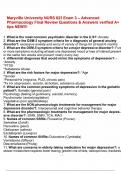
Maryville University NURS 623 Exam 3 – Advanced Pharmacology Final Review Questions & Answers verified A+ tips NEW!!!
Maryville University NURS 623 Exam 3 – Advanced Pharmacology Final Review Questions & Answers verified A+ tips NEW!!!Maryville University NURS 623 Exam 3 – Advanced Pharmacology Final Review Questions & Answers verified A+ tips NEW!!! Maryville University NURS 623 Exam 3 – Advanced Pharmacology Final Review Questions & Answers verified A+ tips NEW!!! 1. What is the most common psychiatric disorder in the U.S?: Anxiety 2. What are the DSM-5 symptom criteria for a diagnosis of general anxiety disorder?: excessive anxiety and worry of variety of things for at least 6 months 3. What are the DSM-5 symptom criteria for a major depressive disorder?: Five or more symptoms including at least one depressed mood or loss of interest present in the same two weeks and present nearly every day 4. differential diagnoses that would mimic the symptoms of depression?: - *Anxiety *PTSD *Substance Abuse 5. What are the risk factors for major depression?: *Age *Gender *Personal Hx (migrains, PUD, chronic pain) *Fx Hx (depression, suicide, alcholism, substance abuse) 6. What are the common presenting symptoms of depression in the geriatric patient?: Somatic (general pain) Psychology (feeling of guilt/worry, suicidal, memory) Psychomotor (anxiety/agitation) Vegetative (poor appitite/sleep) 7. What are the NON-pharmacologic treatments for management for major depressive disorder?: Interpersonal and cognitive behavior therapy 8. What are the pharmacologic treatments for management for major depres- sive disorder?: SSRI, SNRI, TCA, MAO 9. Names of common SSRIs: Fluoxetine (Prozac) Sertraline (Zoloft) Paroxetine (paxil) Citalopram (celexa) Escitalopram (Lexapro) 10. Names of common SNRIs: Duloxetine (Cymbalta) Venlafaxine (Effexor) Desvenlafaxine (Pristiq) 11. What are concerns in elderly taking medication for major depression?: a slower metabolism requires lower dosing; greater risk of falls, osteoporosis, fractures 12. What are the pharmacologic versus nonpharmacologic treatment for man- agement for general anxiety disorder?: non-pharmacological interventions of cognitive behavioral therapy has proven equal results to SSRI pharmacologic ther- apy 13. DIGFAST for bipolar because your digging yourself into hole: Distractibility Indiscretion/Insomnia Grandiosity Flight of ideas Activities ‘ Sleep Deficit Talkativeness 14. What is the symptom criteria for BD I ?: identification of at least one-lifetime mania episode must have occurred 15. What is the symptom criteria for BD II ?: identification of at least one hypo- mania episode and one major depressive episode must have occurred 16. What is the symptom criteria for diagnosing unipolar (depression): persis- tently depressed mood or loss of interest in activities, causing significant impairment in daily life (no mania/hypomania) 17. How do you assess suicide risk (consider mnemonic SAD PERSONS): S-ex A-ge D-epression P-revious attempt E-thanol abuse R-ational thinking loss S-ocial support loss O-rganized plan N-o spouse S-ickness 18. How would you identify intimate partner violence?: *reluctant to speak in front of partner *gives evasive answers *Overly protective or controlling partner 19. What are the stages of grieving? (DABDA): Denial Anger
Document information
- Uploaded on
- June 20, 2025
- Number of pages
- 17
- Written in
- 2024/2025
- Type
- Exam (elaborations)
- Contains
- Questions & answers


