

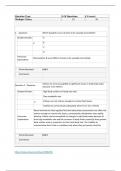
Question Type: # Of Questions: # Correct:
Multiple Choice 50 50
1. Question : Which hepatitis virus is known to be sexually transmitted?
Student Answer: A
B
C
D
Instructor
Only hepatitis B virus (HBV) is known to be sexually transmitted.
Explanation:
Points Received: 2 of 2
Comments:
Infants are most susceptible to significant losses in total body water
Question 2. Question :
because of an infant’s:
Student Answer: High body surface–to–body size ratio
Slow metabolic rate
Kidneys are not mature enough to counter fluid losses
Inability to communicate adequately when he or she is thirsty
Renal mechanisms that regulate fluid and electrolyte conservation are often not
mature enough to counter the losses; consequently, dehydration may rapidly
Instructor develop. Infants can be susceptible to changes in total body water because of
Explanation: their high metabolic rate and the turnover of body fluids caused by their greater
body surface area in proportion to their total body size. The inability to
communicate their thirst is a problem only when they are poorly cared for.
Points Received: 0 of 2
Comments:
https://www.stuvia.com/user/Mboffin
, What part of the kidney controls renal blood flow, glomerular
Question 3. Question :
filtration, and renin secretion?
Student Answer: Macula densa
Visceral epithelium
Juxtaglomerular apparatus (JGA)
Filtration slits
Control of renal blood flow, glomerular filtration, and renin secretion occur at the
Instructor JGA. Together, the juxtaglomerular cells and macula densa cells form the JGA.
Explanation: The control of renal blood flow, glomerular filtration, and renin secretion is not
directed by any of the other options.
Points Received: 2 of 2
Comments:
Question 4. Question : Which statement concerning exotoxins is true?
Student Answer: Exotoxins are contained in cell walls of gram-negative bacteria.
Exotoxins are released during the lysis of bacteria.
Exotoxins are able to initiate the complement and coagulation
cascades.
Exotoxins are released during bacterial growth.
Instructor Exotoxins are proteins released during bacterial growth. The other options
Explanation: are not true of exotoxins.
Points Received: 0 of 2
Comments:
An infant has a loud, harsh, holosystolic murmur and systolic thrill that
can be detected at the left lower sternal border that radiates to the
Question 5. Question :
neck. These clinical findings are consistent with which congenital heart
defect?
https://www.stuvia.com/user/Mboffin
, Student
Atrial septal defect (ASD)
Answer:
Ventricular septal defect (VSD)
Patent ductus arteriosus (PDA)
Atrioventricular canal (AVC) defect
On physical examination, a loud, harsh, holosystolic murmur and systolic thrill can
be detected at the left lower sternal border. The intensity of the murmur reflects
Instructor the pressure gradient across the VSD. An apical diastolic rumble may be present
Explanation: with a moderate-to-large defect, reflecting increased flow across the mitral valve.
The presentations of the other congenital heart defects are not consistent with
the described symptoms.
Points Received: 2 of 2
Comments:
Which hormone is required for water to be reabsorbed in the distal
Question 6. Question :
tubule and collecting duct?
Student Answer: Antidiuretic hormone
Aldosterone
Cortisol
Adrenocorticotropin hormone
Antidiuretic hormone is required for water to be reabsorbed in the distal tubule
Instructor and collecting duct. The later, straight segment of the distal tubule and the
Explanation: collecting duct are permeable to water as controlled by antidiuretic hormone.
The other options are not involved in this process.
Points Received: 2 of 2
Comments:
Question 7. Question : Which of the following is classified as a megaloblastic anemia?
Student Answer: Iron deficiency
https://www.stuvia.com/user/Mboffin
Multiple Choice 50 50
1. Question : Which hepatitis virus is known to be sexually transmitted?
Student Answer: A
B
C
D
Instructor
Only hepatitis B virus (HBV) is known to be sexually transmitted.
Explanation:
Points Received: 2 of 2
Comments:
Infants are most susceptible to significant losses in total body water
Question 2. Question :
because of an infant’s:
Student Answer: High body surface–to–body size ratio
Slow metabolic rate
Kidneys are not mature enough to counter fluid losses
Inability to communicate adequately when he or she is thirsty
Renal mechanisms that regulate fluid and electrolyte conservation are often not
mature enough to counter the losses; consequently, dehydration may rapidly
Instructor develop. Infants can be susceptible to changes in total body water because of
Explanation: their high metabolic rate and the turnover of body fluids caused by their greater
body surface area in proportion to their total body size. The inability to
communicate their thirst is a problem only when they are poorly cared for.
Points Received: 0 of 2
Comments:
https://www.stuvia.com/user/Mboffin
, What part of the kidney controls renal blood flow, glomerular
Question 3. Question :
filtration, and renin secretion?
Student Answer: Macula densa
Visceral epithelium
Juxtaglomerular apparatus (JGA)
Filtration slits
Control of renal blood flow, glomerular filtration, and renin secretion occur at the
Instructor JGA. Together, the juxtaglomerular cells and macula densa cells form the JGA.
Explanation: The control of renal blood flow, glomerular filtration, and renin secretion is not
directed by any of the other options.
Points Received: 2 of 2
Comments:
Question 4. Question : Which statement concerning exotoxins is true?
Student Answer: Exotoxins are contained in cell walls of gram-negative bacteria.
Exotoxins are released during the lysis of bacteria.
Exotoxins are able to initiate the complement and coagulation
cascades.
Exotoxins are released during bacterial growth.
Instructor Exotoxins are proteins released during bacterial growth. The other options
Explanation: are not true of exotoxins.
Points Received: 0 of 2
Comments:
An infant has a loud, harsh, holosystolic murmur and systolic thrill that
can be detected at the left lower sternal border that radiates to the
Question 5. Question :
neck. These clinical findings are consistent with which congenital heart
defect?
https://www.stuvia.com/user/Mboffin
, Student
Atrial septal defect (ASD)
Answer:
Ventricular septal defect (VSD)
Patent ductus arteriosus (PDA)
Atrioventricular canal (AVC) defect
On physical examination, a loud, harsh, holosystolic murmur and systolic thrill can
be detected at the left lower sternal border. The intensity of the murmur reflects
Instructor the pressure gradient across the VSD. An apical diastolic rumble may be present
Explanation: with a moderate-to-large defect, reflecting increased flow across the mitral valve.
The presentations of the other congenital heart defects are not consistent with
the described symptoms.
Points Received: 2 of 2
Comments:
Which hormone is required for water to be reabsorbed in the distal
Question 6. Question :
tubule and collecting duct?
Student Answer: Antidiuretic hormone
Aldosterone
Cortisol
Adrenocorticotropin hormone
Antidiuretic hormone is required for water to be reabsorbed in the distal tubule
Instructor and collecting duct. The later, straight segment of the distal tubule and the
Explanation: collecting duct are permeable to water as controlled by antidiuretic hormone.
The other options are not involved in this process.
Points Received: 2 of 2
Comments:
Question 7. Question : Which of the following is classified as a megaloblastic anemia?
Student Answer: Iron deficiency
https://www.stuvia.com/user/Mboffin


