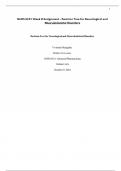
NURS 6521 Week 8 Assignment - Decision Tree for Neurological and Musculoskeletal Disorders
Decision Tree for Neurological and Musculoskeletal Disorders There are various neurological disorders that lead to a decline in thinking. One of this disorder is Alzheimer's. The purpose of this paper is to respond to questions from an Alzheimer's case study. Summary of Case Study with three Decisions Mr. Akkad, a 76-year-old Iranian man, oriented to self, came to the office with his son. The patient was exhibiting “strange behavior” as observed by changes in personality and behavior, per his son. The patient showed less interested in religious activities and was “critical” of everyone. Per the patient’s son, patient was forgetfulness, had language difficulties, and other cognitive impairments. The patient’s mini mental state score was eighteen out of thirty, suggesting moderate dementia, with some problems in attention, calculation, memory, orientation, and registration. Patient denied having visual or auditory hallucinations. He had impaired insight, judgement, and impulse control. First, I will add Rivastigmine (Exelon) 1.5 mg oral BID the patient is taking to Rivastigmine 3mg oral BID in two weeks. Next, I increased Rivastigmine to 4.5mg orally BID and lastly, I will increase Rivastigmine to 6mg orally BID. Decisions and Evidence Exelon was chosen as it helps in treating patients with Alzheimer and dementia as this medication aids in improving cognitive function. Exelon is an acetylcholinesterase inhibitor that augments brain chemical activities enhancing transmission of central cholinergic neurons. Rivastigmine is a cholinesterase inhibitor that increases the levels of acetylcholine in the brain thus improving memory function in patients with Alzheimer’s (Heckman et al., 2018). Exelon is the drug of choice here because it prevents the breakdown of acetylcholine by acetylcholinesterase making acetylcholine readily available at the cholinergic synapse (Rosenthal 3 & Burchum, 2017). By so doing Exelon improves mental function. It does not treat Alzheimer but slows it progression. Donepezil was not taken as an option because it causes reversible inhibition of acetylcholinesterase and has no evidence of remarkable improvement or delay of disease progression (Kumar et al., 2021). At this stage I was hoping that the patient will tolerate the low dose of the medication with improve cognitive function. Unfortunately, after four weeks the patient did not feel better. Therefore, the actual and expected outcomes were different. Because the patient returned after four weeks not feeling better, the decision to increase Exelon to 4.5 mg orally BID was made. Increasing this dose slowly to 4.5 mg not 6 mg gradually helps in increasing mental function without risk of dependence, intolerance, and adverse effects. Research has shown that higher doses Exelon while titrating slowly are more beneficial (Gloria et al., 2021). The efficacy of Exelon is dose dependent. After the second decision, the patient returned four weeks later, tolerating the medication, and yet not feeling better. I did not take the decision to stop Exelon and start on Namenda, since it takes several weeks for patients on Exelon to show signs of improvement. Decision two was taken with hopes to improve, maintain cognitive function while tolerating a higher dose of the medication. The actual and expected outcome were a little similar as the patient tolerated the new increase dose of the medication, with no adverse effects and his symptoms were stabilized. The last decision was to increase the dose to 6mg orally BID. This is because the higher the dose of Exelon, the more acetylcholine will be present in the brain, boosting the patient’s behavior and cognitive function (Kumar et al., 2021). With this increase the patient will be able to focus on his activities such as religious practice. The patient was not maintained on 4.5 mg dose but increased to 6 mg dose because Exelon has a high efficacy at a higher dose. The hopes of this decision point were to see a greater improvement in patient cognitive function and 4 religious activities and tolerance to treatment at the new high dose. The actual and expected outcomes were the same as the patient felt better and showed interest in his religious activities. For example, after adding the dose to 6 mg, the patient reported no side effects and was able to participate in his religious activities. At this point I will educate the patient’s son about presumptive Alzheimer irreversible disease for his dad. Conclusion Exelon has proven to improve the cognitive function of patients with Alzheimer and slow the progression of the disease. The patients on this medication should be started on a low dose and then titrated slowly to higher doses so as to prevent adverse effects and improve on the medication efficacy. Patients should be educated that the treatment options with cholinesterase inhibitors may take long to be effective. 5 References Gloria D. Pickar, EdD, RN, Amy Pickar Abernethy, MD, Beth Swart, Myrna Davis, Janet O’Connell & . (2021). Dosage calculations (5th ed.). Cengage Learning Canada Inc. Heckman, P., Blokland, A., & Sambeth, A. (2018). No interaction between rivastigmine and citalopram on memory and novelty processing in healthy human volunteers. Journal of Psychopharmacology, 33(2), 210–218. Kumar, A., Gupta, A., , & Sharma, S. (2021). Donepezil. n: StatPearls [Internet]. Treasure Island (FL): StatPearls Publishing; 2022 Jan–. PMID: . Rosenthal, L., & Burchum, J. (2017). Lehne’s pharmacotherapeutics for advanced practice nurses and physician assistants - e-book (2nd ed.). Saunders.
Written for
- Institution
-
Walden University
- Course
-
NURS 6521
Document information
- Uploaded on
- June 16, 2025
- Number of pages
- 5
- Written in
- 2024/2025
- Type
- Exam (elaborations)
- Contains
- Questions & answers
Subjects
- nurs 6521
- advanced pharmacology
- pharmacology
-
nurs 6521 week 8 assignment
-
nurs 6521 advanced pharmacology

Also available in package deal