

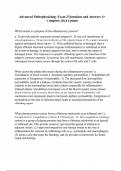
Advanced Pathophysiology Exam 2 Questions and Answers A+ Complete 2025 Update
Which action is a purpose of the inflammatory process? a. To provide specific responses toward antigens b. To lyse cell membranes of microorganisms c. To prevent infection of the injured tissue d. To create immunity against subsequent tissue injury - C. If the epithelial barrier is damaged, then a highly efficient local and systemic response (inflammation) is mobilized to limit the extent of damage, to protect against infection, and to initiate the repair of damaged tissue. The response to a specific offending agent is the function of the adaptive immune response. Lysosomes lyse cell membranes. Immunity against a subsequent tissue injury occurs through the action of B cells and T cells. What causes the edema that occurs during the inflammatory process? a. Vasodilation of blood vessels b. Increased capillary permeability c. Endothelial cell expansion d. Emigration of neutrophils - B. The increased flow and capillary permeability result in a leakage of plasma from the vessels, causing swelling (edema) in the surrounding tissue and is solely responsible for inflammation-induced edema. Vasodilation (increased size of the blood vessels) causes slower blood velocity and increases blood flow to the injured site. Endothelial cell contraction (not expansion) leads to increased capillary permeability. Emigration of neutrophils to the area of infection/injury leads to increased destruction of the offending agent. What plasma protein system forms a fibrinous meshwork at an inflamed
Document information
- Uploaded on
- June 15, 2025
- Number of pages
- 28
- Written in
- 2024/2025
- Type
- Exam (elaborations)
- Contains
- Questions & answers


