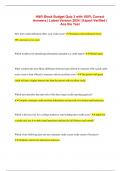
OB NCLEX Exam 3 (2025) |
Comprehensive Practice
Questions with Verified
Answers & Rationales
,should the nurse be aware of?
a. Preeclampsia is a condition of the first trimester;
eclampsia is a condition of the second and third
trimesters.
b. Preeclampsia results in decreased function in
such organs as the placenta, kidneys, liver, and
brain.
c. The causes of preeclampsia and eclampsia are
well documented.
d. Severe preeclampsia is defined as preeclampsia
plus proteinuria.
Give this one a go later!
b. "Even though this is your second cesarean birth, you may
wish to review the preoperative and postoperative
procedures."
Even though the client has previously had this surgical
procedure, the prudent nurse should provide client
teaching at this time. Maternal and fetal risks are associated
with every cesarean section. Physiologic and psychologic
recovery from a cesarean section is multifactorial and
,individual to each client each time. Preoperative teaching
should always be performed regardless of whether the
client has already had this procedure.
b. Preeclampsia results in decreased function in such
organs as the placenta, kidneys, liver, and brain.
b. Intense abdominal pain
Pain is absent with placenta previa and may be agonizing
with abruptio placentae. Bleeding, uterine activity, and
cramping may be present in varying degrees for both
placental conditions.
b. Women experiencing precipitous labor are about the
only women experiencing dysfunctional labor who are not
exhausted.
Precipitous labor lasts less than 3 hours. Short women more
than 30 pounds overweight are more at risk for
dysfunctional labor. Hypotonic uterine dysfunction, in which
the contractions become weaker, is more common.
Abnormal labor patterns are more common in women
younger than 20 years.
, 2 of 50
Term
a. Place the woman in the knee-chest position.
The woman is assisted into a position (e.g.,
modified Sims position, Trendelenburg position, or
knee-chest position) in which gravity keeps the
pressure of the presenting part off the cord.
Relieving pressure on the cord is the nursing
priority. The nurse may also use her gloved hand
or two fingers to lift the presenting part off the
cord. If the cord is protruding from the vagina it
may be covered with a sterile towel soaked in
saline. The nurse should administer O2 by facial
mask at 8 to 10 L/min until delivery is complete. If
the cervix is fully dilated, the nurse should prepare
for immediate vaginal delivery. Cesarean birth is
indicated only if cervical dilation is not complete.
Give this one a go later!
Comprehensive Practice
Questions with Verified
Answers & Rationales
,should the nurse be aware of?
a. Preeclampsia is a condition of the first trimester;
eclampsia is a condition of the second and third
trimesters.
b. Preeclampsia results in decreased function in
such organs as the placenta, kidneys, liver, and
brain.
c. The causes of preeclampsia and eclampsia are
well documented.
d. Severe preeclampsia is defined as preeclampsia
plus proteinuria.
Give this one a go later!
b. "Even though this is your second cesarean birth, you may
wish to review the preoperative and postoperative
procedures."
Even though the client has previously had this surgical
procedure, the prudent nurse should provide client
teaching at this time. Maternal and fetal risks are associated
with every cesarean section. Physiologic and psychologic
recovery from a cesarean section is multifactorial and
,individual to each client each time. Preoperative teaching
should always be performed regardless of whether the
client has already had this procedure.
b. Preeclampsia results in decreased function in such
organs as the placenta, kidneys, liver, and brain.
b. Intense abdominal pain
Pain is absent with placenta previa and may be agonizing
with abruptio placentae. Bleeding, uterine activity, and
cramping may be present in varying degrees for both
placental conditions.
b. Women experiencing precipitous labor are about the
only women experiencing dysfunctional labor who are not
exhausted.
Precipitous labor lasts less than 3 hours. Short women more
than 30 pounds overweight are more at risk for
dysfunctional labor. Hypotonic uterine dysfunction, in which
the contractions become weaker, is more common.
Abnormal labor patterns are more common in women
younger than 20 years.
, 2 of 50
Term
a. Place the woman in the knee-chest position.
The woman is assisted into a position (e.g.,
modified Sims position, Trendelenburg position, or
knee-chest position) in which gravity keeps the
pressure of the presenting part off the cord.
Relieving pressure on the cord is the nursing
priority. The nurse may also use her gloved hand
or two fingers to lift the presenting part off the
cord. If the cord is protruding from the vagina it
may be covered with a sterile towel soaked in
saline. The nurse should administer O2 by facial
mask at 8 to 10 L/min until delivery is complete. If
the cervix is fully dilated, the nurse should prepare
for immediate vaginal delivery. Cesarean birth is
indicated only if cervical dilation is not complete.
Give this one a go later!