

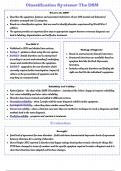
Classification Systems: The DSM
What is the DSM?
Describes the symptoms, features and associated risk factors of over 300 mental and behavioral
disorders arranged into 22 categories.
Based on a classification system that was used to identify disorders experienced by World War 2
soldiers.
The system provides an important first step on appropriate support however erroneous diagnosis can
lead to labeling, stigmatisation and ineffective treatment.
The DSM-V:
Published in 2013 and divided into sections.
Making a Diagnosis:
Section 1 - guidance about using the new system.
Based on unstructured (clinical) interviews.
Section 2- details disorders and is catergorised
Structured interviews are available based on
according to current understanding f underlying
symptom lists like the Beck Depression
causes and similarities between the symptoms.
Inventory.
Section 3 - suggestions for new disorders which
Includes ruling out disorders and finding the
currently require further investigation. Impact of
right one that fits the individual’s symptoms.
culture on the presentation of symptoms and the
way they are communicated.
Reliability and Validity:
Robert Spitzer - the chair of the DSM-III taskforce - introduced the Cohen’s kappa to improve reliability.
Test-retest reliability and inter-rater reliability.
Disorders have been removed and added to different versions.
Descriptive reliability - when 2 people with the same diagnosis exhibit similar symptoms.
Aetiological reliability - when they share similar casual factors.
Concurrent validity - when a clinician uses more than one method or technique to reach a diagnosis and both
methods lead to the same diagnosis.
Predictive validity - prognosis and reaction to treatment.
Evaluation
Strength:
Good level of agreement for some disorders - field trials have demonstrated impressive levels of agreement
between clinicians for a variety of disorders.
Darrel Regler 2013 reported 3 disorders had kappa ratings showing that certain criteria for things like
PTSD have changed in terms of numbers and the specific symptom required to make a diagnosis and it is
clear that clinicians have adapted well to these changes.
What is the DSM?
Describes the symptoms, features and associated risk factors of over 300 mental and behavioral
disorders arranged into 22 categories.
Based on a classification system that was used to identify disorders experienced by World War 2
soldiers.
The system provides an important first step on appropriate support however erroneous diagnosis can
lead to labeling, stigmatisation and ineffective treatment.
The DSM-V:
Published in 2013 and divided into sections.
Making a Diagnosis:
Section 1 - guidance about using the new system.
Based on unstructured (clinical) interviews.
Section 2- details disorders and is catergorised
Structured interviews are available based on
according to current understanding f underlying
symptom lists like the Beck Depression
causes and similarities between the symptoms.
Inventory.
Section 3 - suggestions for new disorders which
Includes ruling out disorders and finding the
currently require further investigation. Impact of
right one that fits the individual’s symptoms.
culture on the presentation of symptoms and the
way they are communicated.
Reliability and Validity:
Robert Spitzer - the chair of the DSM-III taskforce - introduced the Cohen’s kappa to improve reliability.
Test-retest reliability and inter-rater reliability.
Disorders have been removed and added to different versions.
Descriptive reliability - when 2 people with the same diagnosis exhibit similar symptoms.
Aetiological reliability - when they share similar casual factors.
Concurrent validity - when a clinician uses more than one method or technique to reach a diagnosis and both
methods lead to the same diagnosis.
Predictive validity - prognosis and reaction to treatment.
Evaluation
Strength:
Good level of agreement for some disorders - field trials have demonstrated impressive levels of agreement
between clinicians for a variety of disorders.
Darrel Regler 2013 reported 3 disorders had kappa ratings showing that certain criteria for things like
PTSD have changed in terms of numbers and the specific symptom required to make a diagnosis and it is
clear that clinicians have adapted well to these changes.


