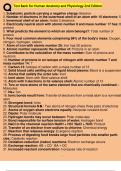
Test Bank for Human Anatomy and Physiology 2nd Edition
1. Subatomic particle carrying a negative charge: Electron
2. Number of electrons in the outermost shell of an atom with 15 electrons: 5
3. Innermost shell of an atom: Holds 2 electrons
4. Electrically neutral atom with atomic number 8 and mass number 17 has: 8
protons
5. What predicts the element to which an atom belongs?: Total number of
protons
6. Four most common elements comprising 96% of the body's mass: Oxygen,
nitrogen, hydrogen, carbon
7. Atom of iron with atomic number 26: Iron has 26 protons
8. Atomic number represents the number of: Protons in an atom
9. Contributes to the calculation of the mass number: Sum of protons and
neutrons
10. Number of protons in an isotope of nitrogen with atomic number 7 and
mass number 14: 7
11. Carbon-13: Isotope of carbon with a mass number of 13
12. Solid blood cells settling out of liquid blood plasma: Blood is a suspension
13. Atoms that satisfy the octet rule: Inert
14. Inert atom: Atom with filled valence shell
15. Atom with 3 electrons in its valence shell: Atomic number of 13
16. Two or more atoms of the same element that are chemically combined: -
Molecules
17. Na+: Ion
18. Ionic bonds result from: Transfer of electrons from a metal atom to a nonmetal
atom
19. Strongest bond: Ionic
20. Structural formula N aN : Two atoms of nitrogen share three pairs of electrons
21. Atoms of oxygen share electrons equally: Nonpolar covalent bond
22. Dipole: Polar molecule
23. Hydrogen bonds may occur between: Polar molecules
24. Bond responsible for surface tension of water: Hydrogen bond
25. NaCl in the chemical reaction NaOH + HCl ’NaCl + H2O: Product
26. Transfer of an electron from sodium to chlorine: Chemical energy
27. Reaction that releases energy: Exergonic reaction
28. Process of digesting food breaks large food particles into smaller parti-
cles: Catabolic reaction
29. Oxidation-reduction (redox) reactions: Electron exchange occurs
30. Exchange reaction: AB + CD ’ BA + DC
31. Increased reactant concentration: Increases rate of reaction
1/2
1. Subatomic particle carrying a negative charge: Electron
2. Number of electrons in the outermost shell of an atom with 15 electrons: 5
3. Innermost shell of an atom: Holds 2 electrons
4. Electrically neutral atom with atomic number 8 and mass number 17 has: 8
protons
5. What predicts the element to which an atom belongs?: Total number of
protons
6. Four most common elements comprising 96% of the body's mass: Oxygen,
nitrogen, hydrogen, carbon
7. Atom of iron with atomic number 26: Iron has 26 protons
8. Atomic number represents the number of: Protons in an atom
9. Contributes to the calculation of the mass number: Sum of protons and
neutrons
10. Number of protons in an isotope of nitrogen with atomic number 7 and
mass number 14: 7
11. Carbon-13: Isotope of carbon with a mass number of 13
12. Solid blood cells settling out of liquid blood plasma: Blood is a suspension
13. Atoms that satisfy the octet rule: Inert
14. Inert atom: Atom with filled valence shell
15. Atom with 3 electrons in its valence shell: Atomic number of 13
16. Two or more atoms of the same element that are chemically combined: -
Molecules
17. Na+: Ion
18. Ionic bonds result from: Transfer of electrons from a metal atom to a nonmetal
atom
19. Strongest bond: Ionic
20. Structural formula N aN : Two atoms of nitrogen share three pairs of electrons
21. Atoms of oxygen share electrons equally: Nonpolar covalent bond
22. Dipole: Polar molecule
23. Hydrogen bonds may occur between: Polar molecules
24. Bond responsible for surface tension of water: Hydrogen bond
25. NaCl in the chemical reaction NaOH + HCl ’NaCl + H2O: Product
26. Transfer of an electron from sodium to chlorine: Chemical energy
27. Reaction that releases energy: Exergonic reaction
28. Process of digesting food breaks large food particles into smaller parti-
cles: Catabolic reaction
29. Oxidation-reduction (redox) reactions: Electron exchange occurs
30. Exchange reaction: AB + CD ’ BA + DC
31. Increased reactant concentration: Increases rate of reaction
1/2