OIKUJHTFGDRE
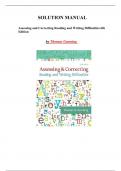
SOLUTION MANUAL
Assessing and Correcting Reading and Writing Difficulties 6th
Edition
by Thomas Gunning
AP
LU
S0
01
LKMJNHGFDS
, OIKUJHTFGDRE
Chapter 1: Introduction to Literacy Difficulties
Chapter Overview
Chapter 1 provides a theoretical overview of the text. Several definitions of reading disability are
explored as is the nature of corrective instruction. Principles of corrective instruction are
described, including the current emphasis on response to intervention. These form the foundation
for the assessment and instructional procedures presented in the text.
Learner Objectives
Students will learn and be able to:
• Explain the nature and incidence of reading difficulties.
• Discuss the nature of intervention and corrective instruction.
• Explain and begin to implement the major principles of corrective
instruction.
• Explain the impact of federal legislation, response to intervention (RTI),
AP
Common Core, and other state standards on preventive and corrective
instruction.
Before Reading
Discuss with students their experiences with learning difficulties, whether these are past
difficulties with reading, writing or academic subjects or current difficulties learning a skill, or a
particular area of knowledge. Discuss how the difficulties were corrected. Also discuss
experiences they have had with students who were struggling to learn to read and write.
Encourage students to read Using What You Know and to complete the Anticipation Guide before
LU
reading the first chapter, which provides an overview of reading difficulties. Students might also
survey the chapter before beginning to read.
During Reading
Encourage students to use SQ3R or another study strategy as they read. Also encourage them to
pay particular attention to boldfaced items, margin notes, and graphics. Often these highlight the
chapter’s most important concepts. At the end of the chapter’s four main sections, which are
S0
aligned with the chapter’s learning objectives, a Check Your Understanding appears. Encourage
students to use Check Your Understanding to assess their comprehension of the section. Explain
that this type of activity builds understanding and retention better than reading the chapter a
second time. Also encourage students to view the video clips, which have been carefully chosen
to reinforce and expand key concepts in the chapter. Video clips in this chapter feature
shortcomings of the discrepancy concept, the importance of early intervention, an example of
systematic instruction, an overview of IDEA, and a comparison of an IEP with a 504 plan.
01
After Reading
A graphic organizer for each chapter provides students with the opportunity to summarize or
manipulate some of the key points in the chapter. In addition to promoting understanding and
retention, completing the organizers will help them become familiar with techniques that they
might use with their pupils. Students might also maintain a learning log of their text reading and
reflect on key points. Controversial or confusing points, such as the concept of dyslexia, might be
discussed at the beginning of the next class. If not used for assessment, the test questions might
be used for review.
Teaching Activities
1. Demonstrate for the class a top-down, interactive, and bottom-up phonics lesson and discuss
strengths and weaknesses of each.
2. Discuss state guidelines for selecting students for inclusion in Title I and special education
programs and the use of Response to Intervention. You might have students take another
look at the video clip noted on p. 2 that discusses the shortcomings of the discrepancy
definition.
3. Discuss criteria used by local school districts for selecting students for special help with
reading and writing. Discuss ways in which Response to Intervention is being implemented.
LKMJNHGFDS
, OIKUJHTFGDRE
Also discuss the impact that Common Core or other state standards might have on students.
4. Discuss the controversy of using reading-level versus grade-level materials. Students might
read the following articles to obtain additional information:
Allington, R. L., McCuiston, K., & Billen, M. (2015). What research says about text
complexity and learning to read. The Reading Teacher, 68, 491-502.
Shanahan, T. (2014). Should we teach students at their reading levels? Reading Today,
32 (2), 14-15.
Note: Throughout the text databases of periodicals and other sources available free of charge to
library card holders are noted. PDFs of both of the above sources were obtained from
EBSCOhost offered by the Connecticut State Library. Many state, local, and college libraries
offer EBSCOhost and similar resources.
Performance Assessment
1. Ask students to describe in writing their approach to corrective instruction, noting in particular
whether they are primarily top-down, bottom-up, or interactive and what this means in terms
AP
of assessment and instruction.
2. Have students list and critique the criteria for selecting students for intervention or
remediation for the school in which they teach or a local school, if they are not now teaching.
Also have students look at state standards for determining eligibility for special education for
students with a learning disability.
Traditional Assessment
See items in Test Bank.
LU
S0
01
LKMJNHGFDS
, OIKUJHTFGDRE
Chapter 2: Factors Involved in Reading and Writing Difficulties
Chapter Overview
Chapter 2 provides an overview of major factors involved in reading and writing difficulties. These
include cognitive, visual processing, language, social and emotional, physical, educational, social
and cultural, and economic factors. Although these factors are covered separately, often there is
an interaction among them. There is also an interaction of factors within the student and the
environment. A primary factor is the nature and quality of instruction. When carefully taught, most
students classified as disabled readers overcome their difficulties.
Learner Objectives
Students will learn and be able to:
• Explain interacting factors in reading disability.
• Describe the major cognitive factors involved in reading disability.
AP
• Outline the major language factors involved in reading disability.
• Discuss the major emotional factors involved in reading disability.
• Describe the major physical factors involved in reading disability and use
checklists and observation to detect possible visual and hearing difficulties.
• Discuss the major social, cultural, family, economic, and educational factors
involved in reading
Before Reading
Discuss with students possible factors that might lead to a reading or writing disability or make it
LU
worse. Explain that this chapter surveys a broad range of factors involved in reading difficulties.
Encourage students to read Using What You Know and to complete the Anticipation Guide before
reading this chapter. Students might also survey the chapter before beginning to read.
During Reading
Encourage students to use SQ3R or another study strategy as they read. Also encourage them to
pay particular attention to boldfaced items, margin notes, and graphics. Often these highlight the
S0
chapter’s most important concepts. At the end of each of the chapter’s six main sections, which
are aligned with the chapter’s learning objectives, a Check Your Understanding appears.
Encourage students to use Check Your Understanding to assess their comprehension of the
section. Explain that this type of activity builds understanding and retention better than reading
the chapter a second time. Also encourage students to view the video clips, which have been
carefully chosen to reinforce and expand key concepts in the chapter. Video clips in this chapter
feature an explanation of working memory, a teacher’s explanation of ways of working with ADHD
students, a demonstration of the testing of automatized naming, students’ discussion of word
01
finding strategies, explanation of self-efficacy, fourth-graders discussion of self-regulation,
explanation of how a student with a hearing loss is successful in school, and discussion of a
landmark study on drastic differences in children’s language acquisition.
After Reading
Encourage students to complete the graphic organizer for this chapter. Students might also
maintain a learning log of their text reading and reflect on key points. Controversial or confusing
points, such as the role of economic or social factors in reading disability, might be discussed at
the beginning of the next class. If not used for assessment, the questions in the Test Bank might
be used for review.
Teaching Activities .
1. If available, have students test each other on a telebinocular vision test and an audiometer.
2. If students are teaching, have them try out the vision and hearing checklists.
3. Have students reflect on their personal executive functioning and how it has developed over
the years.
4. Have students examine and discuss the Benchmark School Interactive Learning Profile
(Gaskins & Galloway, 2010) and, if feasible, fill it out for a struggling reader.
LKMJNHGFDS
SOLUTION MANUAL
Assessing and Correcting Reading and Writing Difficulties 6th
Edition
by Thomas Gunning
AP
LU
S0
01
LKMJNHGFDS
, OIKUJHTFGDRE
Chapter 1: Introduction to Literacy Difficulties
Chapter Overview
Chapter 1 provides a theoretical overview of the text. Several definitions of reading disability are
explored as is the nature of corrective instruction. Principles of corrective instruction are
described, including the current emphasis on response to intervention. These form the foundation
for the assessment and instructional procedures presented in the text.
Learner Objectives
Students will learn and be able to:
• Explain the nature and incidence of reading difficulties.
• Discuss the nature of intervention and corrective instruction.
• Explain and begin to implement the major principles of corrective
instruction.
• Explain the impact of federal legislation, response to intervention (RTI),
AP
Common Core, and other state standards on preventive and corrective
instruction.
Before Reading
Discuss with students their experiences with learning difficulties, whether these are past
difficulties with reading, writing or academic subjects or current difficulties learning a skill, or a
particular area of knowledge. Discuss how the difficulties were corrected. Also discuss
experiences they have had with students who were struggling to learn to read and write.
Encourage students to read Using What You Know and to complete the Anticipation Guide before
LU
reading the first chapter, which provides an overview of reading difficulties. Students might also
survey the chapter before beginning to read.
During Reading
Encourage students to use SQ3R or another study strategy as they read. Also encourage them to
pay particular attention to boldfaced items, margin notes, and graphics. Often these highlight the
chapter’s most important concepts. At the end of the chapter’s four main sections, which are
S0
aligned with the chapter’s learning objectives, a Check Your Understanding appears. Encourage
students to use Check Your Understanding to assess their comprehension of the section. Explain
that this type of activity builds understanding and retention better than reading the chapter a
second time. Also encourage students to view the video clips, which have been carefully chosen
to reinforce and expand key concepts in the chapter. Video clips in this chapter feature
shortcomings of the discrepancy concept, the importance of early intervention, an example of
systematic instruction, an overview of IDEA, and a comparison of an IEP with a 504 plan.
01
After Reading
A graphic organizer for each chapter provides students with the opportunity to summarize or
manipulate some of the key points in the chapter. In addition to promoting understanding and
retention, completing the organizers will help them become familiar with techniques that they
might use with their pupils. Students might also maintain a learning log of their text reading and
reflect on key points. Controversial or confusing points, such as the concept of dyslexia, might be
discussed at the beginning of the next class. If not used for assessment, the test questions might
be used for review.
Teaching Activities
1. Demonstrate for the class a top-down, interactive, and bottom-up phonics lesson and discuss
strengths and weaknesses of each.
2. Discuss state guidelines for selecting students for inclusion in Title I and special education
programs and the use of Response to Intervention. You might have students take another
look at the video clip noted on p. 2 that discusses the shortcomings of the discrepancy
definition.
3. Discuss criteria used by local school districts for selecting students for special help with
reading and writing. Discuss ways in which Response to Intervention is being implemented.
LKMJNHGFDS
, OIKUJHTFGDRE
Also discuss the impact that Common Core or other state standards might have on students.
4. Discuss the controversy of using reading-level versus grade-level materials. Students might
read the following articles to obtain additional information:
Allington, R. L., McCuiston, K., & Billen, M. (2015). What research says about text
complexity and learning to read. The Reading Teacher, 68, 491-502.
Shanahan, T. (2014). Should we teach students at their reading levels? Reading Today,
32 (2), 14-15.
Note: Throughout the text databases of periodicals and other sources available free of charge to
library card holders are noted. PDFs of both of the above sources were obtained from
EBSCOhost offered by the Connecticut State Library. Many state, local, and college libraries
offer EBSCOhost and similar resources.
Performance Assessment
1. Ask students to describe in writing their approach to corrective instruction, noting in particular
whether they are primarily top-down, bottom-up, or interactive and what this means in terms
AP
of assessment and instruction.
2. Have students list and critique the criteria for selecting students for intervention or
remediation for the school in which they teach or a local school, if they are not now teaching.
Also have students look at state standards for determining eligibility for special education for
students with a learning disability.
Traditional Assessment
See items in Test Bank.
LU
S0
01
LKMJNHGFDS
, OIKUJHTFGDRE
Chapter 2: Factors Involved in Reading and Writing Difficulties
Chapter Overview
Chapter 2 provides an overview of major factors involved in reading and writing difficulties. These
include cognitive, visual processing, language, social and emotional, physical, educational, social
and cultural, and economic factors. Although these factors are covered separately, often there is
an interaction among them. There is also an interaction of factors within the student and the
environment. A primary factor is the nature and quality of instruction. When carefully taught, most
students classified as disabled readers overcome their difficulties.
Learner Objectives
Students will learn and be able to:
• Explain interacting factors in reading disability.
• Describe the major cognitive factors involved in reading disability.
AP
• Outline the major language factors involved in reading disability.
• Discuss the major emotional factors involved in reading disability.
• Describe the major physical factors involved in reading disability and use
checklists and observation to detect possible visual and hearing difficulties.
• Discuss the major social, cultural, family, economic, and educational factors
involved in reading
Before Reading
Discuss with students possible factors that might lead to a reading or writing disability or make it
LU
worse. Explain that this chapter surveys a broad range of factors involved in reading difficulties.
Encourage students to read Using What You Know and to complete the Anticipation Guide before
reading this chapter. Students might also survey the chapter before beginning to read.
During Reading
Encourage students to use SQ3R or another study strategy as they read. Also encourage them to
pay particular attention to boldfaced items, margin notes, and graphics. Often these highlight the
S0
chapter’s most important concepts. At the end of each of the chapter’s six main sections, which
are aligned with the chapter’s learning objectives, a Check Your Understanding appears.
Encourage students to use Check Your Understanding to assess their comprehension of the
section. Explain that this type of activity builds understanding and retention better than reading
the chapter a second time. Also encourage students to view the video clips, which have been
carefully chosen to reinforce and expand key concepts in the chapter. Video clips in this chapter
feature an explanation of working memory, a teacher’s explanation of ways of working with ADHD
students, a demonstration of the testing of automatized naming, students’ discussion of word
01
finding strategies, explanation of self-efficacy, fourth-graders discussion of self-regulation,
explanation of how a student with a hearing loss is successful in school, and discussion of a
landmark study on drastic differences in children’s language acquisition.
After Reading
Encourage students to complete the graphic organizer for this chapter. Students might also
maintain a learning log of their text reading and reflect on key points. Controversial or confusing
points, such as the role of economic or social factors in reading disability, might be discussed at
the beginning of the next class. If not used for assessment, the questions in the Test Bank might
be used for review.
Teaching Activities .
1. If available, have students test each other on a telebinocular vision test and an audiometer.
2. If students are teaching, have them try out the vision and hearing checklists.
3. Have students reflect on their personal executive functioning and how it has developed over
the years.
4. Have students examine and discuss the Benchmark School Interactive Learning Profile
(Gaskins & Galloway, 2010) and, if feasible, fill it out for a struggling reader.
LKMJNHGFDS