

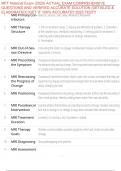
MFT National Exam (2025) ACTUAL EXAM COMPREHENSIVE
MFT National Exam
QUESTIONS AND VERIFIED ACCURATE SOLUTION (DETAILED &
Study online at https://quizlet.com/_82v15d
ELABORATED) |GET IT 100% ACCURATE!! 2025 TEST!!
1. MRI Primary Con- Bateson, Jackson, Satir, Haley, Weakland, Watzlawick
tributors
2. MRI Therapy 1. Intro to treatment setup. 2. Inquiry and definition of problem. 3. Estimation
Structure of the solution (pos. feedback) maintaining. 4. Setting goals for treatment. 5.
Selecting and making behavioral or strategic interventions.
6. Termination
3. MRI Out-of-Ses- Instructing the clients to engage in behavioral change outside of the session as
sion Directive opposed to in session.
4. MRI Prescribing Paradoxical intervention where one instructs the client to intentionally engage in
the Symptom the behavior they wish to change. Client may rebel and experience desired change
or comply and realize they have control.
5. MRI Restraining Paradoxical intervention where clients come into session and report that they are
the Progress of experiencing change so therapist encourages them to slow down and be cautious
Change about changing too fast.
6. MRI Positioning Paradoxical intervention of pushing a family member further into the absurdity of
their initial position, thereby making them realize their own absurdity.
7. MRI Paradoxical Used to address that families are naturally resistant to change. Involves instructing
Intervention fam not to change or to change in ways that contradict their desired change.
8. MRI Treatment Limited to 10 sessions, less if problem is solved.
Duration
9. MRI Therapy Resolve current problem, provide symptoms relief and create second-order
Goals change.
10. MRI Diagnosing Non-pathologizing and systemic.
11. MRI Assessment
, MFT National Exam
Study online at https://quizlet.com/_82v15d
Get description of problem. Understand the problem, then therapist identifies the
behavioral patterns that maintain that pattern.
12. MRI Symmetrical Based on equality, behavior of one mirrors that of the other.
Relationship
13. MRI Complemen- Based on differences that fit together.
tary Relationship
14. MRI Metacom- Communicating about communicating. Essentially refers to non-verbals going on
munication in the room that have an impact on what is being said verbally.
15. MRI Report and Every communication has 2 components:
Command Func- Report- Content of the message.
tions Command- A message about the relationship.
16. MRI More of the Problem when families fail to appropriately respond to normal life circumstances,
Same families will do more of the failed solution as opposed to trying a different
solution.
17. MRI Problem as The problem is not the problem, the attempted solutions to fix the problem
Attempted Solu- reinforces the interactional behavioral sequence.
tion
18. MRI First-Order Changes in family patterns that occur at the behavioral level.
Change
19. MRI Second-Or- Changes in family patterns of interaction that occurs at the level of beliefs or rules.
der Change
20. Object-Relations Non-pathologizing.
Diagnosing
21.
, MFT National Exam
Study online at https://quizlet.com/_82v15d
Object-Relations Develop insight and work through unresolved conflict. Eventually, individuals
Therapy Goals develop healthy egos and begin to relate to others maturely without projection.
22. Object-Relations 1. Assess early childhood experiences and current and past relationships. Explore
Therapy current relationship style.
Structure 2. Foster insight and begin working through.
3. Individual begins to experiment with developing new behaviors and ways to
interact. Fosters later experiences that can re-shape internalized objects.
23. Object-Relations Non-Structured. Explores:
Assessment -Early childhood experiences and the clients' interpretations of them.
-Past and present relationship with caregivers.
-Current relationship style and where they are struggling with healthy relation-
ships.
24. Object-Relations Internalized objects become introjects, and are split into being either all-good or
Introject all-bad.
25. Object-Relations The therapist's tendency to attribute qualities that reflect unresolved grievances
Countertransfer- from a previous relationship onto a client.
ence
26. Object-Relations Tendency of individuals to attribute qualities to other individuals that reflect
Transference unresolved grievances from a previous relationship.
27. Object-Relations Therapist's hypothesis about the influence of the client's past experiences on their
Interpretation current behaviors and struggles.
28. Object-Relations After insight is achieved, working through process entails translating insight into
Working more desirable and constructive ways of being.
Through
29. Object-Relations The process of raising unconscious forces to awareness, allowing clients to better
Insight understand how underlying dynamics impact their behavior and relationships.
MFT National Exam
QUESTIONS AND VERIFIED ACCURATE SOLUTION (DETAILED &
Study online at https://quizlet.com/_82v15d
ELABORATED) |GET IT 100% ACCURATE!! 2025 TEST!!
1. MRI Primary Con- Bateson, Jackson, Satir, Haley, Weakland, Watzlawick
tributors
2. MRI Therapy 1. Intro to treatment setup. 2. Inquiry and definition of problem. 3. Estimation
Structure of the solution (pos. feedback) maintaining. 4. Setting goals for treatment. 5.
Selecting and making behavioral or strategic interventions.
6. Termination
3. MRI Out-of-Ses- Instructing the clients to engage in behavioral change outside of the session as
sion Directive opposed to in session.
4. MRI Prescribing Paradoxical intervention where one instructs the client to intentionally engage in
the Symptom the behavior they wish to change. Client may rebel and experience desired change
or comply and realize they have control.
5. MRI Restraining Paradoxical intervention where clients come into session and report that they are
the Progress of experiencing change so therapist encourages them to slow down and be cautious
Change about changing too fast.
6. MRI Positioning Paradoxical intervention of pushing a family member further into the absurdity of
their initial position, thereby making them realize their own absurdity.
7. MRI Paradoxical Used to address that families are naturally resistant to change. Involves instructing
Intervention fam not to change or to change in ways that contradict their desired change.
8. MRI Treatment Limited to 10 sessions, less if problem is solved.
Duration
9. MRI Therapy Resolve current problem, provide symptoms relief and create second-order
Goals change.
10. MRI Diagnosing Non-pathologizing and systemic.
11. MRI Assessment
, MFT National Exam
Study online at https://quizlet.com/_82v15d
Get description of problem. Understand the problem, then therapist identifies the
behavioral patterns that maintain that pattern.
12. MRI Symmetrical Based on equality, behavior of one mirrors that of the other.
Relationship
13. MRI Complemen- Based on differences that fit together.
tary Relationship
14. MRI Metacom- Communicating about communicating. Essentially refers to non-verbals going on
munication in the room that have an impact on what is being said verbally.
15. MRI Report and Every communication has 2 components:
Command Func- Report- Content of the message.
tions Command- A message about the relationship.
16. MRI More of the Problem when families fail to appropriately respond to normal life circumstances,
Same families will do more of the failed solution as opposed to trying a different
solution.
17. MRI Problem as The problem is not the problem, the attempted solutions to fix the problem
Attempted Solu- reinforces the interactional behavioral sequence.
tion
18. MRI First-Order Changes in family patterns that occur at the behavioral level.
Change
19. MRI Second-Or- Changes in family patterns of interaction that occurs at the level of beliefs or rules.
der Change
20. Object-Relations Non-pathologizing.
Diagnosing
21.
, MFT National Exam
Study online at https://quizlet.com/_82v15d
Object-Relations Develop insight and work through unresolved conflict. Eventually, individuals
Therapy Goals develop healthy egos and begin to relate to others maturely without projection.
22. Object-Relations 1. Assess early childhood experiences and current and past relationships. Explore
Therapy current relationship style.
Structure 2. Foster insight and begin working through.
3. Individual begins to experiment with developing new behaviors and ways to
interact. Fosters later experiences that can re-shape internalized objects.
23. Object-Relations Non-Structured. Explores:
Assessment -Early childhood experiences and the clients' interpretations of them.
-Past and present relationship with caregivers.
-Current relationship style and where they are struggling with healthy relation-
ships.
24. Object-Relations Internalized objects become introjects, and are split into being either all-good or
Introject all-bad.
25. Object-Relations The therapist's tendency to attribute qualities that reflect unresolved grievances
Countertransfer- from a previous relationship onto a client.
ence
26. Object-Relations Tendency of individuals to attribute qualities to other individuals that reflect
Transference unresolved grievances from a previous relationship.
27. Object-Relations Therapist's hypothesis about the influence of the client's past experiences on their
Interpretation current behaviors and struggles.
28. Object-Relations After insight is achieved, working through process entails translating insight into
Working more desirable and constructive ways of being.
Through
29. Object-Relations The process of raising unconscious forces to awareness, allowing clients to better
Insight understand how underlying dynamics impact their behavior and relationships.


