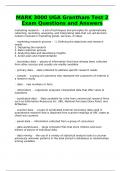
MARK 3000 UGA Grantham Test 2
Exam Questions and Answers
marketing research - -a set of techniques and principles for systematically
collecting, recording, analyzing, and interpreting data that can aid decision
makers involved in marketing goods, services, or ideas
- marketing research process - -1. Defining the objectives and research
needs
2. Designing the research
3. Data collection process
4. Analyzing data and developing insights
5. Action plan and implementation
- secondary data - -pieces of information that have already been collected
from other sources and usually are readily available
- primary data - -data collected to address specific research needs
- sample - -a group of customers who represent the customers of interest in
a research study
- data - -raw numbers or facts
- information - -organized, analyzed, interpreted data that offer value to
marketers
- syndicated data - -Data available for a fee from commercial research firms
such as Information Resources Inc. (IRI), National Purchase Diary Panel, and
ACNielsen.
- scanner data - -a type of syndicated external secondary data used in
quantitative research that is obtained from scanner readings of UPC codes at
check-out counters
- panel data - -information collected from a group of consumers
- data warehouses - -large computer files that store millions and even
billions of pieces of individual data
- data mining - -the use of a variety of statistical analysis tools to uncover
previously unknown patterns in the data stored in databases or relationships
among variables
, - churn - -the number of consumers who stop using a product or service,
divided by the average number of consumers of that product or service
- big data - -data sets that are too large and complex to analyze with
conventional data management and data mining software
- qualitative research - -informal research methods, including observation,
following social media sites, in-depth interviews, focus groups, and projective
techniques
- quantitative research - -structured responses that can be statistically
tested to confirm insights and hypotheses generated via qualitative research
or secondary data
- observation - -an exploratory research method that entails examining
purchase and consumption behaviors through personal or video camera
scrutiny
- virtual community - -online networks of people who communicate about
specific topics
- sentiment mining - -data gathered by evaluating customer comments
posted through social media sites such as Facebook and Twitter
- in-depth interview - -an exploratory research technique in which trained
researchers ask questions, listen to and record the answers, and then pose
additional questions to clarify or expand on a particular issue
- focus group interview - -A research technique in which a small group of
persons (usually 8 to 12) comes together for an intensive discussion about a
particular topic, with the conversation guided by a trained moderator using
an unstructured method of inquiry.
- survey - -a systematic means of collecting information from people that
generally uses a questionnaire
- questionairre - -a form that features a set of questions designed to gather
information from respondents and thereby accomplish the researchers'
objectives; structured or unstructured answers
- unstructured questions - -open-ended questions that allow respondents to
answer in their own words
- structured questions - -closed-ended questions for which a discrete set of
response alternatives, or specific answers, is provided for respondents to
evaluate
Exam Questions and Answers
marketing research - -a set of techniques and principles for systematically
collecting, recording, analyzing, and interpreting data that can aid decision
makers involved in marketing goods, services, or ideas
- marketing research process - -1. Defining the objectives and research
needs
2. Designing the research
3. Data collection process
4. Analyzing data and developing insights
5. Action plan and implementation
- secondary data - -pieces of information that have already been collected
from other sources and usually are readily available
- primary data - -data collected to address specific research needs
- sample - -a group of customers who represent the customers of interest in
a research study
- data - -raw numbers or facts
- information - -organized, analyzed, interpreted data that offer value to
marketers
- syndicated data - -Data available for a fee from commercial research firms
such as Information Resources Inc. (IRI), National Purchase Diary Panel, and
ACNielsen.
- scanner data - -a type of syndicated external secondary data used in
quantitative research that is obtained from scanner readings of UPC codes at
check-out counters
- panel data - -information collected from a group of consumers
- data warehouses - -large computer files that store millions and even
billions of pieces of individual data
- data mining - -the use of a variety of statistical analysis tools to uncover
previously unknown patterns in the data stored in databases or relationships
among variables
, - churn - -the number of consumers who stop using a product or service,
divided by the average number of consumers of that product or service
- big data - -data sets that are too large and complex to analyze with
conventional data management and data mining software
- qualitative research - -informal research methods, including observation,
following social media sites, in-depth interviews, focus groups, and projective
techniques
- quantitative research - -structured responses that can be statistically
tested to confirm insights and hypotheses generated via qualitative research
or secondary data
- observation - -an exploratory research method that entails examining
purchase and consumption behaviors through personal or video camera
scrutiny
- virtual community - -online networks of people who communicate about
specific topics
- sentiment mining - -data gathered by evaluating customer comments
posted through social media sites such as Facebook and Twitter
- in-depth interview - -an exploratory research technique in which trained
researchers ask questions, listen to and record the answers, and then pose
additional questions to clarify or expand on a particular issue
- focus group interview - -A research technique in which a small group of
persons (usually 8 to 12) comes together for an intensive discussion about a
particular topic, with the conversation guided by a trained moderator using
an unstructured method of inquiry.
- survey - -a systematic means of collecting information from people that
generally uses a questionnaire
- questionairre - -a form that features a set of questions designed to gather
information from respondents and thereby accomplish the researchers'
objectives; structured or unstructured answers
- unstructured questions - -open-ended questions that allow respondents to
answer in their own words
- structured questions - -closed-ended questions for which a discrete set of
response alternatives, or specific answers, is provided for respondents to
evaluate