

Adv Biology MIDTERMPractice Exam 2025
UPDATE/PRACTICE QUESTIONS AND CORRECT
VERIFIED ANSWERS(complete
solutions)ASSURED SUCCESS/GRADED A+!!
Save
Terms in this set (78)
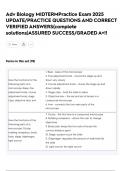
1. Base - base of the microscope
2. Fine adjustment knob - moves the stage up and
Give the functions for the down very slowly
following parts of a 3. Course adjustment knob - moves the stage up and
microscope: Base, fine down rapidly
adjustment knob, course 4. Stage clips - hold the slide in place
adjustment knob, stage 5. Objective lens - the second set of lenses in a
clips, objective lens, arm compound microscope
6. Arm - connects the two main parts of the
microscope
7. Ocular - the first lens in a compound microscope
8. Rotating nosepiece - allows the user to change
Give the functions of the
objectives
following parts of a
9. Body tube: keeps the two sets of lenses the
microscope: Ocular,
correct distance apart
rotating nosepiece, body
10. Stage: a place to put the slide
tube, stage, diaphragm,
11. Diaphragm: regulates the amount of slide that hits
light source
the slide
12: Light source: the light source
, ______________ is the clarity in Resolution
an image and the power
to show details clearly
______________ is a measure of Magnification
how the image is
enlarged
Most oculars have a 10x
magnification of ____.
Step one: Observe / ask a question
Step two: Form a hypothesis
List the 5 steps of the
Step three: Designing a controlled experiment
scientific method
Step four: Recording and analyzing results
Step five: Drawing conclusions
What is a hypothesis? a possible explanation to the question or problem
A broad and comprehensive statement that is
What is a theory?
thought to be true
1. are made up of units called cells
2. are able to reproduce
3. are based on a universal genetic code called DNA
What are the 8
4. grow & develop
characteristics of life? (All
5. obtain & use energy (hunting, photosynthesis, etc)
living things...)
6. respond to stimuli in their environment
7. maintain homeostasis
8. evolve or change over time
What is a unicellular An organism made up of only one cell.
organism?
What is a colonial a group of cells that live together, but are not
organism? coordinated
What is a multicellular An organism made of many cells
organism?
UPDATE/PRACTICE QUESTIONS AND CORRECT
VERIFIED ANSWERS(complete
solutions)ASSURED SUCCESS/GRADED A+!!
Save
Terms in this set (78)
1. Base - base of the microscope
2. Fine adjustment knob - moves the stage up and
Give the functions for the down very slowly
following parts of a 3. Course adjustment knob - moves the stage up and
microscope: Base, fine down rapidly
adjustment knob, course 4. Stage clips - hold the slide in place
adjustment knob, stage 5. Objective lens - the second set of lenses in a
clips, objective lens, arm compound microscope
6. Arm - connects the two main parts of the
microscope
7. Ocular - the first lens in a compound microscope
8. Rotating nosepiece - allows the user to change
Give the functions of the
objectives
following parts of a
9. Body tube: keeps the two sets of lenses the
microscope: Ocular,
correct distance apart
rotating nosepiece, body
10. Stage: a place to put the slide
tube, stage, diaphragm,
11. Diaphragm: regulates the amount of slide that hits
light source
the slide
12: Light source: the light source
, ______________ is the clarity in Resolution
an image and the power
to show details clearly
______________ is a measure of Magnification
how the image is
enlarged
Most oculars have a 10x
magnification of ____.
Step one: Observe / ask a question
Step two: Form a hypothesis
List the 5 steps of the
Step three: Designing a controlled experiment
scientific method
Step four: Recording and analyzing results
Step five: Drawing conclusions
What is a hypothesis? a possible explanation to the question or problem
A broad and comprehensive statement that is
What is a theory?
thought to be true
1. are made up of units called cells
2. are able to reproduce
3. are based on a universal genetic code called DNA
What are the 8
4. grow & develop
characteristics of life? (All
5. obtain & use energy (hunting, photosynthesis, etc)
living things...)
6. respond to stimuli in their environment
7. maintain homeostasis
8. evolve or change over time
What is a unicellular An organism made up of only one cell.
organism?
What is a colonial a group of cells that live together, but are not
organism? coordinated
What is a multicellular An organism made of many cells
organism?


