

AHA ACLS Test From Real Exam 2025
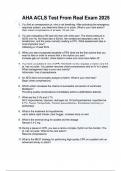
1. You find an unresponsive pt. who is not breathing. After activating the emergency response system, you determine there is no pulse. What is your next action? Start chest compressions of at least 100 per min. 2. You are evaluating a 58-year-old man with chest pain. The blood pressure is 92/50 mm Hg, the heart rate is 92/min, the nonlabored respiratory rate is 14 breaths/min, and the pulse oximetry reading is 97%. What assessment step is most important now? Obtaining a 12 lead ECG. 3. When you see a suspected asystole or PEA what are the first actions that you need to take in order to ensure that is the rhythm you see? increase gain on monitor, check leads to make sure none have fallen off 4. You have completed 2 min of CPR. The ECG monitor displays a rhythm and the pt. has no pulse. You partner resumes chest compressions and an IV is in place. What management step is your next priority? Administer 1mg of epinepherine 5. An AED does not promptly analyze a rhythm. What is your next step? Begin chest compressions. 6. Which action increases the chance of successful conversion of ventricular fibrillation? Providing quality compressions immediately before a defibrillation attempt. 7. What are the 5 H's and 5 T's 5H's: Hypovolemia, Hypoxia, Hydrogen ion, HYpo/Hyperkalemia, Hypothermia 5 T's: Toxins, Tamponade, Tension pneumothorax, thrombosis (coronary or pulmonary) 8. What is the treatment for Hypothermia warm saline rapid infuser, bear hugger, increase temp on vent 9. What is the reversal drug for opiates and the dosage Narcan 0.4-2 mg 10. During a pause in CPR, you see a narrow complex rhythm on the monitor. The pt. has no pulse. What is the next action? Resume compressions 11. What is the BEST strategy for performing high-quality CPR on a patient with an advanced airway in place? Provide continuous chest compressions without pauses and 10 ventilations per minute. 12. Which action is a component of high-quality chest compressions? Allowing complete chest recoil 13. What is the reversal drug for benzodiazepiens Romazincon 0.2 mg, 0.3, then 0.5 till a max dose of 3 mg 14. Three minutes after witnessing a cardiac arrest, one member of your team inserts an endotracheal tube while another performs continuous chest compressions. During subsequent ventilation, you notice the presence of a waveform on the capnography screen and a PETCO2 level of 8 mm Hg. What is the significance of this finding? Chest compressions may not be effective. 15. What is a good diagnostic tool to determine if a patient is in cardiac tamponade Echo machine to see if there's fluid 16. For the past 25 minutes, an EMS crew has attempted resuscitation of a patient who originally presented in ventricular fibrillation. After the first shock, the ECG screen displayed asystole, which has persisted despite 2 doses of epinephrine, a fluid bolus, and high-quality CPR. What is your next treatment? Consider terminating resuscitive efforts after consulting medical control. 17. Which situation BEST describes PEA? Sinus rhythm without a pulse 18. What are the symptoms of your patient having a tension pneumothorax tracheal deviation, JVD, difficulty bagging, Low 02 sat 19. During your assessment, your patient suddenly loses consciousness. After calling for help and determining that the patient is not breathing, you are unsure whether the patient has a pulse. What is your next action? Begin chest compressions. 20. What is an advantage of using hands-free defibrillation pads instead of defibrillation paddles? Hands-free pads allow for a more rapid defibrillation. 21. What action is recommended to help minimize interruptions in chest compressions during CPR? Continue CPR while charging the defibrillator. 22. The use of quantitative capnography in intubated patients is? allows for monitoring of CPR quality. 23. What is the treatment for Pulmonary embolus thorombolytic and take to cath lab ( typically not a good prognosis) 24. Bradycardia with a pulse Atropine 0.5 mg IV 1 3-5 minutes, reassess, atropine 0.5 mg, place pads on for pacing, Give 1 mg versed to sedate once you start shocking, If atropine is not working, and you want to continue with drugs, Dopamine infusion 2-10 mcg/kg per minute or epinephrine 2-10mcg/minute 25. Which drug and dose are recommended for the management of a patient in refractory ventricular fibrillation? Amioderone 300mg 26. What is the treatment for Cardiac Tamponade Pericardial centesis (5th intercostal space midclavicular line, needle in to drain line) 27. Which drug should be used during Unstable Bradycardia with a pulse in the presence of MI Dopamine, and transcutaneous pacing 28. What is the appropriate interval for an interruption in chest compressions? 10 seconds or less 29. What is the treatment for Tachycardia with a pulse Sedate and synchronized cardioversion. 30. What is the treatment for a tension pneumothorax? needle in 2nd intercostal space midclavicular line 31. Which action improves the quality of chest compressions delivered during a resuscitation attempt? Switch providers about every 2 minutes or every 5 compression cycles. 32. What is the treatment if patient is in V tach and has a pulse Amiodarone: 150 mg over 10 minutes. Maintenance infusion 1 mg/min for 6 hours. Can give a total of 7 boluses. 33. What is the appropriate ventilation strategy for an adult in respiratory arrest with a pulse of 80 beats/min? 1 breath every 5-6 seconds 34. IF patient is in V tach with a pulse how long must you wait before giving the second dose of Amiodarone? WHat other drug could you use? ten minutes after the first dose stops. Or Procaninamide: 20-50 mg/min for a max of 17 mg/kg maintenance 1-4 mg/min ( generally 2 mg per minute) 35. What is the most common cause of a PEA and what is the best treatment? hypovolemia, hang fluid 36. When does procaninamide need to be stopped or reconsidered If QRS widens by more than 50%, hypotension 37. A patient presents to the emergency department with new onset of dizziness and fatigue. On examination, the patient's heart rate is 35/min, the blood pressure is 70/50 mm Hg, the respiratory rate is 22 breaths/min, and the oxygen saturation is 95%. What is the appropriate first medication? Atropine 0.5mg 38. A patient with dizziness and shortness of breath with a sinus bradycardia of 40/min. The initial atropine dose was ineffective, and your monitor/defibrillator is not equipped with a transcutaneous pacemaker. What is the appropriate dose of dopamine for this patient? 2 to 10 mcg/kg per minute 39. A pt. presents to the ER with dizziness and SOB with a sinus brady of 40/min. The initial atropine dose was ineffective and your monitor does not provide TCP. What is the appropriate dose of Dopamine for this pt? 2-10mcg/kg/min 40. What is the recommended dose of cardioversion for Atrial fibrillation 120-200 j with monophasic; 100-120 j with bphasic 41. A patient has sudden onset of dizziness. The patient's heart rate is 180/min, blood pressure is 110/70 mm Hg, respiratory rate is 18 breaths/min, and pulse oximetry reading is 98% on room air. The lead II ECG shows SVT, what is your next move? Vagal manuever. 43. How much sedation is given before cardioversion? 1-2 mg of versed, 25-50 mcg of Fentanyl for sedation if stable before cardioversion 44. A pt. has an onset of dizziness. The pt.s heart rate is 180, BP is 110/70, resp. rate is 18, O2 sat is 98%. This is a reg narrow complex tach rythm. What is the next intervention? Vagal manuever. 45. What is the recommended dose of cardioversion of atrial flutter and other SVTs 50-100 j 46. A monitored patient in the ICU developed a sudden onset of narrow-complex tachycardia at a rate of 220/min. The patient's blood pressure is 128/58 mm Hg, the PETCO2 is 38 mm Hg, and the pulse oximetry reading is 98%. There is vascular access at the left internal jugular vein, and the patient has not been given any vasoactive drugs. A 12-lead ECG confirms a supraventricular tachycardia with no evidence of ischemia or infarction. The heart rate has not responded to vagal maneuvers. What is the next recommended intervention? Adenosine 6mg IV push 47. A monitored pt. in the ICU developed a suddent onset of narrow complex tach at a rate of 220/min. The pt's BP is 128/58, the PETCO2 is 38mm Hg, and the O2 sat is 98%. There is an EJ established for vascular access. The pt. denies taking any vasodialators. A 12 lead shows no ischemia or infarction. Vagal manuevers are ineffective. What is the next intervention? Adenosine 12mg IV 48. What is the recommended dose of cardivoersion for V Tach 100 j 49. What is the reccommended dose of cardioversion for junctional tachycardia or MAT not recommended, shock cannot stop these rhythm 50. You are receiving a radio report from an EMS team en route with a patient who may be having an acute stroke. The hospital CT scanner is not working at this time. What should you do in this situation? Divert the patient to a hospital 15 minutes away with CT capabilities. 51. Choose an appropriate indication to stop or withhold resuscitative efforts. Evidence of rigor mortis. 52. Choose an appropriate indication to stop or withhold resuscitate efforts. Evidence of rigor mortis. 53. What is the treatment for Wolf Parkinson White, Stable Procainamide, Amiodarone is only chosen. NO BETA BLOCKERS OR CALCIUM CHANNEL BLOCKERS 54. A 49-year-old woman arrives in the emergency department with persistent epigastric pain. She had been taking oral antacids for the past 6 hours because she thought she had heartburn. The initial blood pressure is 118/72 mm Hg, the heart rate is 92/min and regular, the nonlabored respiratory rate is 14 breaths/min, and the pulse oximetry reading is 96%. Which is the most appropriate intervention to perform next? Obtain a 12 lead ECG. 55. A patient in respiratory failure becomes apneic but continues to have a strong pulse. The heart rate is dropping rapidly and now shows a sinus bradycardia at a rate of 30/min. What intervention has the highest priority? Simple airway manuevers and assisted ventilations. 56. What is the treatment for Stable Torsades If history of alcoholism: give magnesium sulfate start with 1 g over 30 minutes 57. What is the appropriate procedure for endotracheal tube suctioning after the appropriate catheter is selected? Suction during withdrawal but for no longer than 10 seconds. 58. What is the treatment for stable supraventricular tachycardia vagal response, have them bear down, cough, ice bag to the face then use adensosine 6 mg IV push, flush (wide oen fluid) wait 1-2 minutes, then give 12 mg of adenosine, repeat 12 mg of adensone, get urine tox screen for potential drug overdose or stimulant. 59. While treating a stable pt for dizziness, a BP of 68/30, cool and clammy, you see a brady rythm on the ECG. How do you treat this? Atropine 0.5mg 60. A 68-year-old woman experienced a sudden onset of right arm weakness. EMS personnel measure a blood pressure of 140/90 mm Hg, a heart rate of 78/min, a nonlabored respiratory rate of 14 breaths/min, and a pulse oximetry reading of 97%. The lead II ECG displays sinus rhythm. What is the most appropriate action for the EMS team to perform next? Cincinnati Prehospital Stroke Scale assessment 61. What is the treatment for unstable torsades needs to be defibrillated at 120 joules because it is impossible to synchronize 62. What are the options for treatment for Supraventricular Tachycardia amiodarone, procanimide, deltiazem, Metoprolol 63. EMS is transporting a patient with a positive prehospital stroke assessment. Upon arrival in the emergency department, the initial blood pressure is 138/78 mm Hg, the pulse rate is 80/min, the respiratory rate is 12 breaths/min, and the pulse oximetry reading is 95% on room air. The lead II ECG displays sinus rhythm. The blood glucose level is within normal limits. What intervention should you perform next? Head CT scan 64. What is the treatment for Unstable Atrial Flutter cardiovert start at 50 J
Document information
- Uploaded on
- June 4, 2025
- Number of pages
- 16
- Written in
- 2024/2025
- Type
- Exam (elaborations)
- Contains
- Questions & answers


