

Advanced Pathophysiology Exam Guide
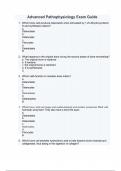
1. Which bone cells produce osteocalcin when stimulated by 1,25-dihydroxyvitamin D and synthesize osteoid? a. Osteoclasts b. Osteocytes c. Fibrocytes d. Osteoblasts D 2. What happens to the original bone during the second phase of bone remodeling? a. The original bone is replaced b. It hardens c. the original bone is resorbed d. It is synthesized C 3. Which cells function to maintain bone matrix? a. Osteoclasts b. Osteocytes c. Osteoblasts d. Osteophytes B 4. Which bone cells are large and multinucleated and contain lysosomes filled with hydrolytic enzymes? They also have a short life span. a. Osteoblasts b. Osteoclasts c. Osteocytes d. Fibrocytes B 5. Which bone cell secretes hydrochloric acid to help dissolve bone minerals and collagenase, thus aiding in the digestion of collagen? a. Osteocytes b. Osteoblasts c. Osteoclasts d. Osteophytes C 6. Which glucoprotein is believed to inhibit calcium phosphate precipitation and play a part in bone resorption by recruiting osteoclasts a. Osteocalcin b. Osteonectin c. Laminin d. Bone albumin A 7. Which glucoprotein is thought to transport essential elements such as hormones, ions, and other metabolites to and from bone cells? a. osteocalcin b.Osteonectin c. laminin d. Bone albumin D 8. How is the work function of a muscle usually calculated? a. Muscle type b. Calculating force X distance c. Foot pounds d. Kilograms B 9. What is the basic structural unit in compact bone? a. Small channels called canaliculi b. Osteocytes within the lacunae c. Tiny spaces within the lacunae d. Haversian system D 10. Which part of an injured joint becomes insensitive to pain and regenerates slowly and minimally? a. Synovium b. Articular cartilage c. Bursa d. Tendon B 11. The outer layer of the periosteum contains blood vessels and nerves that penetrate the inner structures of the bone by way of which structure? a. Volkmann canals b. Canaliculi c. Sharpey canals d. Trabeculae A 12. What is the function of Sharpey fibers? a. To anchor the outer layer of the periosteum to the inner layer b. To contain blood vessels and nerves on the outer layer of the periosteum c. To help attach tendons and ligaments to the periosteum d. To attach muscles to the periosteum C 13. The student learns that after puberty, the epiphyseal plate calcifies and the epiphysis merges with which structure? a. Epiphyseal line b. Epiphyseal plate c. Metaphysis d. Articular cartilage C 14. The stage of healing in the bone that involves procallus formation entails which process? a. Formation of a hematoma that allows the development of a fibrin network b. Production of granulation tissue by fibroblasts, capillary buds, and osteoblasts c. Development of a primitive bone matrix termed woven bone d. Remodeling of the periosteal and endosteal bone surfaces B 15. The professor asks a student to describe the movement of a diarthrosis joint. What answer by the student is best? a. Immovable joint b. Slightly moveable c. Variable movement d. Freely moveable D 16. Which type of joint holds teeth in the maxilla or mandible? a. Amphiarthrosis b. Diarthrosis c. Synarthrosis d. Gomphosis D 17. The hyaline cartilage joints between the ribs and sternum are examples of which type of joint? a. Synchondrosis b. Symphysis c. Gomphosis d. Syndesmosis A 18. The joint that contains a synovial membrane that lines the inner joint capsule is an example of which type of joint? a. Amphiarthrosis b. Diarthrosis c. Synarthrosis d. Biarthrosis B 19. What is the function of the synovial membrane's type A cells within the intima? a. To release mast cells, initiating the inflammatory process after joint injury b. To ingest and remove bacteria and debris by phagocytosis in the joint cavity c. To secrete hyaluronate, a binding agent that gives synovial fluid its viscous quality d. To store fat cells and glycogen, providing adenosine triphosphate for joint activity B 20. The professor is quizzing student on synovial fluid. Which statement shows the students need further instruction? a. It contains protein polysaccharides to repair the synovial membrane after injury. b. It lubricates the joint surfaces, allowing ease of movement. c. It nourishes the pad of the articular cartilage. d. It contains leukocytes to phagocytize joint debris and microorganisms.
Document information
- Uploaded on
- June 4, 2025
- Number of pages
- 10
- Written in
- 2024/2025
- Type
- Exam (elaborations)
- Contains
- Questions & answers


