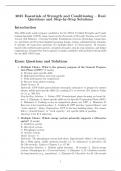
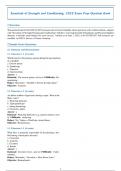
2025 Essentials of Strength and Conditioning – Real
Questions and Step-by-Step Solutions
Introduction
This 2025 study guide prepares candidates for the NSCA Certified Strength and Condi-
tioning Specialist (CSCS) exam, based on the Essentials of Strength Training and Condi-
tioning (4th Edition). Covering Scientific Foundations (exercise physiology, biomechan-
ics, nutrition) and Practical/Applied (program design, testing, administration) domains,
it includes 40 exam-style questions (15 multiple-choice, 15 short-answer, 10 scenario-
based) with verified model answers, detailed rationales, step-by-step solutions, and helper
explanations. Designed for Stuvia upload, it equips candidates with problem-solving skills
for the 2025 CSCS exam.
Exam Questions and Solutions
1. Multiple Choice: What is the primary purpose of the General Prepara-
tion Phase (GPP)? [2 marks]
A. Develop sport-specific skills
B. Build general fitness and work capacity
C. Peak performance for competition
D. Recover from intense training
Model Answer: B
Rationale: GPP builds general fitness (strength, endurance) to prepare for intense
phases, unlike sport-specific skills (A), peaking (C), or recovery (D). Links to Chap-
ter 21, p. 509–510.
Step-by-Step Solution: 1. Define GPP: Foundational phase focusing on broad fit-
ness. 2. Eliminate A: Sport-specific skills are for Specific Preparation Phase (SPP).
3. Eliminate C: Peaking occurs in competition phase, not GPP. 4. Eliminate D:
Recovery is for transition phase. 5. Confirm B: GPP matches “general fitness” and
“work capacity.” Helper Explanation: GPP is the base-building phase. For exams,
link to “general fitness” or “work capacity,” not specific skills or peaking.
Marking: 2 for B; 0 otherwise.
2. Multiple Choice: Which energy system primarily supports a 100-meter
sprint? [2 marks]
A. Oxidative system
B. Glycolytic system
C. Phosphagen system
D. Aerobic system
Model Answer: C
Rationale: The phosphagen system fuels short, high-intensity efforts ( 10 seconds),
like a 100m sprint, unlike oxidative/aerobic (A, D, endurance) or glycolytic (B,
30–120 seconds). Links to Chapter 3, p. 67–68.
Step-by-Step Solution: 1. Identify sprint duration: 10 seconds. 2. Match energy
system: Phosphagen for <15-second bursts. 3. Eliminate A, D: Oxidative/aerobic
for long-duration (e.g., marathons). 4. Eliminate B: Glycolytic for 30–120 seconds
1
, (e.g., 400m). 5. Confirm C: Phosphagen aligns with sprint’s intensity and duration.
Helper Explanation: Phosphagen is for quick, max-effort bursts. For exams, link
short sprints to “phosphagen,” not glycolytic or aerobic.
Marking: 2 for C; 0 otherwise.
3. Multiple Choice: What is the main benefit of tapering before a compe-
tition? [2 marks]
A. Increase training volume
B. Reduce fatigue for peak performance
C. Enhance aerobic endurance
D. Build muscle mass
Model Answer: B
Rationale: Tapering reduces volume/intensity to minimize fatigue, optimizing per-
formance, unlike increasing volume (A), endurance (C), or muscle mass (D). Links
to Chapter 23, p. 559–561.
Step-by-Step Solution: 1. Define tapering: Reducing training to peak for competi-
tion. 2. Eliminate A: Increasing volume opposes tapering’s goal. 3. Eliminate C:
Endurance isn’t the focus of tapering. 4. Eliminate D: Muscle mass is built earlier,
not during tapering. 5. Confirm B: Fatigue reduction is key to peaking. Helper
Explanation: Tapering is like a pre-game rest. For exams, link to “fatigue” and
“peak,” not volume or endurance.
Marking: 2 for B; 0 otherwise.
4. Multiple Choice: What does the Rate of Perceived Exertion (RPE) pri-
marily assess? [2 marks]
A. Maximal strength
B. Subjective training intensity
C. Aerobic capacity
D. Body composition
Model Answer: B
Rationale: RPE measures subjective intensity (e.g., 1–10 scale), guiding training,
unlike strength (A), aerobic capacity (C), or body composition (D). Links to Chap-
ter 17, p. 391.
Step-by-Step Solution: 1. Define RPE: Athlete’s perceived effort during exercise. 2.
Eliminate A: Strength is objective (e.g., 1-RM). 3. Eliminate C: Aerobic capacity
needs tests like VO2 max. 4. Eliminate D: Body composition is unrelated to effort.
5. Confirm B: RPE is subjective and intensity-focused. Helper Explanation: RPE
is how hard it feels. For exams, link to “subjective” and “intensity,” not objective
measures like strength.
Marking: 2 for B; 0 otherwise.
5. Multiple Choice: Which test assesses lower-body power? [2 marks]
A. 1-RM bench press
B. Vertical jump
C. Sit-and-reach
D. 1.5-mile run
Model Answer: B
Rationale: Vertical jump tests lower-body power, unlike bench press (A, upper-
body strength), sit-and-reach (C, flexibility), or 1.5-mile run (D, endurance). Links
to Chapter 13, p. 286–287.
2
Questions and Step-by-Step Solutions
Introduction
This 2025 study guide prepares candidates for the NSCA Certified Strength and Condi-
tioning Specialist (CSCS) exam, based on the Essentials of Strength Training and Condi-
tioning (4th Edition). Covering Scientific Foundations (exercise physiology, biomechan-
ics, nutrition) and Practical/Applied (program design, testing, administration) domains,
it includes 40 exam-style questions (15 multiple-choice, 15 short-answer, 10 scenario-
based) with verified model answers, detailed rationales, step-by-step solutions, and helper
explanations. Designed for Stuvia upload, it equips candidates with problem-solving skills
for the 2025 CSCS exam.
Exam Questions and Solutions
1. Multiple Choice: What is the primary purpose of the General Prepara-
tion Phase (GPP)? [2 marks]
A. Develop sport-specific skills
B. Build general fitness and work capacity
C. Peak performance for competition
D. Recover from intense training
Model Answer: B
Rationale: GPP builds general fitness (strength, endurance) to prepare for intense
phases, unlike sport-specific skills (A), peaking (C), or recovery (D). Links to Chap-
ter 21, p. 509–510.
Step-by-Step Solution: 1. Define GPP: Foundational phase focusing on broad fit-
ness. 2. Eliminate A: Sport-specific skills are for Specific Preparation Phase (SPP).
3. Eliminate C: Peaking occurs in competition phase, not GPP. 4. Eliminate D:
Recovery is for transition phase. 5. Confirm B: GPP matches “general fitness” and
“work capacity.” Helper Explanation: GPP is the base-building phase. For exams,
link to “general fitness” or “work capacity,” not specific skills or peaking.
Marking: 2 for B; 0 otherwise.
2. Multiple Choice: Which energy system primarily supports a 100-meter
sprint? [2 marks]
A. Oxidative system
B. Glycolytic system
C. Phosphagen system
D. Aerobic system
Model Answer: C
Rationale: The phosphagen system fuels short, high-intensity efforts ( 10 seconds),
like a 100m sprint, unlike oxidative/aerobic (A, D, endurance) or glycolytic (B,
30–120 seconds). Links to Chapter 3, p. 67–68.
Step-by-Step Solution: 1. Identify sprint duration: 10 seconds. 2. Match energy
system: Phosphagen for <15-second bursts. 3. Eliminate A, D: Oxidative/aerobic
for long-duration (e.g., marathons). 4. Eliminate B: Glycolytic for 30–120 seconds
1
, (e.g., 400m). 5. Confirm C: Phosphagen aligns with sprint’s intensity and duration.
Helper Explanation: Phosphagen is for quick, max-effort bursts. For exams, link
short sprints to “phosphagen,” not glycolytic or aerobic.
Marking: 2 for C; 0 otherwise.
3. Multiple Choice: What is the main benefit of tapering before a compe-
tition? [2 marks]
A. Increase training volume
B. Reduce fatigue for peak performance
C. Enhance aerobic endurance
D. Build muscle mass
Model Answer: B
Rationale: Tapering reduces volume/intensity to minimize fatigue, optimizing per-
formance, unlike increasing volume (A), endurance (C), or muscle mass (D). Links
to Chapter 23, p. 559–561.
Step-by-Step Solution: 1. Define tapering: Reducing training to peak for competi-
tion. 2. Eliminate A: Increasing volume opposes tapering’s goal. 3. Eliminate C:
Endurance isn’t the focus of tapering. 4. Eliminate D: Muscle mass is built earlier,
not during tapering. 5. Confirm B: Fatigue reduction is key to peaking. Helper
Explanation: Tapering is like a pre-game rest. For exams, link to “fatigue” and
“peak,” not volume or endurance.
Marking: 2 for B; 0 otherwise.
4. Multiple Choice: What does the Rate of Perceived Exertion (RPE) pri-
marily assess? [2 marks]
A. Maximal strength
B. Subjective training intensity
C. Aerobic capacity
D. Body composition
Model Answer: B
Rationale: RPE measures subjective intensity (e.g., 1–10 scale), guiding training,
unlike strength (A), aerobic capacity (C), or body composition (D). Links to Chap-
ter 17, p. 391.
Step-by-Step Solution: 1. Define RPE: Athlete’s perceived effort during exercise. 2.
Eliminate A: Strength is objective (e.g., 1-RM). 3. Eliminate C: Aerobic capacity
needs tests like VO2 max. 4. Eliminate D: Body composition is unrelated to effort.
5. Confirm B: RPE is subjective and intensity-focused. Helper Explanation: RPE
is how hard it feels. For exams, link to “subjective” and “intensity,” not objective
measures like strength.
Marking: 2 for B; 0 otherwise.
5. Multiple Choice: Which test assesses lower-body power? [2 marks]
A. 1-RM bench press
B. Vertical jump
C. Sit-and-reach
D. 1.5-mile run
Model Answer: B
Rationale: Vertical jump tests lower-body power, unlike bench press (A, upper-
body strength), sit-and-reach (C, flexibility), or 1.5-mile run (D, endurance). Links
to Chapter 13, p. 286–287.
2