

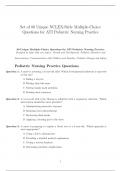
Set of 80 Unique NCLEX-Style Multiple-Choice
Questions for ATI Pediatric Nursing Practice
80 Unique Multiple-Choice Questions for ATI Pediatric Nursing Practice
Designed to align with core topics: Growth and Development, Pediatric Disorders and
Interventions, Communication with Children and Families, Pediatric Dosage and Safety
Pediatric Nursing Practice Questions
Question 1: A nurse is assessing a 3-year-old child. Which developmental milestone is expected
at this age?
A Riding a tricycle
B Writing their full name
C Solving simple math problems
D Reading short sentences
Question 2: A 5-year-old with cystic fibrosis is admitted with a respiratory infection. Which
intervention should the nurse prioritize?
A Administering pancreatic enzymes
B Initiating chest physiotherapy
C Restricting fluid intake
D Applying a heating pad to the chest
Question 3: A nurse is preparing to explain a blood test to a 4-year-old. Which approach is
most appropriate?
A Using a doll to demonstrate
B Providing a detailed medical explanation
C Giving a written handout
D Discussing potential complications
1
,Question 4: A nurse is preparing to administer ibuprofen to a 12-kg child at 10 mg/kg every 6
hours. How many mg should be given per dose?
A 80 mg
B 100 mg
C 120 mg
D 140 mg
Question 5: A nurse is evaluating a 9-month-old infant. Which milestone indicates normal
development?
A Pulling to a standing position
B Walking independently
C Speaking in two-word phrases
D Stacking three blocks
Question 6: A 7-year-old with type 1 diabetes reports feeling shaky. Which action should the
nurse take first?
A Checking blood glucose level
B Administering insulin
C Offering a high-protein snack
D Encouraging rest
Question 7: A nurse is discussing a child’s hospitalization with parents. Which statement pro-
motes family involvement?
A “We encourage you to participate in your child’s care.”
B “You should leave during procedures.”
C “We’ll handle all decisions.”
D “Visiting is limited to one hour.”
Question 8: A nurse is administering amoxicillin to a 15-kg child at 40 mg/kg/day in 3 divided
doses. What is the single dose in mg?
A 150 mg
B 200 mg
C 250 mg
D 300 mg
Question 9: A nurse is assessing an 8-year-old. Which cognitive skill is expected at this age?
2
, A Understanding conservation
B Performing abstract reasoning
C Solving complex equations
D Engaging in egocentric thinking
Question 10: A 2-year-old with a fever is diagnosed with otitis media. Which intervention should
the nurse anticipate?
A Administering antibiotics
B Applying cold compresses to the ear
C Encouraging vigorous activity
D Restricting all fluids
Question 11: A nurse is comforting a 6-year-old before an injection. Which action is most effec-
tive?
A Offering a distraction, like a toy
B Explaining the injection’s mechanism
C Promising it won’t hurt
D Restraining the child immediately
Question 12: A nurse is preparing to administer digoxin to a 6-kg infant. The safe dose range is
10–20 mcg/kg/day. What is the minimum safe daily dose in mcg?
A 40 mcg
B 60 mcg
C 80 mcg
D 100 mcg
Question 13: A nurse is observing a 4-year-old. Which fine motor skill is expected?
A Copying a square
B Writing full sentences
C Tying shoelaces
D Cutting precise shapes
Question 14: A 10-year-old with asthma is experiencing an acute exacerbation. Which medica-
tion should the nurse administer first?
A Albuterol inhaler
B Oral prednisone
3
Questions for ATI Pediatric Nursing Practice
80 Unique Multiple-Choice Questions for ATI Pediatric Nursing Practice
Designed to align with core topics: Growth and Development, Pediatric Disorders and
Interventions, Communication with Children and Families, Pediatric Dosage and Safety
Pediatric Nursing Practice Questions
Question 1: A nurse is assessing a 3-year-old child. Which developmental milestone is expected
at this age?
A Riding a tricycle
B Writing their full name
C Solving simple math problems
D Reading short sentences
Question 2: A 5-year-old with cystic fibrosis is admitted with a respiratory infection. Which
intervention should the nurse prioritize?
A Administering pancreatic enzymes
B Initiating chest physiotherapy
C Restricting fluid intake
D Applying a heating pad to the chest
Question 3: A nurse is preparing to explain a blood test to a 4-year-old. Which approach is
most appropriate?
A Using a doll to demonstrate
B Providing a detailed medical explanation
C Giving a written handout
D Discussing potential complications
1
,Question 4: A nurse is preparing to administer ibuprofen to a 12-kg child at 10 mg/kg every 6
hours. How many mg should be given per dose?
A 80 mg
B 100 mg
C 120 mg
D 140 mg
Question 5: A nurse is evaluating a 9-month-old infant. Which milestone indicates normal
development?
A Pulling to a standing position
B Walking independently
C Speaking in two-word phrases
D Stacking three blocks
Question 6: A 7-year-old with type 1 diabetes reports feeling shaky. Which action should the
nurse take first?
A Checking blood glucose level
B Administering insulin
C Offering a high-protein snack
D Encouraging rest
Question 7: A nurse is discussing a child’s hospitalization with parents. Which statement pro-
motes family involvement?
A “We encourage you to participate in your child’s care.”
B “You should leave during procedures.”
C “We’ll handle all decisions.”
D “Visiting is limited to one hour.”
Question 8: A nurse is administering amoxicillin to a 15-kg child at 40 mg/kg/day in 3 divided
doses. What is the single dose in mg?
A 150 mg
B 200 mg
C 250 mg
D 300 mg
Question 9: A nurse is assessing an 8-year-old. Which cognitive skill is expected at this age?
2
, A Understanding conservation
B Performing abstract reasoning
C Solving complex equations
D Engaging in egocentric thinking
Question 10: A 2-year-old with a fever is diagnosed with otitis media. Which intervention should
the nurse anticipate?
A Administering antibiotics
B Applying cold compresses to the ear
C Encouraging vigorous activity
D Restricting all fluids
Question 11: A nurse is comforting a 6-year-old before an injection. Which action is most effec-
tive?
A Offering a distraction, like a toy
B Explaining the injection’s mechanism
C Promising it won’t hurt
D Restraining the child immediately
Question 12: A nurse is preparing to administer digoxin to a 6-kg infant. The safe dose range is
10–20 mcg/kg/day. What is the minimum safe daily dose in mcg?
A 40 mcg
B 60 mcg
C 80 mcg
D 100 mcg
Question 13: A nurse is observing a 4-year-old. Which fine motor skill is expected?
A Copying a square
B Writing full sentences
C Tying shoelaces
D Cutting precise shapes
Question 14: A 10-year-old with asthma is experiencing an acute exacerbation. Which medica-
tion should the nurse administer first?
A Albuterol inhaler
B Oral prednisone
3


