Page [103
Week 7: Perfusion
Weekly Reading: Giddens: Chapter 18; Linton & Matteson: 617-621, 624-628, Table 33.3,634-635,
Fig 33.12, Fig 33.13, Fig 33.14, Fig 33.15, Fig 33.16, Fig 33.18, Fig 33.19, Table 33.5, 640-643, Table
33.9, 652-654, Chapter 34, 677-691; Silvestri: 694-714; 718-723; Chapter 54; Willihnganz/Clayton:
353-362; 382-386, 397-406; 438-446; 448-450; 454-457; 458-460; 464-465
Lecture 1
Define: (Giddens chapter 18)
Define the concept of perfusion. . g . ,
::‘CU‘-* U ofyolood. throu Qi Qe (0 fi copiliou 1) oleltvin
Central Perfusion
What is cardiac output?
Cnioved 08 blepd thCheat uo L be
‘lg)f‘figgfrei‘oad Qrnatinnt ok lotooct wo heots wantyeles b,blé*i_
ey Yo
Define afterload ‘L\IO‘\(‘.(, dht hoeott must evoyropreto QueQ et
Define contractility k{xjm. ce 08dre hoaybo st Contan e hon
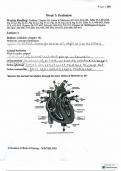
*Review the normal circulation through the heart Linton & Matteson p. 617
From Hediny 8. The Aunas body @ heah and ness, o4 4, 8 Lova, 2011, Seunders.
© Hondros College of Nursing - WINTER 2025
i Scanned with !
k& CamScanner’;
, R RRARAARAARARARARRRRRARRRRRR
Page |104
NN
Risk factors:
List some individual risk factors that can cause impaired perfusion (Giddens p. 168; Table 18.1)
‘_ l(}(‘(_fi‘ TR \(\‘J‘“.‘B
_{)C_‘lfll_fl_&,_l.j_‘&l
Assessing systematically and comprehensively
History (subjective data)
o Nurses ask patients about present health history, past health history, * 430\- Al l ('f h.lu “/{r\lé
personal and psychosocial history.
List some questions to gather some data on your patient’s present health history.
1. Chest ‘\,u'l,
2. Loss of coned, dus
3. List 0f cuuvont necucahior S
s _oret S exerase
What are some cardiac symptoms a patient ma{y provide while you are collecting their history? Describe
each one liste¢
1. “pouvVL
2. 1055 & ConsCioudnese
3. A2 wvu s/ lidnthy adnses
**Review Nursing Assessment of Cardiovascular Function (Linton & Matteson, pg. 625)
Examination Findings (objective daia)
List some variations you may find when collecting vital signs:
P PP PR
hupo hupe rdension. bradycardia tachear dio
What areas of the body would you inspect when gathenng data about perfusion?
Sn, ¥LEAN ofDh |
e Palpate the OOU ool pulse at the point of maximal impulse (PMI) at the
Mc U indredostal. pacl midelavicular line.
14442800000
. Palpgte the upper and lower extremities for €d€M o , temperature, capillary
refill, and ey N
e Auscultation of the patient’s heart may reveal M ot MUY ¥
e Abnormal heart sounds typically heard are S 9 M NALLYS
© Hondros College of Nursing — WINTER 2025
Scanned with
/& CamScanner’;
, Page |105
e The S3 sound may be due to LLht Ventyiole, Overloaol &
o The S4 sound may be dueto _\ (.S Stonee Lo venmtulay
(VAT \ o (S o
)
Murmurs create a __[3) )\ (; sound which can indicate L L you (€ 4 blood
flow through the heart.
Review Box 33.1 Linton & Matteson p. 625 - Age-Related Changes
Review Box 33.2 Linton & Matteson p.626 — Assessment of patients with cardiovascular disorders
Diagnostic Tests and Procedures (Linton & Matteson, pg. 630-631)
Test Purpose & Patient Preparation Post Procedure Nursing
Procedure ¢ Care
Electrocardiogram L) Rf
g what to ‘RempeC el .
oudcet it
(ECG) Loty onl. expeet< proceauce eumao;é patdg
Qetivthjof [°Paintess i
hcout
-dctert abnorpal;
L1 €0
Echocardiogram |
aetcots vadve |
Oonorviad it el Mo'{;pgu'o,(/f 'Rfmou‘l’_%u pront
L&b:x"‘fm ‘pfiqt‘—' puparahe_ din
Stress Test i
(Exercise Tolerance HDDd D‘('JSSU—LL 'hdUL pt wClL.L ;
Test [ETT]) 1 monctoud [0S Clothedt No epecial
comfortablc shoes | care w0 nuded
Gardiae POSSEsthin, o 3] [1assess ppo adlergres o
| ‘Cneck punctunt
Catheterization vein or or Y|to Seaforod or wc\w. site ¢
dye s tnjeeted” INPO v finee bt | . anonator wial
proceduac ol ghs
© Hondros College of Nursing — WINTER 2025
i Scanned with
& CamScanner’;
Week 7: Perfusion
Weekly Reading: Giddens: Chapter 18; Linton & Matteson: 617-621, 624-628, Table 33.3,634-635,
Fig 33.12, Fig 33.13, Fig 33.14, Fig 33.15, Fig 33.16, Fig 33.18, Fig 33.19, Table 33.5, 640-643, Table
33.9, 652-654, Chapter 34, 677-691; Silvestri: 694-714; 718-723; Chapter 54; Willihnganz/Clayton:
353-362; 382-386, 397-406; 438-446; 448-450; 454-457; 458-460; 464-465
Lecture 1
Define: (Giddens chapter 18)
Define the concept of perfusion. . g . ,
::‘CU‘-* U ofyolood. throu Qi Qe (0 fi copiliou 1) oleltvin
Central Perfusion
What is cardiac output?
Cnioved 08 blepd thCheat uo L be
‘lg)f‘figgfrei‘oad Qrnatinnt ok lotooct wo heots wantyeles b,blé*i_
ey Yo
Define afterload ‘L\IO‘\(‘.(, dht hoeott must evoyropreto QueQ et
Define contractility k{xjm. ce 08dre hoaybo st Contan e hon
*Review the normal circulation through the heart Linton & Matteson p. 617
From Hediny 8. The Aunas body @ heah and ness, o4 4, 8 Lova, 2011, Seunders.
© Hondros College of Nursing - WINTER 2025
i Scanned with !
k& CamScanner’;
, R RRARAARAARARARARRRRRARRRRRR
Page |104
NN
Risk factors:
List some individual risk factors that can cause impaired perfusion (Giddens p. 168; Table 18.1)
‘_ l(}(‘(_fi‘ TR \(\‘J‘“.‘B
_{)C_‘lfll_fl_&,_l.j_‘&l
Assessing systematically and comprehensively
History (subjective data)
o Nurses ask patients about present health history, past health history, * 430\- Al l ('f h.lu “/{r\lé
personal and psychosocial history.
List some questions to gather some data on your patient’s present health history.
1. Chest ‘\,u'l,
2. Loss of coned, dus
3. List 0f cuuvont necucahior S
s _oret S exerase
What are some cardiac symptoms a patient ma{y provide while you are collecting their history? Describe
each one liste¢
1. “pouvVL
2. 1055 & ConsCioudnese
3. A2 wvu s/ lidnthy adnses
**Review Nursing Assessment of Cardiovascular Function (Linton & Matteson, pg. 625)
Examination Findings (objective daia)
List some variations you may find when collecting vital signs:
P PP PR
hupo hupe rdension. bradycardia tachear dio
What areas of the body would you inspect when gathenng data about perfusion?
Sn, ¥LEAN ofDh |
e Palpate the OOU ool pulse at the point of maximal impulse (PMI) at the
Mc U indredostal. pacl midelavicular line.
14442800000
. Palpgte the upper and lower extremities for €d€M o , temperature, capillary
refill, and ey N
e Auscultation of the patient’s heart may reveal M ot MUY ¥
e Abnormal heart sounds typically heard are S 9 M NALLYS
© Hondros College of Nursing — WINTER 2025
Scanned with
/& CamScanner’;
, Page |105
e The S3 sound may be due to LLht Ventyiole, Overloaol &
o The S4 sound may be dueto _\ (.S Stonee Lo venmtulay
(VAT \ o (S o
)
Murmurs create a __[3) )\ (; sound which can indicate L L you (€ 4 blood
flow through the heart.
Review Box 33.1 Linton & Matteson p. 625 - Age-Related Changes
Review Box 33.2 Linton & Matteson p.626 — Assessment of patients with cardiovascular disorders
Diagnostic Tests and Procedures (Linton & Matteson, pg. 630-631)
Test Purpose & Patient Preparation Post Procedure Nursing
Procedure ¢ Care
Electrocardiogram L) Rf
g what to ‘RempeC el .
oudcet it
(ECG) Loty onl. expeet< proceauce eumao;é patdg
Qetivthjof [°Paintess i
hcout
-dctert abnorpal;
L1 €0
Echocardiogram |
aetcots vadve |
Oonorviad it el Mo'{;pgu'o,(/f 'Rfmou‘l’_%u pront
L&b:x"‘fm ‘pfiqt‘—' puparahe_ din
Stress Test i
(Exercise Tolerance HDDd D‘('JSSU—LL 'hdUL pt wClL.L ;
Test [ETT]) 1 monctoud [0S Clothedt No epecial
comfortablc shoes | care w0 nuded
Gardiae POSSEsthin, o 3] [1assess ppo adlergres o
| ‘Cneck punctunt
Catheterization vein or or Y|to Seaforod or wc\w. site ¢
dye s tnjeeted” INPO v finee bt | . anonator wial
proceduac ol ghs
© Hondros College of Nursing — WINTER 2025
i Scanned with
& CamScanner’;