

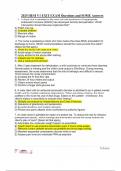
2025 HESI V1 EXIT EXAM Questions and SOME Answers
1. A client who is admitted to the care unit with syndrome of inappropriate antidiuretic hormone (SIADH) has developed osmotic demyelination. Which intervention should thenurse implement first? A) Patch one eye. B) Evaluate swallow. C) Reorient often. D) Range of motion. 2. The nurse is preparing a client who had a below-the-knee (BKA) amputation for discharge to home. Which recommendations should the nurse provide this client? (Select all that apply) A) Wash the stump with soap and water. B) Avoid range of motion exercise. C) Apply alcohol to the stump after bathing. D) Inspect skin for redness. E) Use a residual limb shrinker. 3. After 2 days treatment for dehydration, a child continues to vomit and have diarrhea. Normal saline is infusing and the child’s urine output is 50ml/hour. During morning assessment, the nurse determines that the child is lethargic and difficult to arouse. Which should the nurse implemented? A) Increase the IV fluid flow rate. B) Review 24 hour intake and output. C) Obtain arterial blood gases. D) Perform a finger stick glucose test. 6. A male client with an antisocial personality disorder is admitted to an in patient mental health unit for multiple substance dependency. When providing a history, the client justifies to the nurse his use of illicit drugs. Based on this pattern of behavior, this client’s history is most likely to include which finding? A) Multiple convictions for misdemeanors and Class B felonies B) Delusions of grandiosity and persecution. C) Suicidal ideations and multiple attempts. D) Photos and panic attacks when confronted by authority figures. 7. An older client is admitted for repair of a broken hip. To reduce the risk for infection postoperative period., which nursing care intervention should the nurse include the client’s plan of care? (Select all that apply) A) Administer low molecular weight heparin as prescribed. B) Teach client to use incentive spirometer every 2 hours while awake. C) Remove urinary catheter as soon as possible and encourage voiding. D) Maintain sequential compression devices while in bed. E) Assess pain level and medicate PRN as prescribe lOMoAR cPSD| 2 | P a g e 9. A client with arthritis has been receiving treatment with naproxen and now reports ongoing stomach pain, increasing weakness, and fatigue. Which laboratory test should the nurse monitor? A) Serum Calcium. B) Erythrocyte sedimentation rate. C) Osmolality. D) Hemoglobin. 10. A client with bacterial meningitis is receiving phenytoin. Which assessment finding indication to the nurse that the client is experiencing a therapeutic response to the phenytoin? A) Increased time of ambulation between periods of rest. B) Decrease in intracranial pressure and cerebral edema. C) Absence of seizure activity for the duration of treatment. D) Normal electroencephalogram after drug administration. 11. A client peptic ulcer disease receives a prescription for intermittent suction via a SalemSump nasogastric tube (NGT). After inserting the NGT and obtaining coffee- ground gastric contents, the nurse clamps the NGT because the client must leave the unit for diagnostic studies. Upon return to the unit, the client complains of nausea. What action should the nurse implement first? A) Administering a prescribed antiemetic agent. B) Provide oral suction using a Yankauer tip. C) Connect the NGT to low intermittent suction. D) Irrigate the NGT with sterile normal saline. 12. The healthcare provider prescribes a fluid challenge of 0.9% sodium chloride 1,000 ml to be influenced over 4 hours. The IV administration set delivers 10 gtt/ml. How many gtt/minute should the nurse regulate the infusion? ( round the nearest whole number.) 13. A family member reports that the client who is bedridden has not been turned or repositioned all night and is sleeping on a special air mattress with no sheets. What information should the nurse provide to the family member? A) Clarify that an aerated support surface does not use sheets that often cause skinbreakdown. B) Described the night staff’s plan of care to ensure the client’s sleep is not disturbed. C) Explained that turning is only necessary to reposition the client during waking hours. D) Suggest that a family member turn the client during the night when someone is there. 15. A client with bleeding esophageal varies receives vasopressin IV. What should the nurse monitor for during the IV infusion of this medication? A) Vasodilation of the extremities. B) Chest pain and dysrhythmia. C) Hypotension and tachycardia. D) Decreasing GI cramping and nausea. lOMoAR cPSD| 3 | P a g e 16. The healthcare provider prescribes potassium chloride 25 mEq in 500ml D5W to infuse over 6 hours. The available 20ml vial of potassium chloride is labeled, “How many ml of potassium chloride should the nurse add to the IV fluid? (Round to the nearest tenth.) • Rationale: Using the formula D / H X Q: 25 mEq / 10 mEq x 5ml ꞊12.5ml 17. A male client reports to the on-call clinic nurse that he took tadalif 10 mg PO two hours age and his skin now feels flushed. He reports a history of stable angina, but denies experiencing any current or recent chest pain. What action should the nurse take? A) Tell the client to have someone bring him to an emergency department immediately. B) Advise the client to place one nitroglycerin tablet under his tongue as a precaution. C) Reassure the client that skin flushing is a common side effect of the medication. D) Instruct the client to increase his intake of oral until the skin flushing is relieved. 18. The nurse is performing a peritoneal dialysis exchange on a client with chronic kidney disease (CKD). Which assessment finding should the nurse report to the healthcare provider? A) The client complains of abdominal fullness and cramping during installation. B) The client complains of a slight shortness of breath during installation. C) The amount of the returning dialysis fluid is greater than the amount instilled. D) The appearance of the returning dialysate fluid is cloudy. 19. The healthcare provider prescribed furosemide for a 4-year old child who has a ventricular septal defect. Which outcome indicates to the nurse that this pharmacological intervention was effective? A) Urine specific gravity change from 1.021 to 1.031 B) Daily weight decrease of 2 pounds (0.9 kg) C) Urinary output decrease of 5 ml/hour. D) Blood urea nitrogen (BUN) increase from 8 to 12 mg/dl (2.9 to 4.3) 20. The nurse is preparing to administer an oral antibiotic to a client with unilateral weakness, ptosis, mouth drooping, and aspiration pneumonia. What is the priority nursing assessment that should be done before administering this medication? A) Ask the client about soft food preferences. B) Determine which side of the body is weak. C) Obtain and record the client’s vital signs. D) Auscultate the client’s breath sounds. 21. The nurse is demonstrating correct transfer procedures to the unlicensed assistance personnel (UAP) working on a rehabilitation unit. The UAP asks the nurse how to safely move a physically disabled client from the wheelchair to a bed. What action the nurse recommend? A) Apply a gait belt around the client’s waist once a standing position has been assumed. lOMoAR cPSD| 4 | P a g e B) Pull the client into position by reaching from the opposite side of the bed. lOMoAR cPSD| 5 | P a g e C) Hold the client at arm’s length while transferring to better distribute the body weight. D) Place the client’s locked wheelchair on the client’s strong side next the bed. 22. A young adult woman visits the clinic and learns that she is positive for BRCA1 gene mutation and asks the nurse what to expect next. How should the nurse respond? A) Provide information about survival rates women who have this genetic mutation. B) Gather additional information about the client’s family history for all types of cancer. C) Offer assurance that there are a variety of effective treatments for breast cancer. D) Explain that counseling will be provided to give her information about her cancer risk. 23. The nurse is supervising an unlicensed assistive personnel (UAP) who will be providing personal care for a client with watery diarrhea caused by Clostridium difficile. Which action by the nurse takes priority? A) Remind the UAP to keep the client’s water pitcher filled. B) Review use of personal protective equipment with the UAP. C) Provide barrier cream for application to the perineal area. D) Instruct the UAP to record the number of bowel movements. 24. The nurse enters the room of a client who is awaiting surgery for appendicitis. The unlicensed assistive personnel (UAP) has helped the client to a position of comfort with the right leg flexed and has applied a heating pad to the client’s abdomen to relieve the client’s pain. Which action should the nurse implement first? A) Determine if the consent form has been signed by the client. B) Remove the heating pad from the client’s abdominal area. C) Confirm that the UAP has assisted the client to a position of comfort. D) Evaluate the effectiveness of the heating pad in relieving pain. 25. The nurse completed a dressing change for a client with partial thickness burns to both legs. After completing the dressing change, What intervention should the nurse implement? A) Administer a PRN dose of pain medication. B) Raise this head of bed to a 90 angle. C) Perform passive range of motion. D) Position ankles in a dorsiflexed position. 26. A client is admitted to a medical unit with a diagnosis of gastritis and chronic heavy alcohol abuse. What should the nurse administer to prevent the development of Wernicke’s syndrome? A) Atenolol. B) Famotidine. C) Thiamine. D) Lorazepam. 27. Following laser trabeculoplasty surgery for open-angle glaucoma, the client reports acute pain deep within the eye. What action should the nurse take? A) Apply bilateral eye shields to reduce photosensitivity. B) Begin postoperative prophylactic antibiotics.
Document information
- Uploaded on
- May 29, 2025
- Number of pages
- 16
- Written in
- 2024/2025
- Type
- Exam (elaborations)
- Contains
- Questions & answers


