

EST MODULATION SET 3 (201 - 300) Questions with complete solutio
2025
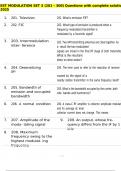
1. 201. Television 201. What is emission F3F?
2. 202. F3C 202. What type of emission is produced when a
frequency modulated transmitter is
modulated by a facsimile signal?
3. 203. Intermodulation 203. Two AM transmitting antennas are close together. As
inter- ference a result the two modulated
signals are mixed in the final RF stage of both transmitter
What is the resultant
ettect on other station?
4. 204. Desensitizing 204. The term used to refer to the reduction of receiver
gain
caused by the signal of a
nearby station transmitter in the same frequency band?
5. 205. Bandwidth of 205. What is the bandwidth occupied by the carrier, both
emission and occupied side- bands and harmonics?
bandwidth
6. 206. A normal condition 206. A class-C RF amplifier is collector amplitude modulat
and its average dc level
collector current does not change. This means
7. 207. Amplitude of the 9. 209. An output, whose fre-
modu- lating signal quency differs from the IF by 1
kHz
8. 208. Maximum
frequency swing to the
highest modulat- ing
frequency
,EST MODULATION SET 3 (201 - 300) Questions with complete solutio
2025
207. What determines the
percentage modulation of an FM
transmitter?
209. The main purpose of the beat frequency
208. Deviation ratio of an FM transmitter oscillator (BFO) is to generate
is the ratio of the
,EST MODULATION SET 3 (201 - 300) Questions with complete solutio
2025
10. 210. Projected cut-off 210. Normally, a linear class BRF power amplifier operate
with
a bias
approximately
equal to
11. 211. Amplify of an AM signal 211. The purpose why an RF amplifier is operated
under linear
class-B conditions (as
opposed to class-C) is to
12. 212. Cross-modulation 212. The term used to refer to the condition where the
inter- ference signal from a very strong
station are superimposed on other signal being received
13. 213. Peak negative voltage 213. is the amplitude of the maximum negative
excursion of a signal as
viewed on an
oscilloscope.
14. 214. FM and double sideband 214. The type of emission that sutter most from
selective fad-
AM ing.
15. 215. Percentage of 215. In an FM-phone signal, is the ratio between
modula- tion the actual frequency
deviation to the maximum frequency deviation.
16. 216. Capture effect 216. is used to refer to the reception blockage of
one
FM-phone signal by
another FM-phone signal.
17. 217. Double-sideband AM 217. A receiver selectivity of 10 kHz in the IF circuitry is
2025
1. 201. Television 201. What is emission F3F?
2. 202. F3C 202. What type of emission is produced when a
frequency modulated transmitter is
modulated by a facsimile signal?
3. 203. Intermodulation 203. Two AM transmitting antennas are close together. As
inter- ference a result the two modulated
signals are mixed in the final RF stage of both transmitter
What is the resultant
ettect on other station?
4. 204. Desensitizing 204. The term used to refer to the reduction of receiver
gain
caused by the signal of a
nearby station transmitter in the same frequency band?
5. 205. Bandwidth of 205. What is the bandwidth occupied by the carrier, both
emission and occupied side- bands and harmonics?
bandwidth
6. 206. A normal condition 206. A class-C RF amplifier is collector amplitude modulat
and its average dc level
collector current does not change. This means
7. 207. Amplitude of the 9. 209. An output, whose fre-
modu- lating signal quency differs from the IF by 1
kHz
8. 208. Maximum
frequency swing to the
highest modulat- ing
frequency
,EST MODULATION SET 3 (201 - 300) Questions with complete solutio
2025
207. What determines the
percentage modulation of an FM
transmitter?
209. The main purpose of the beat frequency
208. Deviation ratio of an FM transmitter oscillator (BFO) is to generate
is the ratio of the
,EST MODULATION SET 3 (201 - 300) Questions with complete solutio
2025
10. 210. Projected cut-off 210. Normally, a linear class BRF power amplifier operate
with
a bias
approximately
equal to
11. 211. Amplify of an AM signal 211. The purpose why an RF amplifier is operated
under linear
class-B conditions (as
opposed to class-C) is to
12. 212. Cross-modulation 212. The term used to refer to the condition where the
inter- ference signal from a very strong
station are superimposed on other signal being received
13. 213. Peak negative voltage 213. is the amplitude of the maximum negative
excursion of a signal as
viewed on an
oscilloscope.
14. 214. FM and double sideband 214. The type of emission that sutter most from
selective fad-
AM ing.
15. 215. Percentage of 215. In an FM-phone signal, is the ratio between
modula- tion the actual frequency
deviation to the maximum frequency deviation.
16. 216. Capture effect 216. is used to refer to the reception blockage of
one
FM-phone signal by
another FM-phone signal.
17. 217. Double-sideband AM 217. A receiver selectivity of 10 kHz in the IF circuitry is


