

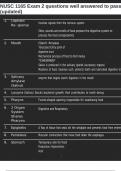
NUSC 1165 Exam 2 questions well answered to pass
(updated)
1. Cephalic
Involves signals from the nervous system
Re- sponse
Sites, sounds and smells of food prepare the digestive system to
process the food components
2. Mouth (Starch ’Amylase
’Glucose) Entry point of
digestive tract
Mechanical process of food to form bolus
*CHEWING*
Saliva is produced in the salivary glands (accessory organs)
Mositens of food, cleanses outh, protects teeth and lubricated digestive tra
3. Salivary enzyme that begins starch digestion in the mouth
Amylase
(Saliva)
4. Lysozyme (Saliva) blocks bacterial growth that contributes to tooth decay
5. Pharynx Funnel-shaped opening responsible for swallowing food
6. 2 Organ Digestive and Respiratory
System
Shares
Pharynx
7. Epiglottis A flap of tissue that seals ott the windpipe and prevents food from enterin
8. Peristalsis Muscular contractions that move food down the esophagus
9. Stomach Temporary site for food
Production: Hydrochloric
Acid
1/
43
,NUSC 1165 Exam 2 questions well answered to pass
(updated)
10. Stomach Wall Composed of thick muscles that contract to mix food
Longitudinal, circular and diagonal
11. Comprised of bolus and hydrochloric acid (remains in stomach for 2-6
hours)
2/
43
,NUSC 1165 Exam 2 questions well answered to pass
(updated)
Chyme (Stom- 19. Lacteals (Small Intestine)
ach)
20. Capillaries (Small Intestine)
12. Role of Hy-
drochloric
Acid (HCl) in
Pepsin
Activation
13. Role of
Gastrin
Hormone
14. Factors that
Con- tribute to
Stom- ach
Emptying Rate
15. Segmentation
in the Small
Intes- tine
16. Peristalsis in
the Small
Intestine
17. Villi (Small
Intes- tine)
18. Microvilli
(Small
Intestine)
3/
43
, NUSC 1165 Exam 2 questions well answered to pass
(updated)
Fingerlike projections participate in digestion and absorption of nutrients
reates the pH required for
Covers the villi and increases the surface area of the small intestine
activity, it releases its ions
and when pepsinogen mixes
in the gastric juice, pepsin Small lymph vessel in the small intestine, vessels that handle the transport of lipid
takes form. digestion products
Vessels located in the villi, transports amino acids, sugars and water-soluble
nutrients
rin is peptide hormone
responsible for enhancing
mucosal growth, mobility and
secretion of HCl in the
stomach
olality, exercise intensity, Meal
volume, temperature,
fat/protein, particle size and
dietary fiber
ontal muscular contractions within
the small intestine
cal muscular contractions
ls the chyme from the stomach
into the small intestine
4/
43
(updated)
1. Cephalic
Involves signals from the nervous system
Re- sponse
Sites, sounds and smells of food prepare the digestive system to
process the food components
2. Mouth (Starch ’Amylase
’Glucose) Entry point of
digestive tract
Mechanical process of food to form bolus
*CHEWING*
Saliva is produced in the salivary glands (accessory organs)
Mositens of food, cleanses outh, protects teeth and lubricated digestive tra
3. Salivary enzyme that begins starch digestion in the mouth
Amylase
(Saliva)
4. Lysozyme (Saliva) blocks bacterial growth that contributes to tooth decay
5. Pharynx Funnel-shaped opening responsible for swallowing food
6. 2 Organ Digestive and Respiratory
System
Shares
Pharynx
7. Epiglottis A flap of tissue that seals ott the windpipe and prevents food from enterin
8. Peristalsis Muscular contractions that move food down the esophagus
9. Stomach Temporary site for food
Production: Hydrochloric
Acid
1/
43
,NUSC 1165 Exam 2 questions well answered to pass
(updated)
10. Stomach Wall Composed of thick muscles that contract to mix food
Longitudinal, circular and diagonal
11. Comprised of bolus and hydrochloric acid (remains in stomach for 2-6
hours)
2/
43
,NUSC 1165 Exam 2 questions well answered to pass
(updated)
Chyme (Stom- 19. Lacteals (Small Intestine)
ach)
20. Capillaries (Small Intestine)
12. Role of Hy-
drochloric
Acid (HCl) in
Pepsin
Activation
13. Role of
Gastrin
Hormone
14. Factors that
Con- tribute to
Stom- ach
Emptying Rate
15. Segmentation
in the Small
Intes- tine
16. Peristalsis in
the Small
Intestine
17. Villi (Small
Intes- tine)
18. Microvilli
(Small
Intestine)
3/
43
, NUSC 1165 Exam 2 questions well answered to pass
(updated)
Fingerlike projections participate in digestion and absorption of nutrients
reates the pH required for
Covers the villi and increases the surface area of the small intestine
activity, it releases its ions
and when pepsinogen mixes
in the gastric juice, pepsin Small lymph vessel in the small intestine, vessels that handle the transport of lipid
takes form. digestion products
Vessels located in the villi, transports amino acids, sugars and water-soluble
nutrients
rin is peptide hormone
responsible for enhancing
mucosal growth, mobility and
secretion of HCl in the
stomach
olality, exercise intensity, Meal
volume, temperature,
fat/protein, particle size and
dietary fiber
ontal muscular contractions within
the small intestine
cal muscular contractions
ls the chyme from the stomach
into the small intestine
4/
43


