

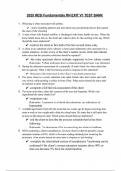
2025 HESI Fundamentals RN EXIT V1 TEST BANK
1. Wheezing is often associated with asthma - assess breathing patterns and learn about any precipitating factors that caused the onset of the wheezing 2. A male client with limited mobility is discharged with home health services. When the home health nurse arrives, the client asks what he does for the swelling in his leg. Which should the nurse implement? -instruct the client to flex both of his feet several times a day 3. A client at an outpatient clinic submits a clean-catch midstream urine specimen for a routine urinalysis. In later review of the client’s medical record, which data indicates tothe nurse that the specimen collection should be repeated? -the urine specimen shows multiple organisms in low colony counts Rationale: *often indicates that a contaminated specimen was obtained 4. During the admission assessment of a terminally ill male client, the client states that heis an agnostic. What is the best nursing action in response to this statement? -document the statement in the client’s spiritual assessment 5. The nurse observes a newly admitted older adult female take short stems and walk very slowly while pushing a walker in front of her. What action should the nurse take in response to these observations? -complete a full fall risk assessment of the client 6. The nurse notes that a client has cyanosis of the toes and fingertips. Which vital signsshould the nurse obtain first? -respiratory rate Rationale: *cyanosis is a bluish discoloration, an indication of hypoxemia 7. A middle-aged male client tells the nurse that two weeks ago he began exercising four times a week to lose weight and to help him sleep better. He states that it still takes him an hour to fall asleep at night. Which action should thenurse implement? -ask the client to describe the exercise schedule that he has been following Rationale: *to determine if he is exercising too close to bedtime 8. While suctioning a client's nasopharynx, the nurse observes that the patient's oxygen saturation remains at 94%, which is the same reading obtained prior tostarting the procedure. What action should the nurse take in response to this finding? -complete the intermittent suction of nasopharynx *suctioning can be continued if the client’s oxygen saturation remains above 90% or does not decrease 5% from the initial baseline lOMoAR cPSD| 9. An older male client returns to the clinic for chronic pain management after taking morphine sulfate (MS Contin) 25 mg every 12 hours. He states he took the medication only when the pain was too severe to sleep. What action should the nurse implement? -instruct the client to take the MS Contin every 12 hours as prescribed 10. A female unlicensed assistive personnel (UAP) is assigned to take the vital signs of a client with pertussis for whom droplet precautions have been implemented. The UAP requests a change in assignment, stating she has not yet been fitted fora particulate filter mask. What action should the nurse take first? -instruct the UAP that a standard face mask is sufficient for the provision of care for the assigned client Rationale: *a particulate filter mask is indicated for clients with airborne precautions 11. The community health nurse is making a home visit when the client, who is sitting at thekitchen table, begins to have a seizure. What action should the nurse take first? -assist the client to the floor 12. A client is in contact isolation due to a stage IV coccyx wound infected with methicillin resistant staphylococcus aureus (MRSA). The nurse plans interventions to prevent multiple re-entries to the client’s room. In which order should the nurse perform the interventions? -restart the IV, perform tracheostomy care, change the coccyx dressing 13. A client who has been taking diuretics for premenstrual swelling reports muscle weakness. Which serum electrolyte value should the nurse report to the healthcare provider? -Potassium 3.1 mEq/L (3.1 mmol/L) 14. A client diagnosed with primary open-angle glaucoma received a prescription formiotic eye drops, pilocarpine HCl (Pilocarpine). What instructions should the nurse plan to include in the client’s teaching? - “do not allow the dropper bottle to touch the eye” 15. *Sleeping side lying with hips and knees flexed prevents unnecessary pressure on support muscles, ligaments, and lumbosacral joints and reduces low backpain 16. *Obesity a BMI greater than 30 17. *Hygiene self-care deficit evaluate the client’s participation in self-care to optimal level of capacity isthe best goal to evaluate progress in recovery lOMoAR cPSD| 18. The unlicensed assistive personnel (UAP) describes the appearance of the bowel movement s of several clients. Which descriptions warrant additional follow-up by the nurse? -multiple hard pellets, tarry appearance, and brown liquid 19. A client with a gastronomy tube is recovering a continuous feeding, and the nurse suspects that the client has aspirated some of the feeding. What is the action by thenurse? -stop the tube feeding and assess the client 20. *it is the best response for the nurse to provide a response that reflects what the clientstated and confirms their condition is serious. 21. The nurse is caring for a male client with diminished circulation in the lower extremities. The client washes his feet in the shower, but is unable to bend safely to dry his feet. While drying the client’s feet, the nurse should emphasize the need to thoroughly dry which area of the feet? -between the toes 22. When performing blood pressure measurement to assess for orthostatic hypotension, which action should the nurse implement first? -position the client supine for a few minutes 23. A client who lives in an assisted living facility develops cognitive impairment following a stroke. Informed consent is needed to provide additional nursing services. Who should the nurse contact? -a daughter-in-law designated as the client’s Durable Power of Attorney (DPOA) 24. A 24-hour urine specimen is being collected for analysis of creatinine clearance. After explaining the procedure, the client tells the nurse that the first sample is in the urinal. When discarding this specimen, what action should the nurse take? -check the sample’s pH and specific gravity 25. A client has begun a long-term maintenance therapy with lithium, which has a narrow therapeutic index. Which adverse effect is most important for nurse to include in the teaching plan? -toxicity 26. A postoperative client has three different PRN analgesics prescribed for different levelsof pain. The nurse inadvertently administers a dose that is not within the prescribed parameters. What action should the nurse take first? -assess for side effects/adverse effects of the medication 27. Which landmarks are useful to the nurse when administering an intramuscular injection in the ventrogluteal site? -the greater trochanter and anterior superior iliac spine lOMoAR cPSD| 28. To assess the quality of an adult client’s pain, what approach should the nurse use? -ask the client to describe the pain 29. The home health nurse is reviewing the personal care needs of an elderly client who lives alone. Which client assessment findings indicate the need to assign an unlicensedassistive personnel (UAP) to provide routine foot care and file the client’s toenails? (Select all that apply) -diminished visual activity syncope (dizziness) when bending hand tremors 30. The nurse measures the client’s blood pressure (PB) and notes that it is significantly higher than the previous reading. What should the nurse do next?(Select all that apply) -retake the client’s blood pressure in the opposite arm, determine the client’s activity and feeling prior to the BP measurement 31. A male Native American presents to the clinic with complaints of frequent abdominal cramping and nausea. He states that he has chronic constipation andhad not had a bowel movement in five days, despite trying several home remedies. Which intervention is most important for the nurse to implement? assess for the presence of an impaction Rationale: *it is common for cultures, such as Native Americans, to believe in using home remedies and herbs before seeking medical attention. The herbalremedies used for constipation and nausea 32. A client is admitted with pneumonia and has a recent history of methicillin-resistant Staphylococcus aureus (MRSA). The client is placed inisolation. While caring for the client, which item should the nurse place in adesignated biohazard bag before it is removed from the room? -paper mask and gown 33. The home care nurse is teaching a client how to change the dressing on a new venous stasis ulcer. The client has a history of deep vein thrombosis and is allergic to latex. When removing the adhesive bandages, the nurse observes skinredness surrounding the dressing wound. What action should the nurse implement? -replace dressing with cotton pads and silk tape Rationale: *the skin redness surrounding the wound may be due to latex inthe adhesive bandages, so the bandage should be replaced withnon-latexdressing, such as cotton pads and silk tape. A culture is not indicated. A topical antibiotic ointment may be used if the wound appears infected, but is not indicated for inflammatory redness created by the latex dressing. lOMoAR cPSD| Ankle-brachial pressure index compares the ratio of blood pressure inlower legs to blood pressure in arms and is used to assess circulationprior to applying compression stockings, which should not be applied since the client has an open wound. 34. An older woman with end stage heart disease is hospitalized for severe heartfailure. She is alert, oriented, and requests that no heroic measures are implemented if her breathing stops. What action should the nurse take firs? -discuss with the client her meaning of heroic measures 35. A male client has right-sided hemoglobin following a left cerebrovascular accident (CVA). His sitting balance has improved, and he is now able to sit in a wheelchair. To assist the client in transferring from the bed to a wheelchair, whataction should the nurse take? -place the wheelchair on the client’s left side 36. A nurse administers an opioid analgesic to a postoperative client who also hassevere obstructive sleep apnea (OSA). What intervention is most important forthe nurse to implement before leaving the client alone? -elevate the head of the bead to a 45-degree angle 37. While interviewing a client, the nurse records the assessment in the electronichealth record. which statement is most accurate regarding electronic documentation during an interview a - the client's comfort level is increased when the nurse breaks eyecontact to type notes into the record b - the interview process is enhanced with electronic documentationand allow the client to speak at a normal pace c - completing the electronic record during the interview is a legal obligation of the examining nurse d- the nurse has limited ability to observe nonverbal communicationwhile entering the assessment electronically 38. The nurse observes that there are reddened areas on the cheekbones of a clientreceiving oxygen per nasal cannula at 3L/minute, and the client’s oxygen saturation level is 92%. What intervention should the nurse implement? -place padding around the cannula tubing *reddened areas on the cheekbones are the result of pressure from the cannula tubing. Paddingthe tubing of the nasal cannula helps reduce the excessive pressure 39. A client on a prescribed full liquid diet has a nursing diagnosis of “Risk for impaired skin integrity related to reduced oral intake”. What snack is best toprovide this client? a. beef broth, or chicken broth lOMoAR cPSD| b. purified lowfat milk lOMoAR cPSD| c. apple or grapefruit juice d. ensure, a liquid supplement 40.A client with limited tolerance for activity needs to walk in the hallway with assistance. Which instructions should the nurse give to the unlicensed assistivepersonnel (UAP) who is assisting with the client’s care? -measure the client’s vital signs before the client walks; report the onset of any dizziness or light headedness; offer to assist the client to void prior towalking in the hall Rationale: *assessment, including need for a gait belt, and teachingshould be performed by the nurse and not delegated to the UAP. 41. The nurse is caring for a hospitalized client who was placed in restraints due to confusion. The family removes the restraints while they are with the client. Whenthe family leaves, what action should the nurse take first? -Reassess the client to determine the need for continuing restraints. 42. While planning care for a client experiencing pain, which outcome statementshould the nurse include in the plan of care? -report a 5-point decrease on a 1 to 10 pain scale one hour after analgesia 43. The nurse is performing a routine dressing change for a client with a stage 3 pressure ulcer that is red with significant granulation. The wound has a gauzedressing covering the area. What action should the nurse implement? apply a hydrocolloidal gel (Duoderm) dressing 44. An older adult male client is admitted to the medical unit following a fall at home.When undressing him, the nurse notes that he is wearing an adult diaper and skin breakdown is obvious over his sacral area. What action should the nurse implement first? -complete a functional assessment of the client’s self-care abilities 45. A young male client with testicular cancer has a living will that describes his desire that no extraordinary measures he taken to save his life. The healthcareprovider knows the client has a good prognosis and refuses to write a “do not resuscitate” (DNR) prescription. What action should the nurse take? -initiate an ethics committee review of the case 46. A male client who had emergency gallbladder surgery yesterday is getting ready for discharge. The nurse knows that the client speaks very lOMoAR cPSD| little English. When teaching wound care, which method should the nurse use to evaluate the client’sunderstanding of self-care at home? -have the client demonstrate prescribed wound care 47. A female client’s significant other has been at her bedside providing reassurances and support for the past 3 days, as desired by the client. The client’s estranged husband arrives and demands that the significant other not be allowed to visit or be given condition updates. Which intervention should thenurse implement? -communicate the client’s wishes to all members of the multi-disciplinary team 1. When turning an immobile bedridden client without assistance, which action by the nurse best ensures client safety? A. Securely grasp the client's arm and leg. B. Put bed rails up on the side of bed opposite from the nurse. C. Correctly position and use a turn sheet. D. Lower the head of the client's bed slowly. Rationale: Because the nurse can only stand on one side of the bed, bed rails should be up on the opposite side to ensure that the client does not fall out of bed. Option A can cause client injury to the skin or joint. Options C and D are useful techniques while turning a client but have less priority in terms of safety than use of the bed rails. 2. The nurse identifies a potential for infection in a client with partial- thickness (second-degree) and full-thickness (third-degree) burns. What intervention has the highest priority in decreasing the client's risk of infection? A. Administration of plasma expanders B. Use of careful handwashing technique C. Application of a topical antibacterial cream D. Limiting visitors to the client with burns Rationale: Careful handwashing technique is the single most effective intervention for the prevention of contamination to all clients. Option A reverses the hypovolemia that initially accompanies burn trauma but is not related to decreasing the proliferation lOMoAR cPSD| of infective organisms. Options C and D are recommended by various burn centers as possible ways to reduce the chance of infection. Option B is a proven technique lOMoAR cPSD| to prevent infection. lOMoAR cPSD| 3. The nurse is aware that malnutrition is a common problem among clients served by a community health clinic for the homeless. Which laboratory value is the most reliable indicator of chronic protein malnutrition? A. Low serum albumin level B. Low serum transferrin level C. High hemoglobin level D. High cholesterol level Rationale: Long-term protein deficiency is required to cause significantly lowered serum albumin levels. Albumin is made by the liver only when adequate amounts of amino acids (from protein breakdown) are available. Albumin has a long half-life, so acute protein loss does not significantly alter serum levels. Option B is a serum protein with a half-life of only 8 to 10 days, so it will drop with an acute protein deficiency. Options C and D are not clinical measures of protein malnutrition. 4. In completing a client's preoperative routine, the nurse finds that the operative permit is not signed. The client begins to ask more questions about the surgical procedure. Which action should the nurse take next? A. Witness the client's signature to the permit. B. Answer the client's questions about the surgery. C. Inform the surgeon that the operative permit is not signed and the client has questions about the surgery. D. Reassure the client that the surgeon will answer any questions before the anesthesia is administered. Rationale: The surgeon should be informed immediately that the permit is not signed. It is the surgeon's responsibility to explain the procedure to the client and obtain the client's signature on the permit. Although the nurse can witness an operative permit, the procedure must first be explained by the health care provider or surgeon, including answering the client's questions. The client's questions should be addressed before the permit is signed. lOMoAR cPSD| 5. The nurse is assessing several clients prior to surgery. Which factor in a client's history poses the greatest threat for complications to occur during surgery? A. Taking birth control pills for the past 2 years B. Taking anticoagulants for the past year C. Recently completing antibiotic therapy D. Having taken laxatives PRN for the last 6 months Rationale: Anticoagulants increase the risk for bleeding during surgery, which can pose a threat for the development of surgical complications. The health care provider should be informed that the client is taking these drugs. Although clients who take birth control pills may be more susceptible to the development of thrombi, such problems usually occur postoperatively. A client with option C or D is at less of a surgical risk than with option B. 6. When assisting a client from the bed to a chair, which procedure is best for the nurse to follow? A. Place the chair parallel to the bed, with its back toward the head of the bed and assist the client in moving to the chair. B. With the nurse's feet spread apart and knees aligned with the client's knees, stand and pivot the client into the chair. C. Assist the client to a standing position by gently lifting upward, underneath the axillae. D. Stand beside the client, place the client's arms around the nurse's neck, and gently move the client to the chair. Rationale: Option B describes the correct positioning of the nurse and affords the nurse a wide base of support while stabilizing the client's knees when assisting to a standing position. The chair should be placed at a 45-degree angle to the bed, with the back of the chair toward the head of the bed. Clients should never be lifted under the axillae; this could damage nerves and strain the nurse's back. The client should be instructed to use the arms of the chair and should never place his or her arms lOMoAR cPSD| around the nurse's neck; this places undue stress on the nurse's neck and back and increases the risk for a fall. 7. Which step(s) should the nurse take when administering ear drops to an adult client? (Select all that apply.) A. Place the client in a side-lying position. B. Pull the auricle upward and outward. C. Hold the dropper 6 cm above the ear canal. D. Place a cotton ball into the inner canal. E. Pull the auricle down and back. Rationale: The correct answers (A and B) are the appropriate administration of ear drops. The dropper should be held 1 cm (½ inch) above the ear canal (C). A cotton ball should be placed in the outermost canal (D). The auricle is pulled down and back for a child younger than 3 years of age, but not an adult (E). 8. The nurse is instructing a client in the proper use of a metered-dose inhaler. Which instruction should the nurse provide the client to ensure the optimal benefits from the drug? A. "Fill your lungs with air through your mouth and then compress the inhaler." B. "Compress the inhaler while slowly breathing in through your mouth." C. "Compress the inhaler while inhaling quickly through your nose." D. "Exhale completely after compressing the inhaler and then inhale." Rationale: The medication should be inhaled through the mouth simultaneously with compression of the inhaler. This will facilitate the desired destination of the aerosol medication deep in the lungs for an optimal bronchodilation effect. Options A, C, and D do not allow for deep lung penetration lOMoAR cPSD| 9. A 20-year-old female client with a noticeable body odor has refused to shower for the last 3 days. She states, "I have been told that it is harmful to bathe during my period." Which action should the nurse take first? A. Accept and document the client's wish to refrain from bathing. B. Offer to give the client a bed bath, avoiding the perineal area. C. Obtain written brochures about menstruation to give to the client. D. Teach the importance of personal hygiene during menstruation with the client. Rationale: Because a shower is most beneficial for the client in terms of hygiene, the client should receive teaching first, respecting any personal beliefs such as cultural or spiritual values. After client teaching, the client may still choose option A or B. Brochures reinforce the teaching. 10. While reviewing the side effects of a newly prescribed medication, a 72-year- old client notes that one of the side effects is a reduction in sexual drive. Which is the best response by the nurse? A. "How will this affect your present sexual activity?" B. "How active is your current sex life?" C. "How has your sex life changed as you have become older?" D. "Tell me about your sexual needs as an older adult." Rationale: Option A offers an open-ended question most relevant to the client's statement. Option B does not offer the client the opportunity to express concerns. Options C and D are even less relevant to the client's statement. lOMoAR cPSD| 11. The nurse is using the Glasgow Coma Scale to perform a neurologic assessment. A comatose client winces and pulls away from a painful stimulus. Which action should the nurse take next? A. Document that the client responds to painful stimulus. B. Observe the client's response to verbal stimulation. C. Place the client on seizure precautions for 24 hours. D. Report decorticate posturing to the health care provider. Rationale: The client has demonstrated a purposeful response to pain, which should be documented as such. Response to painful stimulus is assessed after response to verbal stimulus, not before. There is no indication for placing the client on seizure precautions. Reporting decorticate posturing to the health care provider is nonpurposeful movement. 12. The nurse plans to administer diazepam, 4 mg IV push, to a client with severe anxiety. How many milliliters should the nurse administer? (Round to the nearest tenth.) A. 0.2 mL B. 0.8 mL C. 1.25 mL D. 2.0 mL Rationale: (1 mL × 4 mg)/5 mg = 0.8 mL lOMoAR cPSD| 13. The nurse prepares to insert a nasogastric tube in a client with hyperemesis who is awake and alert. Which intervention(s) is(are) correct? (Select all that apply.) A. Place the client in a high Fowler position. B. Help the client assume a left side-lying position. C. Measure the tube from the tip of the nose to the umbilicus. D. Instruct the client to swallow after the tube has passed the pharynx. E. Assist the client in extending the neck back so the tube may enter the larynx. Rationale: (A and D) are the correct steps to follow during nasogastric intubation. Only the unconscious or obtunded client should be placed in a left side-lying position (B). The tube should be measured from the tip of the nose to behind the ear and then from behind the ear to the xiphoid process (C). The neck should only be extended back prior to the tube passing the pharynx and then the client should be instructed to position the neck forward (E). 14. The nurse teaches the use of a gait belt to a male caregiver whose wife has right-sided weakness and needs assistance with ambulation. The caregiver performs a return demonstration of the skill. Which observation indicates that the caregiver has learned how to perform this procedure correctly? A. Standing on his wife's strong side, the caregiver is ready to hold the gait belt if any evidence of weakness is observed. B. Standing on his wife's weak side, the caregiver provides security by holding the gait belt from the back. C. Standing behind his wife, the caregiver provides balance by holding both sides of the gait belt. D. Standing slightly in front and to the right of his wife, the caregiver guides her forward by gently pulling on the gait belt. Rationale: His wife is most likely to lean toward the weak side and needs extra support on lOMoAR cPSD| that side and from the back to prevent falling. Options A, C, and D provide less security for her. 15. Which nursing diagnosis has the highest priority when planning care for a client with an indwelling urinary catheter?. A. Self-care deficit B. Functional incontinence C. Fluid volume deficit D. High risk for infection Rationale: Indwelling urinary catheters are a major source of infection. Options A and B are both problems that may require an indwelling catheter. Option C is not affected by an indwelling catheter 16. A client has a nursing diagnosis of Altered sleep patterns related to nocturia. Which client instruction is important for the nurse to provide? A. Decrease intake of fluids after the evening meal. B. Drink a glass of cranberry juice every day. C. Drink a glass of warm decaffeinated beverage at bedtime. D. Consult the health care provider about a sleeping pill. Rationale: Nocturia is urination during the night. Option A is helpful to decrease the production of urine, thus decreasing the need to void at night. Option B helps prevent bladder infections. Option C may promote sleep, but the fluid will contribute to nocturia. Option D may result in urinary incontinence if the client is sedated and does not awaken to void. 17. When performing sterile wound care in the acute care setting, the nurse obtains a bottle of normal saline from the bedside table that is labeled "opened" and dated 48 hours prior to the current date. Which is the best action for the nurse to take? A. Use the normal saline solution once more and then discard. B. Obtain a new sterile syringe to draw up the lOMoAR cPSD| labeled saline solution. C. Use the saline solution and then relabel the bottle with the current date. D. Discard the saline solution and obtain a new unopened bottle. Rationale: Solutions labeled as opened within 24 hours may be used for clean procedures, but only newly opened solutions are considered sterile. This solution is not newly opened and is out of date, so it should be discarded. Options A, B, and C describe incorrect procedures. 18. Based on the nursing diagnosis of risk for infection, which intervention is best for the nurse to implement when providing care for an older incontinent client? A. Maintain standard precautions. B. Initiate contact isolation measures. C. Insert an indwelling urinary catheter. D. Instruct client in the use of adult diapers. Rationale: The best action to decrease the risk of infection in vulnerable clients is handwashing. Option B is not necessary unless the client has an infection. Option C increases the risk of infection. Option D does not reduce the risk of infection. 19. When taking a client's blood pressure, the nurse is unable to distinguish the point at which the first sound was heard. Which is the best action for the nurse to take? A Deflate the cuff completely and immediately . reattempt the reading. B. Reinflate the cuff completely and leave it inflated for 90 to 110 seconds before taking the second reading. C. Deflate the cuff to zero and wait 30 to 60 seconds before reattempting the reading. D Document the exact level visualized on the . sphygmomanometer where the first fluctuation was seen. lOMoAR cPSD| Rationale: Deflating the cuff for 30 to 60 seconds allows blood flow to return to the extremity so that an accurate reading can be obtained on that extremity a second time. Option A could result in a falsely high reading. Option B reduces circulation, causes pain, and could alter the reading. Option D is not an accurate method of assessing blood pressure. 20. A client's blood pressure reading is 156/94 mm Hg. Which action should the nurse take first? A. Tell the client that the blood pressure is high and that the reading needs to be verified by another nurse. B. Contact the health care provider to report the reading and obtain a prescription for an antihypertensive medication. C. Replace the cuff with a larger one to ensure an ample fit for the client to increase arm comfort. D. Compare the current reading with the client's previously documented blood pressure readings. Rationale: Comparing this reading with previous readings will provide information about what is normal for this client; this action should be taken first. Option A might unnecessarily alarm the client. Option B is premature. Further assessment is needed to determine if the reading is abnormal for this client. Option C could falsely decrease the reading and is not the correct procedure for obtaining a blood pressure reading. 21. A nurse stops at a motor vehicle collision site to render aid until the emergency personnel arrive and applies pressure to a groin wound that is bleeding profusely. Later the client has to have the leg amputated and sues the nurse for malpractice. Which is the most likely outcome of this lawsuit? A. The Patient's Bill of Rights protects clients from malicious intents, so the nurse could lose the case. B. The lawsuit may be settled out of court, but the lOMoAR cPSD| nurse's license is likely to be revoked. C. There will be no judgment against the nurse, whose actions were protected under the Good Samaritan Act. D. The client will win because the four elements of negligence (duty, breach, causation, and damages) can be proved. Rationale: The Good Samaritan Act protects health care professionals who practice in good faith and provide reasonable care from malpractice claims, regardless of the client outcome. Although the Patient's Bill of Rights protects clients, this nurse is protected by the Good Samaritan Act. The state Board of Nursing has no reason to revoke a registered nurse's license unless there was evidence that actions taken in the emergency were not done in good faith or that reasonable care was not provided. All four elements of malpractice were not shown. 22. When the health care provider diagnoses metastatic cancer and recommends a gastrostomy for an older female client in stable condition, the son tells the nurse that his mother must not be told the reason for the surgery because she "can't handle" the cancer diagnosis. Which legal principle is the court most likely to uphold regarding this client's right to informed consent? A. The family can provide the consent required in this situation because the older adult is in no condition to make such decisions. B. Because the client is mentally incompetent, the son has the right to waive informed consent for her. C. The court will allow the health care provider to make the decision to withhold informed consent under therapeutic privilege. D. If informed consent is withheld from a client, health care providers could be found guilty of negligence. Rationale: Health care providers may be found guilty of negligence, specifically assault and battery, if they carry out a treatment without the client's consent. The client's condition is stable, so option A is not a valid rationale. Advanced age does not lOMoAR cPSD| automatically authorize the son to make all decisions for his mother, and there is no evidence that the client is mentally incompetent. Although option C may have been upheld in the past, when paternalistic medical practice was common, today's courts are unlikely to accept it 23. The nurse is obtaining a lie-sit-stand blood pressure reading on a client. Which action is most important for the nurse to implement? A. Stay with the client while the client is standing. B. Record the findings on the graphic sheet in the chart. C. Keep the blood pressure cuff on the same arm. D. Record changes in the client's pulse rate. Rationale: Although all these measures are important, option A is most important because it helps ensure client safety. Option B is necessary but does not have the priority of option A. Options C and D are important measures to ensure accuracy of the recording but are of less importance than providing client safety. 24. A client becomes angry while waiting for a supervised break to smoke a cigarette outside and states, "I want to go outside now and smoke. It takes forever to get anything done here!" Which intervention is best for the nurse to implement? A. Encourage the client to use a nicotine patch. B. Reassure the client that it is almost time for another break. C. Have the client leave the unit with another staff member. D. Review the schedule of outdoor breaks with the client. Rationale: The best nursing action is to review the schedule of outdoor breaks and provide concrete information about the schedule. Option A is contraindicated if the client wants to continue smoking. Option B is insufficient to encourage a trusting relationship with the client. Option C is preferential for this client only and is inconsistent with unit rules. 25. Which serum laboratory value should the nurse monitor carefully for a client who has a nasogastric (NG) tube to suction for the past week?
Document information
- Uploaded on
- May 28, 2025
- Number of pages
- 45
- Written in
- 2024/2025
- Type
- Exam (elaborations)
- Contains
- Questions & answers


