lOMoAR cPSD| 56342273
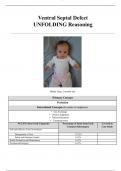
Ventral Septal Defect
UNFOLDING Reasoning
Mandy Gray, 2 months old
Primary Concept
Perfusion
Interrelated Concepts (In order of emphasis)
• Gas Exchange
• Clinical Judgment
• Patient Education
• Communication
NCLEX Client Need Categories Percentage of Items from Each Covered in
Category/Subcategory Case Study
Safe and Effective Care Environment
Management of Care 17-23%
Safety and Infection Control 9-15%
Health Promotion and Maintenance 6-12%
Psychosocial Integrity 6-12%
, lOMoAR cPSD| 56342273
Physiological Integrity
Basic Care and Comfort 6-12%
Pharmacological and Parenteral Therapies 12-18%
Reduction of Risk Potential 9-15%
Physiological Adaptation 11-17%
History of Present Problem:
Mandy Gray is a two-month-old infant born with a large ventricular septal defect (VSD) that was diagnosed by
her pediatrician during her two-week infant check-up. The parents called her pediatric cardiology clinic because
Mandy was breathing faster and showed signs of increased work of breathing. Her mother states that she is
having difficulty nursing because she tires easily and then becomes fussy and cries because she is hungry. Her
height and weight are below the 25th percentile (wt: 4.5 kg. ht: 54 cm). Her Mom reports that
Mandy’s weight has increased by 8 ounces (240 g) in the last 24 hours. Her pediatric cardiologist is concerned
about worsening heart failure and Mancy will be admitted with a diagnosis of acute heart failure.
Personal/Social History:
Mandy is the first child of Jim and Jessica who were married two years ago. They were both raised in the
Catholic faith but are not active in the church. Both parents seem anxious about their infant daughter but express
hopefulness about the surgery to correct the problem. The surgery is scheduled in four months. Her mother is an
RN who works in a dermatology clinic. Since Mandy’s birth, her mother has stayed home to care for Mandy
because she is too medically fragile to be cared for in a daycare setting. Both of Jim’s parents are deceased, and
Jessica’s parents live in another state.
What data from the histories are RELEVANT and must be interpreted as clinically significant by the nurse? (Reduction
of Risk Potential)
Ventral Septal Defect
UNFOLDING Reasoning
Mandy Gray, 2 months old
Primary Concept
Perfusion
Interrelated Concepts (In order of emphasis)
• Gas Exchange
• Clinical Judgment
• Patient Education
• Communication
NCLEX Client Need Categories Percentage of Items from Each Covered in
Category/Subcategory Case Study
Safe and Effective Care Environment
Management of Care 17-23%
Safety and Infection Control 9-15%
Health Promotion and Maintenance 6-12%
Psychosocial Integrity 6-12%
, lOMoAR cPSD| 56342273
Physiological Integrity
Basic Care and Comfort 6-12%
Pharmacological and Parenteral Therapies 12-18%
Reduction of Risk Potential 9-15%
Physiological Adaptation 11-17%
History of Present Problem:
Mandy Gray is a two-month-old infant born with a large ventricular septal defect (VSD) that was diagnosed by
her pediatrician during her two-week infant check-up. The parents called her pediatric cardiology clinic because
Mandy was breathing faster and showed signs of increased work of breathing. Her mother states that she is
having difficulty nursing because she tires easily and then becomes fussy and cries because she is hungry. Her
height and weight are below the 25th percentile (wt: 4.5 kg. ht: 54 cm). Her Mom reports that
Mandy’s weight has increased by 8 ounces (240 g) in the last 24 hours. Her pediatric cardiologist is concerned
about worsening heart failure and Mancy will be admitted with a diagnosis of acute heart failure.
Personal/Social History:
Mandy is the first child of Jim and Jessica who were married two years ago. They were both raised in the
Catholic faith but are not active in the church. Both parents seem anxious about their infant daughter but express
hopefulness about the surgery to correct the problem. The surgery is scheduled in four months. Her mother is an
RN who works in a dermatology clinic. Since Mandy’s birth, her mother has stayed home to care for Mandy
because she is too medically fragile to be cared for in a daycare setting. Both of Jim’s parents are deceased, and
Jessica’s parents live in another state.
What data from the histories are RELEVANT and must be interpreted as clinically significant by the nurse? (Reduction
of Risk Potential)