

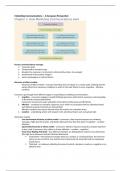
Marketing Communications – A European Perspective
Chapter 3. How Marketing Communications work
Process communications message:
o Consumer goals
o Characteristics of product type
o Situation the consumer is in (hurried or distracted by others, for example)
o Involvement in the product category
o Social, psychological or cultural factors
Hierarchy of effects models
- Hierarchy of effects models = assumes that things have to happen in a certain order, implying that the
earlier effects form necessary conditions in order for the later effects to occur (cognitive – affective –
conative).
Consumers go through three different stages in responding to marketing communications:
1. Cognitive – consumers engage in mental (thinking) processes which lead to awareness and knowledge
of the brand communicated (think)
Consumers may become aware and gather information continuously and effortlessly
2. Affective – emotional or evaluative responses occur which are associated with the advertised brand
and attitudes towards the brand are formed (feel)
Affective reactions may only be formed when the need for an evaluation arises.
3. Conative – undertaking actions with respect to the advertised brand, such as buying it (do)
Alternative models:
- Low-involvement hierarchy of effects model = consumers, after frequent exposure to marketing
massages, might buy the product, and decide afterwards how they feel about it (cognitive – conative –
affective).
- Experiential hierarchy of effects model = consumers’ affective responses towards a product lead them
to buy it and, if necessary, they reflect on it later (affective – conative – cognitive)
- Foote-Cone-Belding (FCB grid) = four different situations are distinguished, based on two dimensions
(the high-low involvement and the think-feel dimension).
Involvement = the importance people attach to a product or a buying decision, the extent to
which one has to think it over and the level of perceived risk associated with an inadequate
brand choice.
Think-feel = a continuum reflecting the extent to which a decision is made on a cognitive or an
affective basis
,Foote-Cone-Belding grid:
The Rossiter-Percy grid is alternative or modification of FCB grid.
- High & Low-involvement
- Transformational or informational buying motive
Transformational buying motives = positive motivations (sensory gratification, social approval
or intellectual stimulation) – products that give pleasure (ice cream, cosmetics and perfume)
Informational buying motives = reducing or reversing negative motivations such as solving or
avoiding a problem, or normal depletion – products are detergents (babies’ nappies and
insurance goods)
Hierarchy of effects models consider brand awareness as a prerequisite for brand attitude formation. They
correctly assume that affective responses cannot be formed or that a purchase cannot take place without
having an awareness of the brand.
Companies strive to reach top-of-mind awareness (TOMA) (= which brand is most salient within a product
category, first brand that comes to mind when thinking of a particular product category).
Shortcomings hierarchy models:
- No hierarchy of cognitive, affective and conative effects can be observed
- Hierarchy models do not allow interactions between the different stages
Attitude formations and change
- Attitude = person’s overall evaluation of an object, a product, a person, an organization, an ad, etc.
An attitude towards a particular brand (Ab) can be considered as a measure of how much a person likes or
dislikes the brand, or of the extent to which he or she holds a favorable or unfavorable view of it.
Brand attitudes is the belief that the more favorable brand attitudes are, the more likely a purchase of the
brand becomes. Brand attitudes can be changed over time.
1. Cognitive component = reflects knowledge, beliefs and evaluations of the object
2. Affective component = the feeling associated with the object
3. Behavioral component = action readiness (behavioral intentions) with respect to the object
,To change attitudes, marketers might concentrate on changing one of the three components. Communications
campaigns trying to influence the consumer on an affective basis often use emotional ads containing no or very
few product arguments.
These different communications models regarding attitude formation and attitude change can be classified in
two dimensions:
1. Way attitudes are formed – primarily cognitive, affective or behavioral
2. Level of elaboration of a message, or central-route versus peripheral-route processing – motivation,
ability and opportunity (MAO)
o Motivation = willingness to engage in behavior, make decisions, pay attention, process
information, etc. Is influenced by consumer needs and goals
Consumer needs (functional, symbolic or hedonic)
Functional needs = pertain to solving consumer problems
Symbolic needs = how we see ourselves and how we would like to be
perceived by others
Hedonic needs = reflect consumers’ desires for sensory pleasure
Needs/goals can be classified as approach or promotion goals, and avoidance or prevention goals.
The former pertain to positive outcomes while the latter relate to avoiding negative outcomes. When the
former are prevalent then marketing communications should bring a message focused on positive outcomes
(you feel excitement when driving this car), while for the latter goals a message should emphasize negative
outcomes (the excellent air bags will protect you during a crash).
o Ability = the resources needed to achieve a particular goal.
o Opportunity = the extent to which the situation enables a person to obtain the goal set.
MAO is presented in the Elaboration Likelihood Model (ELM):
If motivation, ability and opportunity are all high, the elaboration likelihood is said to be high and consumers
are expected to engage in central-route processing.
- Central-route processing = willing to elaborate on the information, to evaluate the arguments and find
out what the information really has to offer.
Depending on the quality and credibility of the arguments, consumers will react by producing counter-, support
or neutral arguments.
If one or more of the MAO factors is/are low, consumers are more likely to process the information peripherally.
- Peripherally = no real information processing, but an evaluation based on simple, peripheral cues
(background music, humor, number of arguments used).
, The reason why consumers start paying more attention to peripheral cues is that in many ads peripheral cues
form the only processable information under circumstances of low motivation, limited ability or limited
opportunity. Ads without attractive peripheral cues, but with an easy-to-process, product-related message,
might also work under low MAO, simply because the cognitive resources to form counter-arguments are
lacking.
ELM assume that under different MAO conditions, both rational arguments and affect may give rise to
peripheral and central processing.
It is not so much the MAO factors, but consumers’ goals that might determine whether consumers rely on the
substance of the message (i.e. the strength of the claims, the compelling Ness of the product attributes, etc.) to
form a judgement or on their affective responses (i.e. ad-evoked feelings, aesthetic of the product design,
charisma of the endorser, etc.). Research also shows that when individuals focus on ideals (promotion goals,
relating to one’s hopes, wishes and aspirations, such as dreaming of a nice house, an exotic holiday, etc.), they
consider affective information as more relevant than the substance of the message and, as a consequence, are
more likely to base their evaluation on affect. On the other hand, when consumers’ ‘thoughts’ (prevention
goals, relating to one’s duties, obligations and responsibilities, such as providing for a child’s education, looking
professional at work) are their driving goal, the opposite result is found.
Research insight:
A first study focused on anti-smoking campaigns. The results of an experiment with 256 student smokers
indeed indicated a congruency effect: smokers with a promotion focus felt more involved with the sadness–joy
than with the fear–relief campaign, leading to a more positive attitude towards the sadness–joy campaign than
towards the fear–relief campaign, and vice versa for smokers with a prevention focus. A second study focused
on sun protection campaigns, and 1386 women aged between 24 and 38 participated in the experiment. Also
here, an emotion–congruency trend appeared, but only for high users of sun beds. The conclusion of both
studies is that emotional health campaigns can work for promotion and prevention people on the condition
that the ad- evoked emotions match consumers’ regulatory focus and consumers feel highly and affectively
involved in the subject matter.
- Threat appeals = persuasive messages designed to scare people by describing the terrible things that
can happen to them if they do not do what the message recommends
- Advergames = computer games specifically created to function as advertisements to promote brands’,
containing brand identifiers such as logos and characters.
- Probability markers = specific words or phrases in advertising used to signal to what degree it is likely
that a given claim or argument is true.
- Hedges = markers that indicate the probable, rather than the absolute, truth of a claim. Hedges can be
adverbs, verbs, particles, or other expressions, weaken the impact of a claim by allowing for exceptions
or avoiding total commitment.
- Pledges = the markers that indicate complete commitment to the truthfulness of the claim. Pledges of
which also include some adverbs, verbs and other expressions, are absolute in nature and signal total
confidence in the truthfulness of the claim.
Chapter 3. How Marketing Communications work
Process communications message:
o Consumer goals
o Characteristics of product type
o Situation the consumer is in (hurried or distracted by others, for example)
o Involvement in the product category
o Social, psychological or cultural factors
Hierarchy of effects models
- Hierarchy of effects models = assumes that things have to happen in a certain order, implying that the
earlier effects form necessary conditions in order for the later effects to occur (cognitive – affective –
conative).
Consumers go through three different stages in responding to marketing communications:
1. Cognitive – consumers engage in mental (thinking) processes which lead to awareness and knowledge
of the brand communicated (think)
Consumers may become aware and gather information continuously and effortlessly
2. Affective – emotional or evaluative responses occur which are associated with the advertised brand
and attitudes towards the brand are formed (feel)
Affective reactions may only be formed when the need for an evaluation arises.
3. Conative – undertaking actions with respect to the advertised brand, such as buying it (do)
Alternative models:
- Low-involvement hierarchy of effects model = consumers, after frequent exposure to marketing
massages, might buy the product, and decide afterwards how they feel about it (cognitive – conative –
affective).
- Experiential hierarchy of effects model = consumers’ affective responses towards a product lead them
to buy it and, if necessary, they reflect on it later (affective – conative – cognitive)
- Foote-Cone-Belding (FCB grid) = four different situations are distinguished, based on two dimensions
(the high-low involvement and the think-feel dimension).
Involvement = the importance people attach to a product or a buying decision, the extent to
which one has to think it over and the level of perceived risk associated with an inadequate
brand choice.
Think-feel = a continuum reflecting the extent to which a decision is made on a cognitive or an
affective basis
,Foote-Cone-Belding grid:
The Rossiter-Percy grid is alternative or modification of FCB grid.
- High & Low-involvement
- Transformational or informational buying motive
Transformational buying motives = positive motivations (sensory gratification, social approval
or intellectual stimulation) – products that give pleasure (ice cream, cosmetics and perfume)
Informational buying motives = reducing or reversing negative motivations such as solving or
avoiding a problem, or normal depletion – products are detergents (babies’ nappies and
insurance goods)
Hierarchy of effects models consider brand awareness as a prerequisite for brand attitude formation. They
correctly assume that affective responses cannot be formed or that a purchase cannot take place without
having an awareness of the brand.
Companies strive to reach top-of-mind awareness (TOMA) (= which brand is most salient within a product
category, first brand that comes to mind when thinking of a particular product category).
Shortcomings hierarchy models:
- No hierarchy of cognitive, affective and conative effects can be observed
- Hierarchy models do not allow interactions between the different stages
Attitude formations and change
- Attitude = person’s overall evaluation of an object, a product, a person, an organization, an ad, etc.
An attitude towards a particular brand (Ab) can be considered as a measure of how much a person likes or
dislikes the brand, or of the extent to which he or she holds a favorable or unfavorable view of it.
Brand attitudes is the belief that the more favorable brand attitudes are, the more likely a purchase of the
brand becomes. Brand attitudes can be changed over time.
1. Cognitive component = reflects knowledge, beliefs and evaluations of the object
2. Affective component = the feeling associated with the object
3. Behavioral component = action readiness (behavioral intentions) with respect to the object
,To change attitudes, marketers might concentrate on changing one of the three components. Communications
campaigns trying to influence the consumer on an affective basis often use emotional ads containing no or very
few product arguments.
These different communications models regarding attitude formation and attitude change can be classified in
two dimensions:
1. Way attitudes are formed – primarily cognitive, affective or behavioral
2. Level of elaboration of a message, or central-route versus peripheral-route processing – motivation,
ability and opportunity (MAO)
o Motivation = willingness to engage in behavior, make decisions, pay attention, process
information, etc. Is influenced by consumer needs and goals
Consumer needs (functional, symbolic or hedonic)
Functional needs = pertain to solving consumer problems
Symbolic needs = how we see ourselves and how we would like to be
perceived by others
Hedonic needs = reflect consumers’ desires for sensory pleasure
Needs/goals can be classified as approach or promotion goals, and avoidance or prevention goals.
The former pertain to positive outcomes while the latter relate to avoiding negative outcomes. When the
former are prevalent then marketing communications should bring a message focused on positive outcomes
(you feel excitement when driving this car), while for the latter goals a message should emphasize negative
outcomes (the excellent air bags will protect you during a crash).
o Ability = the resources needed to achieve a particular goal.
o Opportunity = the extent to which the situation enables a person to obtain the goal set.
MAO is presented in the Elaboration Likelihood Model (ELM):
If motivation, ability and opportunity are all high, the elaboration likelihood is said to be high and consumers
are expected to engage in central-route processing.
- Central-route processing = willing to elaborate on the information, to evaluate the arguments and find
out what the information really has to offer.
Depending on the quality and credibility of the arguments, consumers will react by producing counter-, support
or neutral arguments.
If one or more of the MAO factors is/are low, consumers are more likely to process the information peripherally.
- Peripherally = no real information processing, but an evaluation based on simple, peripheral cues
(background music, humor, number of arguments used).
, The reason why consumers start paying more attention to peripheral cues is that in many ads peripheral cues
form the only processable information under circumstances of low motivation, limited ability or limited
opportunity. Ads without attractive peripheral cues, but with an easy-to-process, product-related message,
might also work under low MAO, simply because the cognitive resources to form counter-arguments are
lacking.
ELM assume that under different MAO conditions, both rational arguments and affect may give rise to
peripheral and central processing.
It is not so much the MAO factors, but consumers’ goals that might determine whether consumers rely on the
substance of the message (i.e. the strength of the claims, the compelling Ness of the product attributes, etc.) to
form a judgement or on their affective responses (i.e. ad-evoked feelings, aesthetic of the product design,
charisma of the endorser, etc.). Research also shows that when individuals focus on ideals (promotion goals,
relating to one’s hopes, wishes and aspirations, such as dreaming of a nice house, an exotic holiday, etc.), they
consider affective information as more relevant than the substance of the message and, as a consequence, are
more likely to base their evaluation on affect. On the other hand, when consumers’ ‘thoughts’ (prevention
goals, relating to one’s duties, obligations and responsibilities, such as providing for a child’s education, looking
professional at work) are their driving goal, the opposite result is found.
Research insight:
A first study focused on anti-smoking campaigns. The results of an experiment with 256 student smokers
indeed indicated a congruency effect: smokers with a promotion focus felt more involved with the sadness–joy
than with the fear–relief campaign, leading to a more positive attitude towards the sadness–joy campaign than
towards the fear–relief campaign, and vice versa for smokers with a prevention focus. A second study focused
on sun protection campaigns, and 1386 women aged between 24 and 38 participated in the experiment. Also
here, an emotion–congruency trend appeared, but only for high users of sun beds. The conclusion of both
studies is that emotional health campaigns can work for promotion and prevention people on the condition
that the ad- evoked emotions match consumers’ regulatory focus and consumers feel highly and affectively
involved in the subject matter.
- Threat appeals = persuasive messages designed to scare people by describing the terrible things that
can happen to them if they do not do what the message recommends
- Advergames = computer games specifically created to function as advertisements to promote brands’,
containing brand identifiers such as logos and characters.
- Probability markers = specific words or phrases in advertising used to signal to what degree it is likely
that a given claim or argument is true.
- Hedges = markers that indicate the probable, rather than the absolute, truth of a claim. Hedges can be
adverbs, verbs, particles, or other expressions, weaken the impact of a claim by allowing for exceptions
or avoiding total commitment.
- Pledges = the markers that indicate complete commitment to the truthfulness of the claim. Pledges of
which also include some adverbs, verbs and other expressions, are absolute in nature and signal total
confidence in the truthfulness of the claim.


