

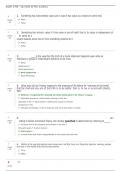
Exam 3 PHI - 103 Intro to Phil. & Ethics
✓ 1. Something has instrumental value just in case it has value as a means to some end.
Points True ✓
: 1/1 False
✓ 2. Something has intrinsic value if it has value in and of itself; that is, its value is independent of
Points its value as a
: 1/1
means towards some end or from something external to it.
True ✓
False
✓
3. is the view that the truth of a moral statement depends upon what an
Points individual or group of individuals believe to be true.
: 1/1
Moral
Objectivism
Moral Agnosticism
Moral Subjectivism ✓
Moral Philosophy
✓ 4. What way did Leo Tolstoy respond to the meaning of life before he “returned to the belief
Points that the chief and only aim of [his] life is to be better, that is, to live in accord with [God’s]
: 1/1 Will.”
Weakness—recognizing life’s absurdity and doing nothing about it but cling to it anyway. ✓
Motivated Ignorance—intentionally refusing to face the
absurdity of life. Epicureanism—seeking the maximum amount
of pleasure in life.
Strength and Energy—a life of character and virtue that ends in suicide.
✓ 5. Acc
Points ording to Divine Command Theory, the morally good/bad is determined by referring to .
: 1/1
scripture and all the religious texts written in the last 3
thousand years human nature
God’s nature ✓
a moral realm that exists independently of and coeternally with God
✓ 6. Nihilism is the view that objective moral values exist and that there are things like objective meaning, purpose
Points and value in the world that can be discovered.
: 1/1
True
False ✓
✘ : 0/1
Points
, 7. worldview that can only utilize which of Aristotle’s four causes when providing an
Na explanation for why are we here—that is, why do humans exist?
tur Final cause and efficient cause
ali
Material cause and formal cause ✘
sm
is Efficient cause and material cause ✓
a Final cause, efficient cause, formal cause and material cause
✓ 1. Something has instrumental value just in case it has value as a means to some end.
Points True ✓
: 1/1 False
✓ 2. Something has intrinsic value if it has value in and of itself; that is, its value is independent of
Points its value as a
: 1/1
means towards some end or from something external to it.
True ✓
False
✓
3. is the view that the truth of a moral statement depends upon what an
Points individual or group of individuals believe to be true.
: 1/1
Moral
Objectivism
Moral Agnosticism
Moral Subjectivism ✓
Moral Philosophy
✓ 4. What way did Leo Tolstoy respond to the meaning of life before he “returned to the belief
Points that the chief and only aim of [his] life is to be better, that is, to live in accord with [God’s]
: 1/1 Will.”
Weakness—recognizing life’s absurdity and doing nothing about it but cling to it anyway. ✓
Motivated Ignorance—intentionally refusing to face the
absurdity of life. Epicureanism—seeking the maximum amount
of pleasure in life.
Strength and Energy—a life of character and virtue that ends in suicide.
✓ 5. Acc
Points ording to Divine Command Theory, the morally good/bad is determined by referring to .
: 1/1
scripture and all the religious texts written in the last 3
thousand years human nature
God’s nature ✓
a moral realm that exists independently of and coeternally with God
✓ 6. Nihilism is the view that objective moral values exist and that there are things like objective meaning, purpose
Points and value in the world that can be discovered.
: 1/1
True
False ✓
✘ : 0/1
Points
, 7. worldview that can only utilize which of Aristotle’s four causes when providing an
Na explanation for why are we here—that is, why do humans exist?
tur Final cause and efficient cause
ali
Material cause and formal cause ✘
sm
is Efficient cause and material cause ✓
a Final cause, efficient cause, formal cause and material cause


