

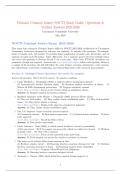
Ultimate Criminal Justice NOCTI Study Guide | Questions &
Verified Answers 2025-2026
Uncommon Community University
May 2025
NOCTI Criminal Justice Exam 2025/2026
This exam tests advanced Criminal Justice skills for NOCTI 2025/2026 certification at Uncommon
Community University, designed for 4th-year law students. It includes 100 questions: 70 multiple-
choice (2 marks each, 140 marks), 15 scenario-based application (4 marks each, 60 marks), and 15
analysis (4 marks each, 60 marks). Total: 260 marks. Use a separate answer sheet for multiple-choice
and start each question in Sections B and C on a new page. Only Casio FX-83/85 calculators are
permitted, though not required. Answers and secret hints and helpers follow each question. Below is
a sample of 30 questions; the full 100 follow the same format, covering criminal law, court systems,
law enforcement, corrections, criminology, and ethical/legal issues with advanced legal analysis.
Section A: Multiple-Choice Questions (40 marks for sample)
Answer all questions. Select the best answer. No negative marking.
1. Under Berghuis v. Thompkins (2010), a suspects silence during interrogation:
A) Automatically invokes Miranda rights B) Requires explicit invocation of silence C)
Waives all Fifth Amendment protections D) Triggers automatic counsel
Secret Hint and Helper: Focus on the Courts ruling on ambiguous silence.
Answer: B. Requires explicit invocation of silence.
2. Qualified immunity under Harlow v. Fitzgerald (1982) protects officers unless:
A) They act with malice B) They violate clearly established rights C) They lack probable
cause D) They fail to obtain a warrant
Secret Hint and Helper: Think of the objective standard for immunity.
Answer: B. They violate clearly established rights.
3. The U.S. Supreme Courts certiorari process requires:
A) Unanimous consent B) Four justices agreement C) A federal statute violation D) State
court approval
Secret Hint and Helper: Recall the Rule of Four.
Answer: B. Four justices agreement.
4. Under Arizona v. Gant (2009), a vehicle search incident to arrest is permissible:
A) For any arrest B) If the suspect can access the vehicle or evidence is relevant C) Without
probable cause D) Only with a warrant
Secret Hint and Helper: Focus on the narrowed scope post-Gant.
Answer: B. If the suspect can access the vehicle or evidence is relevant.
5. The mens rea of reckless differs from knowing in that:
A) Reckless requires intent B) Knowing involves conscious disregard of risk C) Reckless
involves conscious awareness of harm D) Knowing requires lesser culpability
Secret Hint and Helper: Compare Model Penal Code definitions.
Answer: B. Knowing involves conscious disregard of risk.
6. Tennessee v. Garner (1985) limits lethal force against fleeing suspects to:
1
, NOCTI Criminal Justice 2025/2026 Uncommon Community University
A) All felonies B) Violent felonies with probable cause of threat C) Misdemeanors with risk
D) Any public safety concern
Secret Hint and Helper: Focus on the proportionality of threat.
Answer: B. Violent felonies with probable cause of threat.
7. The exclusionary rule, per Mapp v. Ohio (1961), applies to:
A) All evidence B) Illegally obtained evidence C) Private searches D) Administrative
hearings
Secret Hint and Helper: Think of Fourth Amendment violations.
Answer: B. Illegally obtained evidence.
8. Labeling theory in criminology posits that:
A) Crime is biologically driven B) Social labels increase deviant behavior C) Economic
strain causes crime D) Peer influence is primary
Secret Hint and Helper: Focus on societal stigmas impact.
Answer: B. Social labels increase deviant behavior.
9. The Eighth Amendments deliberate indifference standard, per Estelle v. Gamble (1976), re-
quires:
A) Negligence B) Intentional disregard of serious medical needs C) Any medical error D)
Failure to provide luxury care
Secret Hint and Helper: Think of subjective intent in prison care.
Answer: B. Intentional disregard of serious medical needs.
10. A Terry stop requires:
A) Probable cause B) Reasonable suspicion of criminal activity C) Beyond reasonable doubt
D) A warrant
Secret Hint and Helper: Recall Terry v. Ohios threshold.
Answer: B. Reasonable suspicion of criminal activity.
11. The chain of custody is critical to:
A) Public disclosure B) Evidence admissibility C) Sentencing D) Parole decisions
Secret Hint and Helper: Think of preserving evidence integrity.
Answer: B. Evidence admissibility.
12. Under Riley v. California (2014), warrantless phone searches incident to arrest are:
A) Always permissible B) Prohibited absent exigent circumstances C) Allowed for minor
offenses D) Subject to plain view
Secret Hint and Helper: Focus on digital privacy protections.
Answer: B. Prohibited absent exigent circumstances.
13. Restorative justice emphasizes:
A) Retribution B) Victim-offender reconciliation C) Mandatory sentencing D) Isolation
Secret Hint and Helper: Think of repairing harm over punishment.
Answer: B. Victim-offender reconciliation.
14. The Sixth Amendments right to counsel attaches:
A) At arrest B) At the first court appearance C) During booking D) Post-conviction
Secret Hint and Helper: Recall Gideon v. Wainwrights scope.
Answer: B. At the first court appearance.
15. Social Disorganization theory attributes crime to:
A) Individual choice B) Weak community structures C) Genetic predispositions D) Media
influence
Secret Hint and Helper: Focus on neighborhood-level factors.
Answer: B. Weak community structures.
16. An officers acceptance of a bribe violates:
A) Fourth Amendment B) Ethical standards and criminal law C) Miranda requirements
2
Verified Answers 2025-2026
Uncommon Community University
May 2025
NOCTI Criminal Justice Exam 2025/2026
This exam tests advanced Criminal Justice skills for NOCTI 2025/2026 certification at Uncommon
Community University, designed for 4th-year law students. It includes 100 questions: 70 multiple-
choice (2 marks each, 140 marks), 15 scenario-based application (4 marks each, 60 marks), and 15
analysis (4 marks each, 60 marks). Total: 260 marks. Use a separate answer sheet for multiple-choice
and start each question in Sections B and C on a new page. Only Casio FX-83/85 calculators are
permitted, though not required. Answers and secret hints and helpers follow each question. Below is
a sample of 30 questions; the full 100 follow the same format, covering criminal law, court systems,
law enforcement, corrections, criminology, and ethical/legal issues with advanced legal analysis.
Section A: Multiple-Choice Questions (40 marks for sample)
Answer all questions. Select the best answer. No negative marking.
1. Under Berghuis v. Thompkins (2010), a suspects silence during interrogation:
A) Automatically invokes Miranda rights B) Requires explicit invocation of silence C)
Waives all Fifth Amendment protections D) Triggers automatic counsel
Secret Hint and Helper: Focus on the Courts ruling on ambiguous silence.
Answer: B. Requires explicit invocation of silence.
2. Qualified immunity under Harlow v. Fitzgerald (1982) protects officers unless:
A) They act with malice B) They violate clearly established rights C) They lack probable
cause D) They fail to obtain a warrant
Secret Hint and Helper: Think of the objective standard for immunity.
Answer: B. They violate clearly established rights.
3. The U.S. Supreme Courts certiorari process requires:
A) Unanimous consent B) Four justices agreement C) A federal statute violation D) State
court approval
Secret Hint and Helper: Recall the Rule of Four.
Answer: B. Four justices agreement.
4. Under Arizona v. Gant (2009), a vehicle search incident to arrest is permissible:
A) For any arrest B) If the suspect can access the vehicle or evidence is relevant C) Without
probable cause D) Only with a warrant
Secret Hint and Helper: Focus on the narrowed scope post-Gant.
Answer: B. If the suspect can access the vehicle or evidence is relevant.
5. The mens rea of reckless differs from knowing in that:
A) Reckless requires intent B) Knowing involves conscious disregard of risk C) Reckless
involves conscious awareness of harm D) Knowing requires lesser culpability
Secret Hint and Helper: Compare Model Penal Code definitions.
Answer: B. Knowing involves conscious disregard of risk.
6. Tennessee v. Garner (1985) limits lethal force against fleeing suspects to:
1
, NOCTI Criminal Justice 2025/2026 Uncommon Community University
A) All felonies B) Violent felonies with probable cause of threat C) Misdemeanors with risk
D) Any public safety concern
Secret Hint and Helper: Focus on the proportionality of threat.
Answer: B. Violent felonies with probable cause of threat.
7. The exclusionary rule, per Mapp v. Ohio (1961), applies to:
A) All evidence B) Illegally obtained evidence C) Private searches D) Administrative
hearings
Secret Hint and Helper: Think of Fourth Amendment violations.
Answer: B. Illegally obtained evidence.
8. Labeling theory in criminology posits that:
A) Crime is biologically driven B) Social labels increase deviant behavior C) Economic
strain causes crime D) Peer influence is primary
Secret Hint and Helper: Focus on societal stigmas impact.
Answer: B. Social labels increase deviant behavior.
9. The Eighth Amendments deliberate indifference standard, per Estelle v. Gamble (1976), re-
quires:
A) Negligence B) Intentional disregard of serious medical needs C) Any medical error D)
Failure to provide luxury care
Secret Hint and Helper: Think of subjective intent in prison care.
Answer: B. Intentional disregard of serious medical needs.
10. A Terry stop requires:
A) Probable cause B) Reasonable suspicion of criminal activity C) Beyond reasonable doubt
D) A warrant
Secret Hint and Helper: Recall Terry v. Ohios threshold.
Answer: B. Reasonable suspicion of criminal activity.
11. The chain of custody is critical to:
A) Public disclosure B) Evidence admissibility C) Sentencing D) Parole decisions
Secret Hint and Helper: Think of preserving evidence integrity.
Answer: B. Evidence admissibility.
12. Under Riley v. California (2014), warrantless phone searches incident to arrest are:
A) Always permissible B) Prohibited absent exigent circumstances C) Allowed for minor
offenses D) Subject to plain view
Secret Hint and Helper: Focus on digital privacy protections.
Answer: B. Prohibited absent exigent circumstances.
13. Restorative justice emphasizes:
A) Retribution B) Victim-offender reconciliation C) Mandatory sentencing D) Isolation
Secret Hint and Helper: Think of repairing harm over punishment.
Answer: B. Victim-offender reconciliation.
14. The Sixth Amendments right to counsel attaches:
A) At arrest B) At the first court appearance C) During booking D) Post-conviction
Secret Hint and Helper: Recall Gideon v. Wainwrights scope.
Answer: B. At the first court appearance.
15. Social Disorganization theory attributes crime to:
A) Individual choice B) Weak community structures C) Genetic predispositions D) Media
influence
Secret Hint and Helper: Focus on neighborhood-level factors.
Answer: B. Weak community structures.
16. An officers acceptance of a bribe violates:
A) Fourth Amendment B) Ethical standards and criminal law C) Miranda requirements
2


