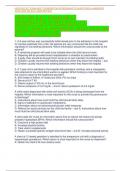
ACTUAL EXAM: NUR 210 Exam 3 2025
Questions and Answers
What percentage of our body weight is body water? - ANS 60%
what are the functions of body fluid in the body? - ANS lubricant
metabolism
transport
regulates body temperature
what are electrolytes and what does concentration depend on? - ANS -Na+, Cl-, Mg+, Ca+, K+
-electrically charged when in solution
-influenced by fluid intake and output, acid base balance, hormones, cell functions
-concentration depends on intake, absorption, distribution, and excretion
how is water distributed throughout the body? - ANS 1) Intracellular:
Two-thirds of water in body
2)Extracellular:
Remaining third is divided into 2 compartments:
-Interstitial fluid (in between cells and organs)
-Plasma
Pg. 1 Copyright © 2025 Jasonmcconell. ALL RIGHTS RESERVED.
,What electrolytes are highest in the intracellular fluid? Extracellular fluid? - ANS ICF: high K+,
Mg+, phosphate
ECF: high Na+, Cl-, bicarbonate ions
what is hydrostatic pressure? is it higher at arteriole or venous end of capillary? when does
hydrostatic pressure increase? - ANS -water pushing pressure
-higher at arteriole end (pushing oxygen and nutrients out of capillary to go to cells)
-increases due to venous obstruction or salt/water retention (due to CHF/kidney failure),
edema occurs
what is osmotic pressure? is it higher at arteriole or venous end of capillary? - ANS -water
pulling pressure
-high at venous end (want to pull fluid back into capillary from cells to bring back to heart, and
get rid of waste products)
what is osmolality? what is the electrolyte involved? - ANS solute concentration in blood,
how much stuff is in fluid
-sodium is main thing influencing osmolarity in blood, highest concentration
-water follows sodium
what is osmosis? - ANS water moving across a semi permeability membrane
moves from low to high concentration
what is colloidal osmotic pressure? what is main thing that influences? - ANS 'oncotic
pressure"
-pressure from stuff in blood
-increased pressure when increase particles (want to pull fluid in
-albumin is main influence
Pg. 2 Copyright © 2025 Jasonmcconell. ALL RIGHTS RESERVED.
, -increase albumin, increase COP, water follows protein
what is diffusion? - ANS movement of particles down a concentration gradient, high to low
what is active transport? - ANS movement of particles against concentration gradient,
requires energy
what is third spacing? how can it happen? what can it cause? - ANS -fluid moves where it is
not supposed to be
-cannot be used for anything
-occurs in abdomen (ascites), liver disease, pancreatitis
-area rich in proteins (keeps pulling fluid in)
-have to drain
causes: slow diffusion, compression of blood vessels, slow healing, increased risk of infection,
pressure ulcers
what is thirst triggered by? - ANS -triggered by osmolality of ECF
high osmolality: concentrated
low osmolality: diluted
-decreased circulating blood volume (low BP)
-dry mucous membranes
what is capillary hydrostatic pressure? is it increased at the venous or arteriole end? -
ANS outward force, pushes fluid out of capillary
increased at arteriole end
what is colloid osmotic pressure? is it higher at the arteriole or venous end? - ANS draws
fluid back into capillaries
Pg. 3 Copyright © 2025 Jasonmcconell. ALL RIGHTS RESERVED.
Questions and Answers
What percentage of our body weight is body water? - ANS 60%
what are the functions of body fluid in the body? - ANS lubricant
metabolism
transport
regulates body temperature
what are electrolytes and what does concentration depend on? - ANS -Na+, Cl-, Mg+, Ca+, K+
-electrically charged when in solution
-influenced by fluid intake and output, acid base balance, hormones, cell functions
-concentration depends on intake, absorption, distribution, and excretion
how is water distributed throughout the body? - ANS 1) Intracellular:
Two-thirds of water in body
2)Extracellular:
Remaining third is divided into 2 compartments:
-Interstitial fluid (in between cells and organs)
-Plasma
Pg. 1 Copyright © 2025 Jasonmcconell. ALL RIGHTS RESERVED.
,What electrolytes are highest in the intracellular fluid? Extracellular fluid? - ANS ICF: high K+,
Mg+, phosphate
ECF: high Na+, Cl-, bicarbonate ions
what is hydrostatic pressure? is it higher at arteriole or venous end of capillary? when does
hydrostatic pressure increase? - ANS -water pushing pressure
-higher at arteriole end (pushing oxygen and nutrients out of capillary to go to cells)
-increases due to venous obstruction or salt/water retention (due to CHF/kidney failure),
edema occurs
what is osmotic pressure? is it higher at arteriole or venous end of capillary? - ANS -water
pulling pressure
-high at venous end (want to pull fluid back into capillary from cells to bring back to heart, and
get rid of waste products)
what is osmolality? what is the electrolyte involved? - ANS solute concentration in blood,
how much stuff is in fluid
-sodium is main thing influencing osmolarity in blood, highest concentration
-water follows sodium
what is osmosis? - ANS water moving across a semi permeability membrane
moves from low to high concentration
what is colloidal osmotic pressure? what is main thing that influences? - ANS 'oncotic
pressure"
-pressure from stuff in blood
-increased pressure when increase particles (want to pull fluid in
-albumin is main influence
Pg. 2 Copyright © 2025 Jasonmcconell. ALL RIGHTS RESERVED.
, -increase albumin, increase COP, water follows protein
what is diffusion? - ANS movement of particles down a concentration gradient, high to low
what is active transport? - ANS movement of particles against concentration gradient,
requires energy
what is third spacing? how can it happen? what can it cause? - ANS -fluid moves where it is
not supposed to be
-cannot be used for anything
-occurs in abdomen (ascites), liver disease, pancreatitis
-area rich in proteins (keeps pulling fluid in)
-have to drain
causes: slow diffusion, compression of blood vessels, slow healing, increased risk of infection,
pressure ulcers
what is thirst triggered by? - ANS -triggered by osmolality of ECF
high osmolality: concentrated
low osmolality: diluted
-decreased circulating blood volume (low BP)
-dry mucous membranes
what is capillary hydrostatic pressure? is it increased at the venous or arteriole end? -
ANS outward force, pushes fluid out of capillary
increased at arteriole end
what is colloid osmotic pressure? is it higher at the arteriole or venous end? - ANS draws
fluid back into capillaries
Pg. 3 Copyright © 2025 Jasonmcconell. ALL RIGHTS RESERVED.