100% satisfaction guarantee Immediately available after payment Both online and in PDF No strings attached 4.2 TrustPilot
logo-home
Exam (elaborations)

D 664 / D664 Objective Assessment Exam Study Guide (Latest Update 2025 / 2026) Learners and Learning Science | Questions and Verified Answers | Grade A | 100% Correct – WGU

Rating
-
Sold
-
Pages
12
Grade
A+
Uploaded on
21-05-2025
Written in
2024/2025

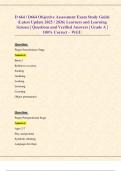
D 664 / D664 Objective Assessment Exam Study Guide (Latest Update 2025 / 2026) Learners and Learning Science | Questions and Verified Answers | Grade A | 100% Correct – WGU Question: Piaget Sensorimoter Stage Answer: Birth-2 Reflexive or active Sucking Grabbing Looking Listening Crawling Object permanence Question: Paiget Preoperational Stage Answer: Ages 2-7 Play and pretend Symbolic thinking Language develops Forms many schemes Egocentrism Use scaffolding in education Question: Piaget Concrete Operational Stage Answer: Ages 7-11 Needs concrete, hands-on experiences Understands reversal Seriation Sorting Classifying Conservation (tall skinny glass and short fat glass hold same amount of liquid. Question: Piaget Formal Operation Stage Answer: Ages 12+ Abstract thinking Critical thinking Hypothesize Predict Metaphors Mental manipulations Systemic problem solving Question: Piaget Cognitive Development Theory Answer: Focus-Interaction with Environment Sensorimoter birth-2 Preoperational 2-7 Concrete Operational 7-11 Formal Operational 12+ Question: Erikson: Psychological Development Theory Answer: Each stage presents a crisis. Resolving the crisis promotes healthy development. Trust vs mistrust Birth-12 months Autonomy vs Shame & Doubt 1-3 Initiative vs Guilt 3-6 Industry vs Inferiority 6-12 Identity vs Role Confusion 12-19 Question: Erikson Stage Trust vs Mistrust birth-12months Answer: Provide love, care and food Need comfort and safety Question: Erikson Stage Autonomy vs Shame & Doubt Answer: ages 1-3 Need for independence Insist on doing things on their own Need: Consistent care Secure environment Encourage autonomy Question: Erikson stage Initiative vs Guilt Answer: ages 3-6 Exploration Trying new things on their own Asking lots of questions Imagination Question: Erikson Stage Industry vs Inferiority Answer: ages 6-12 Intellectual curiosity School performance Need positive reinforcement Praise Avoid undue competition or criticism Use active engagement; critical thinking; problem solving Question: Erikson Stage Identity vs Role Confusion Answer: ages 12-19 Develop sense of self Influenced by other's reactions Peers more important than parents or teachers Social role models Figuring out what they want to do after high school Can engage in abstract and higher level thinking. Question: Pre-frontal cortex Answer: decision making, impulse control, emotional regulation, planning, prioritizing tasks, organization Question: Cerebrum Answer: Thinking, reasoning, problem solving, processing information, learning skills and high level thinking Question: Limbic system Answer: Processing emotions memory formation and decision making Question: Cerebellum Answer: Balance, coordination and motor control Question: Brain stem Answer: Regulation of essential body functions Question: Hippocampus Answer: neural center located in the limbic system; helps process explicit memories for storage Question: Encoding Answer: The initial processing of information whose sensory input is transformed into a form the brain can store and use. Key terms: Deep thinking, Productive struggle, Collaboration, Meaningful choice Environment Instruction techniques: Elaboration; mnemonic devices Question: Storage Answer: retaining information over time breaking information into chunks and grouping into categories Key Terms: Physiological needs; supportive environment; spaced content Instruction techniques: Summarization; Visualization; Association: Spaced Practice Question: Retrieving Answer: The process of getting stored information when needed. Key terms: Growth mindset: Effort and Strategy: Retrieval practice Instructional Techniques: Quizzes; Flashcards; Practice tests; Peer teaching. Question: Meta Cognition Answer: Involves awareness and understanding of ones thinking processes, enabling learners to monitor and regulate their learning effectively. Question: Behaviorism definition Answer: Sheds light on how external stimuli shape behavior, emphasizing the focus on desirable behaviors rather than internal mental processes. Theory posited by B.F. Skinner Question: Behaviorism Learning Strategies Answer: Behaviorism Learning Strategy keys · Best with texted based learning · Use tangible rewards and informative feedback · Create measurable learning outcomes · Measurable and Observable behaviors that are repeated until automatic · Guide students in mastering a set of predictable skills and behaviors · Memory is hardwired by repeated experiences. Question: Cognitivism Answer: Seeks to understand the internal processes involved in learning, such as perception, memory, problem solving and decision making. Creating-Remembering-Applying Question: Cognitivism Learning Theory keys Answer: · Memory is about storage and retrieval · Learning is structured and computational · Existing schema, previous experiences and influences of learning · Observe new behavior patterns and focuses on how to learn · Transfer by duplicating knowledge constructs of the learning · Best with reasoning, clear objectives and problem solving Question: Constructivism Learning Theory Answer: - A theory in education combining cognitive and social elements emphasizing active learning, student centered instruction and construction of knowledge through personal experiences and interactions Question: Social constructivism Answer: underscores the interplay between individual cognition and social factors in shaping learning; highlights the role of observational learning and modeling in knowledge acquisition. Question: Constructivism Learning theory keys Answer: Learner is in control of own learning Transfer happens through socialization Prior knowledge is used in dealing with new situations Learning is influenced by engagement participation and socio-cultural factors Learning is constructed through meaningful real world experiences Zone of proximal development Question: Zone of Proximal Development Answer: The gap between what a learner can learn independently and what they can achieve through guidance and support.

Show more Read less


Whoops! We can’t load your doc right now. Try again or contact support.

Document information

Uploaded on
May 21, 2025
Number of pages
12
Written in
2024/2025
Type
Exam (elaborations)
Contains
Questions & answers

Subjects

Content preview

D 664 / D664 Objective Assessment Exam Study Guide
(Latest Update ) Learners and Learning
Science | Questions and Verified Answers | Grade A |
100% Correct – WGU

Question:
Piaget Sensorimoter Stage
Answer:
Birth-2
Reflexive or active
Sucking
Grabbing
Looking
Listening
Crawling
Object permanence


Question:
Paiget Preoperational Stage
Answer:
Ages 2-7
Play and pretend
Symbolic thinking
Language develops

, Forms many schemes
Egocentrism
Use scaffolding in education


Question:
Piaget Concrete Operational Stage
Answer:
Ages 7-11
Needs concrete, hands-on experiences
Understands reversal
Seriation
Sorting
Classifying
Conservation (tall skinny glass and short fat glass hold same amount of liquid.


Question:
Piaget Formal Operation Stage
Answer:
Ages 12+
Abstract thinking
Critical thinking
Hypothesize
Predict

Get to know the seller

Seller avatar
Reputation scores are based on the amount of documents a seller has sold for a fee and the reviews they have received for those documents. There are three levels: Bronze, Silver and Gold. The better the reputation, the more your can rely on the quality of the sellers work.
Quizbit07 Rasmussen College
View profile
Follow You need to be logged in order to follow users or courses
Sold
98
Member since
2 year
Number of followers
49
Documents
2309
Last sold
1 week ago
High-Quality Exams, Study guides, Reviews, Notes, Case Studies

Welcome! Here, you will find well-structured and exam-oriented study materials created to help you understand complex topics with ease. Whether you’re preparing for nursing licensure exams (NCLEX, ATI, HESI, ANCC, AANP), healthcare certification reviews (ACLS, BLS, PALS, PMHNP, AGNP), or entrance and readiness tests (TEAS, HESI, PAX, NLN), my resources are designed to guide you step-by-step. I also provide study support for university programs and major courses, including Chamberlain University, WGU programs, Portage Learning, as well as Medical-Surgical Nursing, Pharmacology, Anatomy & Physiology, and more. Everything is updated for 2025/2026, organized for quick studying and understanding.

Read more Read less
4.0

13 reviews

5
7
4
2
3
2
2
1
1
1

Recently viewed by you

Why students choose Stuvia

Created by fellow students, verified by reviews

Quality you can trust: written by students who passed their tests and reviewed by others who've used these notes.

Didn't get what you expected? Choose another document

No worries! You can instantly pick a different document that better fits what you're looking for.

Pay as you like, start learning right away

No subscription, no commitments. Pay the way you're used to via credit card and download your PDF document instantly.

Student with book image

“Bought, downloaded, and aced it. It really can be that simple.”

Alisha Student

Frequently asked questions