

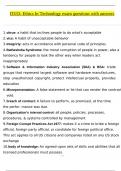
D333- Ethics In Technology exam questions with answers
1.vitrue: a habit that inclines people to do what's acceptable
2.vice: A habit of unacceptable behavior
3.Integrirty: acts in accordance with personal code of principles
4.Bathesheba Syndrome: the moral corruption of people in power, also a
tendency for people to look the other way when leaders act
inappropriately
5.Software & Information Industry Association (SIIA) & BSA: trade
groups that represent largest software and hardware manufactures,
stop unauthorized copyright, protect intellectual property, provides
education
6.Misrepresentation: A false statement or lie that can render the contract
void.
7.breach of contract: A failure to perform, as promised, at the time
the perfor- mance was due.
8.Organization's internal control: all people, policies, processes,
procedures, & systems controlled by management
9.Foreign Corrupt Practices Act 1977: makes it a crime to bribe a foreign
official, foreign party official, or candidate for foreign political office.
This act applies to all US citizens and companies listed on any US stock
exchange
10.body of knowledge: An agreed-upon sets of skills and abilities that all
licensed professionals must possess.
,11.National Council of Examiners & Surveying: develops, administers,
and scores the examinations used for engineering and survey
licensure in the US
12.Negligence: not doing something a reasonable person would do/
something a reasonable person would not do
13.Duty of Care: the obligation people owe each other not to cause any
unreason- able harm or risk of harm
14.Reasonable Professional Standard: A legal standard that
defendants who have particular expertise or competence are
measured against.
15.Reasonable Person Standard: A legal standard that defines how an
objective, careful, and conscientious person would have acted in the
same circumstances.
16.Professional Malpractice: break of duty of care by a professional
17.Zero-Day Exploit: A cyberattack that takes place before the security
community and/or software developers become aware of and fix a
security vulnerability.
18.Black Hat Hacker: someone who violates computer or internet
security mali- ciously or for illegal personal gain
19.Malicious Insider: An employee or contractor who attempts to gain
financially and/or disrupt a company's information systems and
business operations
20.Cybercriminal: Someone who attacks a computer system or network
for finan- cial gain
21.Cyberterrorist: Someone who attempts to destroy the infrastructure
, compo- nents of governments, financial institutions, utilities, and
emergency response units
1.vitrue: a habit that inclines people to do what's acceptable
2.vice: A habit of unacceptable behavior
3.Integrirty: acts in accordance with personal code of principles
4.Bathesheba Syndrome: the moral corruption of people in power, also a
tendency for people to look the other way when leaders act
inappropriately
5.Software & Information Industry Association (SIIA) & BSA: trade
groups that represent largest software and hardware manufactures,
stop unauthorized copyright, protect intellectual property, provides
education
6.Misrepresentation: A false statement or lie that can render the contract
void.
7.breach of contract: A failure to perform, as promised, at the time
the perfor- mance was due.
8.Organization's internal control: all people, policies, processes,
procedures, & systems controlled by management
9.Foreign Corrupt Practices Act 1977: makes it a crime to bribe a foreign
official, foreign party official, or candidate for foreign political office.
This act applies to all US citizens and companies listed on any US stock
exchange
10.body of knowledge: An agreed-upon sets of skills and abilities that all
licensed professionals must possess.
,11.National Council of Examiners & Surveying: develops, administers,
and scores the examinations used for engineering and survey
licensure in the US
12.Negligence: not doing something a reasonable person would do/
something a reasonable person would not do
13.Duty of Care: the obligation people owe each other not to cause any
unreason- able harm or risk of harm
14.Reasonable Professional Standard: A legal standard that
defendants who have particular expertise or competence are
measured against.
15.Reasonable Person Standard: A legal standard that defines how an
objective, careful, and conscientious person would have acted in the
same circumstances.
16.Professional Malpractice: break of duty of care by a professional
17.Zero-Day Exploit: A cyberattack that takes place before the security
community and/or software developers become aware of and fix a
security vulnerability.
18.Black Hat Hacker: someone who violates computer or internet
security mali- ciously or for illegal personal gain
19.Malicious Insider: An employee or contractor who attempts to gain
financially and/or disrupt a company's information systems and
business operations
20.Cybercriminal: Someone who attacks a computer system or network
for finan- cial gain
21.Cyberterrorist: Someone who attempts to destroy the infrastructure
, compo- nents of governments, financial institutions, utilities, and
emergency response units


