

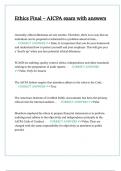
Ethics Final – AICPA exam with answers
Generally, ethical dilemmas are not routine. Therefore, there is no way that an
individual can be prepared or informed for a problem ahead of time. -
➰CORRECT ANSWERS ✔✔False, It is important that you do your homework
and understand how to protect yourself and your employer. This will give you
a "head's up" when you face potential ethical dilemmas
PCAOB set auditing, quality control, ethics, independence and other standards
relating to the preparation of audit reports. - ➰CORRECT ANSWERS
✔✔False, Only for Issuers
The AICPA bylaws require that members adhere to the rules in the Code. -
➰CORRECT ANSWERS ✔✔True
The American Institute of Certified Public Accountants has been the primary
ethical rules for internal auditors. - ➰CORRECT ANSWERS ✔✔False
Members employed by others to prepare financial statements or to perform
auditing must adhere to the objectivity and independence principle in the
AICPA Code of Conduct - ➰CORRECT ANSWERS ✔✔False, They are
charged with the same responsibility for objectivity as members in public
practice
,The AICPA Code of Professional Conduct derives its authority from specific
federal legislation. - ➰CORRECT ANSWERS ✔✔False, The AICPA Code of
Professional Conduct derives its authority from the Bylaws of the AICPA.
An ethical dilemma is defined as a situation where two or more "right" values
are in conflict - ➰CORRECT ANSWERS ✔✔true
Members would be violating the Integrity principle if they have inadvertent
errors and have honest differences of opinion while performing their duties. -
➰CORRECT ANSWERS ✔✔False, Integrity can accommodate the
inadvertent error and honest difference of opinion; it cannot accommodate
deceit or subordination of principles.
AICPA Interpretations limit the scope and application of the rules. -
➰CORRECT ANSWERS ✔✔False, The interpretations of the rules of conduct
provide guidelines about the scope and application of the rules but are not
intended to limit such scope or application
The AICPA Code of Professional Conduct provides practical guidance to only
members in public practice - ➰CORRECT ANSWERS ✔✔False, The AICPA
Code provides practice guidance for all members.
Under the Rules of Professional Conduct promulgated under the Texas Public
Accountancy Act, all of the rules of professional conduct shall apply to and
must be observed by a certificate or registration holder engaged in the client
practice of public accountancy. - ➰CORRECT ANSWERS ✔✔True, Correct
under Rule 501.53(a), Applicability of Rules of Professional Conduct.
, Integrity as defined in the AICPA Code of Conduct is an element of character
fundamental to professional recognition - ➰CORRECT ANSWERS ✔✔True
The characteristics common to all profession include existence of a complex
body of knowledge and acknowledgement of a responsibility to serve the
client. - ➰CORRECT ANSWERS ✔✔False, responsibility to serve the public
Membership in the AICPA is voluntary, but by accepting membership, a CPA
assumes an obligation of self-discipline and agrees to adhere to the Code. -
➰CORRECT ANSWERS ✔✔True
The AICPA Code of Professional Conduct begins with a preface that applies to
all members. - ➰CORRECT ANSWERS ✔✔True
The Responsibilities principle of the AICPA Code of Conduct requires that
service and public trust not be subordinated to personal gain and advantage. -
➰CORRECT ANSWERS ✔✔False, This is integrity
The AICPA Code of Professional Conduct provides assurance to clients and to
the public that the professional intends to maintain high standards. -
➰CORRECT ANSWERS ✔✔True
PCAOB was created by the Sarbanes-Oxley Act of 2002. - ➰CORRECT
ANSWERS ✔✔True
Generally, ethical dilemmas are not routine. Therefore, there is no way that an
individual can be prepared or informed for a problem ahead of time. -
➰CORRECT ANSWERS ✔✔False, It is important that you do your homework
and understand how to protect yourself and your employer. This will give you
a "head's up" when you face potential ethical dilemmas
PCAOB set auditing, quality control, ethics, independence and other standards
relating to the preparation of audit reports. - ➰CORRECT ANSWERS
✔✔False, Only for Issuers
The AICPA bylaws require that members adhere to the rules in the Code. -
➰CORRECT ANSWERS ✔✔True
The American Institute of Certified Public Accountants has been the primary
ethical rules for internal auditors. - ➰CORRECT ANSWERS ✔✔False
Members employed by others to prepare financial statements or to perform
auditing must adhere to the objectivity and independence principle in the
AICPA Code of Conduct - ➰CORRECT ANSWERS ✔✔False, They are
charged with the same responsibility for objectivity as members in public
practice
,The AICPA Code of Professional Conduct derives its authority from specific
federal legislation. - ➰CORRECT ANSWERS ✔✔False, The AICPA Code of
Professional Conduct derives its authority from the Bylaws of the AICPA.
An ethical dilemma is defined as a situation where two or more "right" values
are in conflict - ➰CORRECT ANSWERS ✔✔true
Members would be violating the Integrity principle if they have inadvertent
errors and have honest differences of opinion while performing their duties. -
➰CORRECT ANSWERS ✔✔False, Integrity can accommodate the
inadvertent error and honest difference of opinion; it cannot accommodate
deceit or subordination of principles.
AICPA Interpretations limit the scope and application of the rules. -
➰CORRECT ANSWERS ✔✔False, The interpretations of the rules of conduct
provide guidelines about the scope and application of the rules but are not
intended to limit such scope or application
The AICPA Code of Professional Conduct provides practical guidance to only
members in public practice - ➰CORRECT ANSWERS ✔✔False, The AICPA
Code provides practice guidance for all members.
Under the Rules of Professional Conduct promulgated under the Texas Public
Accountancy Act, all of the rules of professional conduct shall apply to and
must be observed by a certificate or registration holder engaged in the client
practice of public accountancy. - ➰CORRECT ANSWERS ✔✔True, Correct
under Rule 501.53(a), Applicability of Rules of Professional Conduct.
, Integrity as defined in the AICPA Code of Conduct is an element of character
fundamental to professional recognition - ➰CORRECT ANSWERS ✔✔True
The characteristics common to all profession include existence of a complex
body of knowledge and acknowledgement of a responsibility to serve the
client. - ➰CORRECT ANSWERS ✔✔False, responsibility to serve the public
Membership in the AICPA is voluntary, but by accepting membership, a CPA
assumes an obligation of self-discipline and agrees to adhere to the Code. -
➰CORRECT ANSWERS ✔✔True
The AICPA Code of Professional Conduct begins with a preface that applies to
all members. - ➰CORRECT ANSWERS ✔✔True
The Responsibilities principle of the AICPA Code of Conduct requires that
service and public trust not be subordinated to personal gain and advantage. -
➰CORRECT ANSWERS ✔✔False, This is integrity
The AICPA Code of Professional Conduct provides assurance to clients and to
the public that the professional intends to maintain high standards. -
➰CORRECT ANSWERS ✔✔True
PCAOB was created by the Sarbanes-Oxley Act of 2002. - ➰CORRECT
ANSWERS ✔✔True


