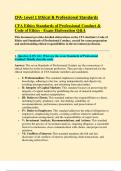
CFA Institute Code of Ethics and Standards of
Professional Conduct Practice Questions
1. According to the CFA Institute Code of Ethics and Standards of
Professional Conduct, which of the following is LEAST likely to prevent
trading on material nonpublic information? A. Firewalls B. Watch lists C.
Selective disclosure
Answer: C is correct. Selective disclosure occurs when companies discriminate in
making material nonpublic information public. Corporations that disclose
information on a limited basis create the potential for insider-trading violations, as
outlined in Standard II(A).
2. William Wong, CFA, an equity analyst at Hayswick Securities, concludes
through fundamental analysis that Nolvec Inc.'s stock is substantially
undervalued and poised for a significant price increase. He delays revising his
recommendation from "hold" to "buy" to allow his brother to purchase
shares at a lower price. Wong is LEAST likely to have violated the CFA
Institute Standards of Professional Conduct related to: A. Duty to clients B.
Reasonable basis C. Priority of transactions
Answer: B is correct. The scenario provides no indication that Wong lacked a
reasonable basis for his conclusion regarding Nolvec. Standard V(A) addresses the
requirement for a reasonable basis.
3. During an onsite company visit, Marsha Ward, CFA, inadvertently
overhears the Chief Executive Officer (CEO) of Stargazer, Inc. discussing the
company's tender offer to purchase Dynamica Enterprises, a retailer of
Stargazer products. According to the CFA Institute Standards of Professional
Conduct, Ward MOST likely CANNOT use this information because: A. It
relates to a tender offer. B. It was overheard and might be considered unreliable. C.
She does not have a reasonable and adequate basis for taking investment action.
Answer: A is correct. Trading on material nonpublic information is restricted,
especially when it pertains to a tender offer. The information overheard is clearly
material and nonpublic, as per Standard II(A).
4. Ian O'Sullivan, CFA, owns and operates two companies: a public relations
firm and a financial research firm. His public relations firm contracted with
,Mallory Enterprises, receiving 40,000 shares of Mallory stock for its services.
Over the subsequent 10 days, the PR firm issued several press releases
highlighting Mallory's strong growth prospects. Simultaneously, O'Sullivan's
financial research firm published a "buy" recommendation for Mallory stock.
According to the CFA Institute Standards of Professional Conduct,
O'Sullivan is MOST likely required to disclose his ownership of Mallory stock
in: A. The press releases only. B. The research report only. C. Both the press
releases and the research report.
Answer: C is correct. Members should disclose all matters that could reasonably
be expected to impair their objectivity. This requirement applies to both the press
releases (Standard I(B)) and the research report (Standard VI(A)).
5. Jefferson Piedmont, CFA, a portfolio manager at Park Investments, plans
to manage the portfolios of several family members in exchange for a
percentage of each portfolio's profits. Given the substantial attention required
for these extensive portfolios, his family requested these services be outside his
employment with Park. Piedmont notifies his employer in writing of his
prospective outside employment. Two weeks later, Piedmont begins managing
the family members' portfolios. By managing these portfolios, did Piedmont
violate any CFA Institute Standards of Professional Conduct? A. Conflicts of
Interest B. Additional Compensation C. Both Additional Compensation and
Conflicts of Interest
Answer: C is correct. Members must disclose all potential conflicts of interest,
including the significant time commitment involved in managing family accounts.
Furthermore, engaging in independent practice for compensation requires receiving
written consent from all parties involved (Standard IV(B) and Standard VI(A)).
6. The eight major provisions of the Global Investment Performance
Standards (GIPS) include all of the following EXCEPT: A. Input Data,
Calculation Methodology, and Real Estate. B. Fundamentals of Compliance,
Composite Construction, and Disclosures. C. Calculation Methodology, Composite
Construction, and Alternative Assets.
Answer: C is correct. Alternative Assets is not one of the eight major provisions of
the GIPS. The eight sections are: Fundamentals of Compliance, Input Data,
Calculation Methodology, Composite Construction, Disclosures, Presentation and
Reporting, Real Estate, and Private Equity (Standard II, Provisions of The Global
Investment Performance Standards).
,7. Hui Chen, CFA, develops marketing materials for an investment fund he
founded three years prior. The materials present the fund's 3-, 2-, and 1-year
returns, accompanied by a footnote in small print stating, "Past performance
does not guarantee future returns." He also includes a separate sheet detailing
the most recent semi-annual and quarterly returns, explicitly noting they have
been neither audited nor verified. Has Chen MOST likely violated any CFA
Institute Standards of Professional Conduct? A. No. B. Yes, because he
included un-audited and unverified results. C. Yes, because he did not adhere to
the global investment performance standards.
Answer: A is correct. The Standards require members to make reasonable efforts
to ensure performance information is fair, accurate, and complete. However, they
do not mandate compliance with GIPS, auditing, or verification requirements
(Standard III(D)).
8. Charlie Mancini, CFA, is the Managing Director for Business Development
at SV Financial (SVF), a large U.S.-based mutual fund organization. Under
pressure to increase revenues, Mancini recently approved flexible terms for a
client agreement with a large hedge fund manager based in Asia. To
accommodate time zone differences, the agreement permits the hedge fund to
trade in all of SVF's mutual funds six hours after the close of U.S. markets.
Did Mancini violate any CFA Institute Standards of Professional Conduct? A.
No. B. Yes, with regard to Fair Dealing. C. Yes, with regard to Fair Dealing and
Material Nonpublic Information.
Answer: C is correct. Clients should be treated fairly and impartially (Standard
III(B)). Additionally, these flexible trading terms could allow the hedge fund
manager to profit unfairly, potentially violating Standard II(A) concerning trading
on material nonpublic information and Standard VI(A) regarding Disclosure of
Conflicts of Interest.
9. Ron Dunder, CFA, the CIO for Bling Trust (BT), an investment advisor,
assigns Doug Chetch, a portfolio manager, to manage several accounts
primarily investing in thinly traded micro-cap stocks. Dunder observes that
Chetch executes numerous stock trades for these accounts on the last day of
each month, near the market close. Finding this unusual, Dunder inquires
with Chetch, who explains the trading activity was at the clients' request.
Dunder conducts no further investigation. Six months later, regulatory
authorities sanction BT for manipulating micro-cap stock prices at month-end
to inflate account values. Did Dunder violate any CFA Institute Standards of
, Professional Conduct? A. No. B. Yes, because he failed to reasonably supervise
Chetch. C. Yes, because he did not report his findings to regulatory authorities.
Answer: B is correct. The CFA Institute Standard on Responsibilities of
Supervisors (Standard IV(C)) requires members/candidates to take steps to detect
and prevent violations of laws, rules, and regulations. Dunder failed in his
supervisory role by accepting Chetch's explanation without further investigation
into the unusual trading activity and the clients' alleged requests.
10. Ross Nelson, CFA, manages accounts for high-net-worth clients, including
his own family's account, in which he has no beneficial ownership. Concerned
about the appearance of impropriety in managing his family's account, Nelson
allocates to his family's account only the shares remaining after other client
accounts have their orders filled when his firm purchases a block of securities.
The fee for managing his family's account follows his firm's normal fee
structure. According to the Standards of Practice Handbook, Nelson's BEST
course of action regarding the management of his family's account would be
to: A. Treat the account like other client accounts. B. Arrange for the account to be
transferred to another firm. C. Transfer the account to another investment manager
in his firm.
Answer: A is correct. Nelson has breached his duty to his family by treating them
differently from other clients. They are entitled to the same treatment as any other
client of the firm. Nelson should manage his family's account like any other client
account, as per Standard VI(B) related to Priority of Transactions.
11. Several years ago, Leo Peek, CFA, co-founded an investment club. The
club's account is fully invested but has not been actively traded for at least a
year and has no plans for future active trading. Peek's employer requires an
annual disclosure of employee stock ownership. Peek discloses all of his
personal trading accounts but omits his holdings in the investment club.
Peek's actions are LEAST likely to be a violation of which of the CFA
Institute Standards of Professional Conduct? A. Misrepresentation B.
Transaction priority C. Conflicts of interest
Answer: B is correct. There is no indication that the investment club is trading
ahead of clients. Standard I(C) addresses Misrepresentation, and Standard VI(A)
covers Conflicts of Interest, both of which could potentially be violated by
nondisclosure of a holding that might influence recommendations or create a
conflict.
Professional Conduct Practice Questions
1. According to the CFA Institute Code of Ethics and Standards of
Professional Conduct, which of the following is LEAST likely to prevent
trading on material nonpublic information? A. Firewalls B. Watch lists C.
Selective disclosure
Answer: C is correct. Selective disclosure occurs when companies discriminate in
making material nonpublic information public. Corporations that disclose
information on a limited basis create the potential for insider-trading violations, as
outlined in Standard II(A).
2. William Wong, CFA, an equity analyst at Hayswick Securities, concludes
through fundamental analysis that Nolvec Inc.'s stock is substantially
undervalued and poised for a significant price increase. He delays revising his
recommendation from "hold" to "buy" to allow his brother to purchase
shares at a lower price. Wong is LEAST likely to have violated the CFA
Institute Standards of Professional Conduct related to: A. Duty to clients B.
Reasonable basis C. Priority of transactions
Answer: B is correct. The scenario provides no indication that Wong lacked a
reasonable basis for his conclusion regarding Nolvec. Standard V(A) addresses the
requirement for a reasonable basis.
3. During an onsite company visit, Marsha Ward, CFA, inadvertently
overhears the Chief Executive Officer (CEO) of Stargazer, Inc. discussing the
company's tender offer to purchase Dynamica Enterprises, a retailer of
Stargazer products. According to the CFA Institute Standards of Professional
Conduct, Ward MOST likely CANNOT use this information because: A. It
relates to a tender offer. B. It was overheard and might be considered unreliable. C.
She does not have a reasonable and adequate basis for taking investment action.
Answer: A is correct. Trading on material nonpublic information is restricted,
especially when it pertains to a tender offer. The information overheard is clearly
material and nonpublic, as per Standard II(A).
4. Ian O'Sullivan, CFA, owns and operates two companies: a public relations
firm and a financial research firm. His public relations firm contracted with
,Mallory Enterprises, receiving 40,000 shares of Mallory stock for its services.
Over the subsequent 10 days, the PR firm issued several press releases
highlighting Mallory's strong growth prospects. Simultaneously, O'Sullivan's
financial research firm published a "buy" recommendation for Mallory stock.
According to the CFA Institute Standards of Professional Conduct,
O'Sullivan is MOST likely required to disclose his ownership of Mallory stock
in: A. The press releases only. B. The research report only. C. Both the press
releases and the research report.
Answer: C is correct. Members should disclose all matters that could reasonably
be expected to impair their objectivity. This requirement applies to both the press
releases (Standard I(B)) and the research report (Standard VI(A)).
5. Jefferson Piedmont, CFA, a portfolio manager at Park Investments, plans
to manage the portfolios of several family members in exchange for a
percentage of each portfolio's profits. Given the substantial attention required
for these extensive portfolios, his family requested these services be outside his
employment with Park. Piedmont notifies his employer in writing of his
prospective outside employment. Two weeks later, Piedmont begins managing
the family members' portfolios. By managing these portfolios, did Piedmont
violate any CFA Institute Standards of Professional Conduct? A. Conflicts of
Interest B. Additional Compensation C. Both Additional Compensation and
Conflicts of Interest
Answer: C is correct. Members must disclose all potential conflicts of interest,
including the significant time commitment involved in managing family accounts.
Furthermore, engaging in independent practice for compensation requires receiving
written consent from all parties involved (Standard IV(B) and Standard VI(A)).
6. The eight major provisions of the Global Investment Performance
Standards (GIPS) include all of the following EXCEPT: A. Input Data,
Calculation Methodology, and Real Estate. B. Fundamentals of Compliance,
Composite Construction, and Disclosures. C. Calculation Methodology, Composite
Construction, and Alternative Assets.
Answer: C is correct. Alternative Assets is not one of the eight major provisions of
the GIPS. The eight sections are: Fundamentals of Compliance, Input Data,
Calculation Methodology, Composite Construction, Disclosures, Presentation and
Reporting, Real Estate, and Private Equity (Standard II, Provisions of The Global
Investment Performance Standards).
,7. Hui Chen, CFA, develops marketing materials for an investment fund he
founded three years prior. The materials present the fund's 3-, 2-, and 1-year
returns, accompanied by a footnote in small print stating, "Past performance
does not guarantee future returns." He also includes a separate sheet detailing
the most recent semi-annual and quarterly returns, explicitly noting they have
been neither audited nor verified. Has Chen MOST likely violated any CFA
Institute Standards of Professional Conduct? A. No. B. Yes, because he
included un-audited and unverified results. C. Yes, because he did not adhere to
the global investment performance standards.
Answer: A is correct. The Standards require members to make reasonable efforts
to ensure performance information is fair, accurate, and complete. However, they
do not mandate compliance with GIPS, auditing, or verification requirements
(Standard III(D)).
8. Charlie Mancini, CFA, is the Managing Director for Business Development
at SV Financial (SVF), a large U.S.-based mutual fund organization. Under
pressure to increase revenues, Mancini recently approved flexible terms for a
client agreement with a large hedge fund manager based in Asia. To
accommodate time zone differences, the agreement permits the hedge fund to
trade in all of SVF's mutual funds six hours after the close of U.S. markets.
Did Mancini violate any CFA Institute Standards of Professional Conduct? A.
No. B. Yes, with regard to Fair Dealing. C. Yes, with regard to Fair Dealing and
Material Nonpublic Information.
Answer: C is correct. Clients should be treated fairly and impartially (Standard
III(B)). Additionally, these flexible trading terms could allow the hedge fund
manager to profit unfairly, potentially violating Standard II(A) concerning trading
on material nonpublic information and Standard VI(A) regarding Disclosure of
Conflicts of Interest.
9. Ron Dunder, CFA, the CIO for Bling Trust (BT), an investment advisor,
assigns Doug Chetch, a portfolio manager, to manage several accounts
primarily investing in thinly traded micro-cap stocks. Dunder observes that
Chetch executes numerous stock trades for these accounts on the last day of
each month, near the market close. Finding this unusual, Dunder inquires
with Chetch, who explains the trading activity was at the clients' request.
Dunder conducts no further investigation. Six months later, regulatory
authorities sanction BT for manipulating micro-cap stock prices at month-end
to inflate account values. Did Dunder violate any CFA Institute Standards of
, Professional Conduct? A. No. B. Yes, because he failed to reasonably supervise
Chetch. C. Yes, because he did not report his findings to regulatory authorities.
Answer: B is correct. The CFA Institute Standard on Responsibilities of
Supervisors (Standard IV(C)) requires members/candidates to take steps to detect
and prevent violations of laws, rules, and regulations. Dunder failed in his
supervisory role by accepting Chetch's explanation without further investigation
into the unusual trading activity and the clients' alleged requests.
10. Ross Nelson, CFA, manages accounts for high-net-worth clients, including
his own family's account, in which he has no beneficial ownership. Concerned
about the appearance of impropriety in managing his family's account, Nelson
allocates to his family's account only the shares remaining after other client
accounts have their orders filled when his firm purchases a block of securities.
The fee for managing his family's account follows his firm's normal fee
structure. According to the Standards of Practice Handbook, Nelson's BEST
course of action regarding the management of his family's account would be
to: A. Treat the account like other client accounts. B. Arrange for the account to be
transferred to another firm. C. Transfer the account to another investment manager
in his firm.
Answer: A is correct. Nelson has breached his duty to his family by treating them
differently from other clients. They are entitled to the same treatment as any other
client of the firm. Nelson should manage his family's account like any other client
account, as per Standard VI(B) related to Priority of Transactions.
11. Several years ago, Leo Peek, CFA, co-founded an investment club. The
club's account is fully invested but has not been actively traded for at least a
year and has no plans for future active trading. Peek's employer requires an
annual disclosure of employee stock ownership. Peek discloses all of his
personal trading accounts but omits his holdings in the investment club.
Peek's actions are LEAST likely to be a violation of which of the CFA
Institute Standards of Professional Conduct? A. Misrepresentation B.
Transaction priority C. Conflicts of interest
Answer: B is correct. There is no indication that the investment club is trading
ahead of clients. Standard I(C) addresses Misrepresentation, and Standard VI(A)
covers Conflicts of Interest, both of which could potentially be violated by
nondisclosure of a holding that might influence recommendations or create a
conflict.