CFA Level 1, Section 1 Ethics & Standards
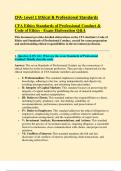
CFA Code of Ethics and Standards of Professional
Conduct: Exam Elaboration
This document provides a comprehensive overview of the CFA Code of Ethics and
select Standards of Professional Conduct, designed to aid in your exam
preparation.
1. What are the 6 components of the CFA Code of Ethics?
The six fundamental principles of the CFA Code of Ethics can be remembered
using the acronym PEJMAR:
Priority: Your client's interests always come first.
Encourage: Practice and encourage others to act professionally and
ethically to reflect credit on yourself and the profession.
Judgment: Use reasonable care and judgment when performing all
professional activities.
Maintain: Keep your knowledge up to date and encourage other
professionals to do the same.
Actions: Employ integrity, competence, diligence, and respect in an ethical
manner with everyone.
Rules: Promote the integrity of capital markets by following the rules.
2. What are the various sections for Standards of Professional Conduct?
There are seven main sections within the Standards of Professional Conduct:
I. Professionalism II. Integrity of Capital Markets III. Duties to Clients and
Prospective Clients IV. Duties to Employers V. Investment Analysis,
Recommendations, and Action VI. Conflicts of Interest VII. Responsibilities as
a CFA Institute Member or CFA Candidate
3. What is Standard I?
Standard I is Professionalism.
4. What are the subsections of Standard I: Professionalism?
,Standard I: Professionalism comprises four subsections:
I-A: Knowledge of the Law
I-B: Independence and Objectivity
I-C: Misrepresentation
I-D: Misconduct
5. What is Standard I-A?
Standard I-A: Knowledge of the Law states:
Members and Candidates must understand and comply with all applicable laws,
rules, and regulations (including the CFA Institute Code of Ethics and Standards of
Professional Conduct) of any government, regulatory organization, licensing
agency, or professional association governing their professional activities. In the
event of conflict, Members and Candidates must not knowingly participate or
assist in and must disassociate from any violation of such laws, rules, or
regulations.
This standard emphasizes the importance of understanding and adhering to all
relevant legal and regulatory frameworks.
6. What are the types of exam questions you can expect regarding applying
Standard I-A?
Exam questions related to Standard I-A often present scenarios involving potential
legal or regulatory violations. You will likely need to assess whether a CFA
Member or Candidate acted appropriately. Key areas to consider include:
Did the Member seek the advice of counsel? Consulting legal counsel is
generally viewed favorably when facing potential legal violations.
Did the member report the violation, and to whom did the member
report it? Failing to report or attempting to conceal potential violations is a
strong indicator of a Standard I-A breach. Reporting to supervisors or
compliance officers is a crucial step.
For multinational operations, which country's laws apply to the
situation at hand? The exam will typically specify which jurisdiction's laws
are relevant. Remember the general rule: apply the stricter of the local law,
rules, and regulations or the CFA Institute Code and Standards.
7. How can you comply with Standard I-A?
, To ensure compliance with Standard I-A, consider the following practices:
Establish Files: Maintain readily accessible files containing all applicable
laws, rules, regulations, statutes, and relevant case law. Implement a system
for managing, distributing, and interpreting this information.
Stay Informed: Implement procedures to ensure that relevant employees are
continuously updated on changes in laws, rules, and regulations.
Distribution Area Laws: In a globalized market, understand and adhere to
the laws of the countries or regions where products or services are
distributed.
Legal or Illegal?: When facing ambiguous situations, always consult legal
counsel to determine the legality of a particular action.
Disassociate: If you become aware of illegal or unethical conduct, you must
disassociate yourself from the activity and actively urge the firm to cease the
violating behavior. Inaction can be construed as participation.
8. What is Standard I-B?
Standard I-B: Independence and Objectivity states:
Members and Candidates must use reasonable care and judgment to achieve and
maintain independence and objectivity in their professional activities. Members
and Candidates must not offer, solicit, or accept any gift, benefit, compensation, or
consideration that reasonably could be expected to compromise their own or
another's independence and objectivity.
This standard focuses on maintaining integrity and avoiding conflicts of interest
that could bias professional judgment.
9. What are the types of exam questions you can expect regarding applying
Standard I-B?
Exam questions on Standard I-B often present scenarios where independence and
objectivity could be compromised, or where the appearance of a conflict exists.
Common situations include:
Company-sponsored analyst conferences with all expenses paid:
Evaluate whether such lavish outings could bias an analyst's future research.
Firms often have policies to mitigate this risk (e.g., firm pays, business-
focused itinerary).
CFA Code of Ethics and Standards of Professional
Conduct: Exam Elaboration
This document provides a comprehensive overview of the CFA Code of Ethics and
select Standards of Professional Conduct, designed to aid in your exam
preparation.
1. What are the 6 components of the CFA Code of Ethics?
The six fundamental principles of the CFA Code of Ethics can be remembered
using the acronym PEJMAR:
Priority: Your client's interests always come first.
Encourage: Practice and encourage others to act professionally and
ethically to reflect credit on yourself and the profession.
Judgment: Use reasonable care and judgment when performing all
professional activities.
Maintain: Keep your knowledge up to date and encourage other
professionals to do the same.
Actions: Employ integrity, competence, diligence, and respect in an ethical
manner with everyone.
Rules: Promote the integrity of capital markets by following the rules.
2. What are the various sections for Standards of Professional Conduct?
There are seven main sections within the Standards of Professional Conduct:
I. Professionalism II. Integrity of Capital Markets III. Duties to Clients and
Prospective Clients IV. Duties to Employers V. Investment Analysis,
Recommendations, and Action VI. Conflicts of Interest VII. Responsibilities as
a CFA Institute Member or CFA Candidate
3. What is Standard I?
Standard I is Professionalism.
4. What are the subsections of Standard I: Professionalism?
,Standard I: Professionalism comprises four subsections:
I-A: Knowledge of the Law
I-B: Independence and Objectivity
I-C: Misrepresentation
I-D: Misconduct
5. What is Standard I-A?
Standard I-A: Knowledge of the Law states:
Members and Candidates must understand and comply with all applicable laws,
rules, and regulations (including the CFA Institute Code of Ethics and Standards of
Professional Conduct) of any government, regulatory organization, licensing
agency, or professional association governing their professional activities. In the
event of conflict, Members and Candidates must not knowingly participate or
assist in and must disassociate from any violation of such laws, rules, or
regulations.
This standard emphasizes the importance of understanding and adhering to all
relevant legal and regulatory frameworks.
6. What are the types of exam questions you can expect regarding applying
Standard I-A?
Exam questions related to Standard I-A often present scenarios involving potential
legal or regulatory violations. You will likely need to assess whether a CFA
Member or Candidate acted appropriately. Key areas to consider include:
Did the Member seek the advice of counsel? Consulting legal counsel is
generally viewed favorably when facing potential legal violations.
Did the member report the violation, and to whom did the member
report it? Failing to report or attempting to conceal potential violations is a
strong indicator of a Standard I-A breach. Reporting to supervisors or
compliance officers is a crucial step.
For multinational operations, which country's laws apply to the
situation at hand? The exam will typically specify which jurisdiction's laws
are relevant. Remember the general rule: apply the stricter of the local law,
rules, and regulations or the CFA Institute Code and Standards.
7. How can you comply with Standard I-A?
, To ensure compliance with Standard I-A, consider the following practices:
Establish Files: Maintain readily accessible files containing all applicable
laws, rules, regulations, statutes, and relevant case law. Implement a system
for managing, distributing, and interpreting this information.
Stay Informed: Implement procedures to ensure that relevant employees are
continuously updated on changes in laws, rules, and regulations.
Distribution Area Laws: In a globalized market, understand and adhere to
the laws of the countries or regions where products or services are
distributed.
Legal or Illegal?: When facing ambiguous situations, always consult legal
counsel to determine the legality of a particular action.
Disassociate: If you become aware of illegal or unethical conduct, you must
disassociate yourself from the activity and actively urge the firm to cease the
violating behavior. Inaction can be construed as participation.
8. What is Standard I-B?
Standard I-B: Independence and Objectivity states:
Members and Candidates must use reasonable care and judgment to achieve and
maintain independence and objectivity in their professional activities. Members
and Candidates must not offer, solicit, or accept any gift, benefit, compensation, or
consideration that reasonably could be expected to compromise their own or
another's independence and objectivity.
This standard focuses on maintaining integrity and avoiding conflicts of interest
that could bias professional judgment.
9. What are the types of exam questions you can expect regarding applying
Standard I-B?
Exam questions on Standard I-B often present scenarios where independence and
objectivity could be compromised, or where the appearance of a conflict exists.
Common situations include:
Company-sponsored analyst conferences with all expenses paid:
Evaluate whether such lavish outings could bias an analyst's future research.
Firms often have policies to mitigate this risk (e.g., firm pays, business-
focused itinerary).