CPA FAR practice questions
Ace Your Accounting Exams with These Expertly
Crafted Elaborations
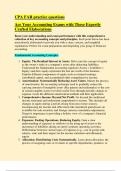
Boost your understanding and exam performance with this comprehensive
collection of key accounting concepts and principles. Each point below has been
meticulously elaborated to provide you with a clear, concise, and insightful
explanation. Perfect for exam preparation and deepening your grasp of financial
accounting.
Fundamental Accounting Concepts:
1. Equity: The Residual Interest in Assets. Delve into the concept of equity
as the owner's stake in a company's assets after deducting liabilities.
Understand the fundamental accounting equation (Assets = Liabilities +
Equity) and how equity represents the true net worth of the business.
Explore different components of equity such as retained earnings,
contributed capital, and accumulated other comprehensive income.
2. Amortization: Systematically Reducing Asset Values. Master the process
of amortization, the accounting technique used to gradually reduce the
carrying amount of intangible assets (like patents and trademarks) or the cost
of certain tangible assets over their useful lives through periodic charges to
expense. Learn the different amortization methods and their application.
3. Comprehensive Income: Beyond Net Profit. Go beyond the traditional
income statement and understand comprehensive income. This includes all
changes in equity during a period arising from non-owner sources,
encompassing net income and other items like unrealized gains/losses on
available-for-sale securities and foreign currency translation adjustments.
Grasp its importance in providing a holistic view of a company's financial
performance.
4. Expenses: Fueling Operations, Reducing Equity. Gain a clear
understanding of expenses as outflows or the using up of assets or the
incurrence of liabilities during an entity's primary operating activities.
Differentiate between various types of expenses (e.g., cost of goods sold,
salaries, rent) and their impact on the income statement and ultimately,
equity.
5. Allocation: Distributing Costs Systematically. Learn about allocation, the
process of assigning costs or revenues to specific departments, products, or
, time periods based on a rational and systematic method. Understand the
importance of accurate allocation for decision-making and performance
evaluation.
6. Deferral: Recognizing Cash Flows Later. Demystify deferral, an
accounting technique used when cash is received or paid before the related
revenue or expense is earned or incurred. Explore examples like prepaid
expenses and unearned revenue and understand how deferral ensures proper
matching of revenues and expenses in the correct accounting period.
7. Dividends: Returning Value to Owners. Understand dividends as
distributions of a company's accumulated earnings to its shareholders. Learn
about different types of dividends (cash, stock) and their impact on the
company's equity and cash flow.
Focus on Specific Reporting Entities:
8. Non-for-Profit Entities: Assessing Management Stewardship and
Performance. Discover the unique reporting objectives for non-profit
organizations, where the focus shifts from profit generation to evaluating
how effectively management utilizes resources to achieve the organization's
mission. Understand key performance indicators relevant to non-profits.
9. Non-for-Profit Entities: Assessing Services Provided. Explore how
financial reporting for non-profits emphasizes the measurement and
reporting of the services delivered to beneficiaries. Learn about different
ways non-profits quantify and communicate their impact.
10.General Purpose Financial Reporting: Providing Information for Broad
User Needs. Understand the objective of general-purpose financial
reporting, which aims to provide financial information useful to a wide
range of users (investors, creditors, etc.) for making economic decisions.
11.Non-for-Profit Entities: Factors Affecting Liquidity. Identify the specific
factors that can influence the liquidity (the ability to meet short-term
obligations) of non-profit organizations, considering their unique funding
models and operational characteristics.
12.General Purpose Financial Reporting: Guiding Investment and Credit
Decisions. Recognize the crucial role of general-purpose financial reports in
providing the necessary information for investors to make informed
investment decisions and for creditors to assess the creditworthiness of an
entity.
13.Governmental Entities: Emphasizing Public Accountability. Understand
the paramount importance of public accountability in governmental financial
reporting. Explore how governmental accounting standards and reporting
Ace Your Accounting Exams with These Expertly
Crafted Elaborations
Boost your understanding and exam performance with this comprehensive
collection of key accounting concepts and principles. Each point below has been
meticulously elaborated to provide you with a clear, concise, and insightful
explanation. Perfect for exam preparation and deepening your grasp of financial
accounting.
Fundamental Accounting Concepts:
1. Equity: The Residual Interest in Assets. Delve into the concept of equity
as the owner's stake in a company's assets after deducting liabilities.
Understand the fundamental accounting equation (Assets = Liabilities +
Equity) and how equity represents the true net worth of the business.
Explore different components of equity such as retained earnings,
contributed capital, and accumulated other comprehensive income.
2. Amortization: Systematically Reducing Asset Values. Master the process
of amortization, the accounting technique used to gradually reduce the
carrying amount of intangible assets (like patents and trademarks) or the cost
of certain tangible assets over their useful lives through periodic charges to
expense. Learn the different amortization methods and their application.
3. Comprehensive Income: Beyond Net Profit. Go beyond the traditional
income statement and understand comprehensive income. This includes all
changes in equity during a period arising from non-owner sources,
encompassing net income and other items like unrealized gains/losses on
available-for-sale securities and foreign currency translation adjustments.
Grasp its importance in providing a holistic view of a company's financial
performance.
4. Expenses: Fueling Operations, Reducing Equity. Gain a clear
understanding of expenses as outflows or the using up of assets or the
incurrence of liabilities during an entity's primary operating activities.
Differentiate between various types of expenses (e.g., cost of goods sold,
salaries, rent) and their impact on the income statement and ultimately,
equity.
5. Allocation: Distributing Costs Systematically. Learn about allocation, the
process of assigning costs or revenues to specific departments, products, or
, time periods based on a rational and systematic method. Understand the
importance of accurate allocation for decision-making and performance
evaluation.
6. Deferral: Recognizing Cash Flows Later. Demystify deferral, an
accounting technique used when cash is received or paid before the related
revenue or expense is earned or incurred. Explore examples like prepaid
expenses and unearned revenue and understand how deferral ensures proper
matching of revenues and expenses in the correct accounting period.
7. Dividends: Returning Value to Owners. Understand dividends as
distributions of a company's accumulated earnings to its shareholders. Learn
about different types of dividends (cash, stock) and their impact on the
company's equity and cash flow.
Focus on Specific Reporting Entities:
8. Non-for-Profit Entities: Assessing Management Stewardship and
Performance. Discover the unique reporting objectives for non-profit
organizations, where the focus shifts from profit generation to evaluating
how effectively management utilizes resources to achieve the organization's
mission. Understand key performance indicators relevant to non-profits.
9. Non-for-Profit Entities: Assessing Services Provided. Explore how
financial reporting for non-profits emphasizes the measurement and
reporting of the services delivered to beneficiaries. Learn about different
ways non-profits quantify and communicate their impact.
10.General Purpose Financial Reporting: Providing Information for Broad
User Needs. Understand the objective of general-purpose financial
reporting, which aims to provide financial information useful to a wide
range of users (investors, creditors, etc.) for making economic decisions.
11.Non-for-Profit Entities: Factors Affecting Liquidity. Identify the specific
factors that can influence the liquidity (the ability to meet short-term
obligations) of non-profit organizations, considering their unique funding
models and operational characteristics.
12.General Purpose Financial Reporting: Guiding Investment and Credit
Decisions. Recognize the crucial role of general-purpose financial reports in
providing the necessary information for investors to make informed
investment decisions and for creditors to assess the creditworthiness of an
entity.
13.Governmental Entities: Emphasizing Public Accountability. Understand
the paramount importance of public accountability in governmental financial
reporting. Explore how governmental accounting standards and reporting