

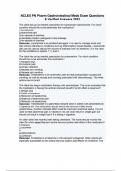
NCLEX PN Pharm Gastrointestinal Meds Exam Questions & Verified Answers 2023
The client has an as needed prescription for loperamide hydrochloride. For which condition should the nurse administer this medication? 1.Constipation 2.Abdominal pain 3.An episode of diarrhea 4.Hematest-positive nasogastric tube drainage 3.An episode of diarrhea Rationale: Loperamide is an antidiarrheal agent. It is used to manage acute and also chronic diarrhea in conditions such as inflammatory bowel disease. Loperamide also can be used to reduce the volume of drainage from an ileostomy. It is not used for the conditions in options 1, 2, and 4. The client has an as needed prescription for ondansetron. For which condition should the nurse administer this medication? 1.Paralytic ileus 2.Incisional pain 3.Urinary retention 4.Nausea and vomiting 4.Nausea and vomiting Rationale: Ondansetron is an antiemetic used to treat postoperative nausea and vomiting, as well as nausea and vomiting associated with chemotherapy. The other options are incorrect The client has begun medication therapy with pancrelipase. The nurse evaluates that the medication is having the optimal intended benefit if which effect is observed? 1.Weight loss 2.Relief of heartburn 3.Reduction of steatorrhea 4.Absence of abdominal pain 3.Reduction of steatorrhea Rationale: Pancrelipase is a pancreatic enzyme used in clients with pancreatitis as a digestive aid. The medication should reduce the amount of fatty stools (steatorrhea). Another intended effect could be improved nutritional status. It is not used to treat abdominal pain or heartburn. Its use could result in weight gain but should not result in weight loss if it is aiding in digestion. An older client has recently been taking cimetidine. The nurse should monitor the client for which most frequent central nervous system side effect of this medication? 1.Tremors 2.Dizziness v 4.Hallucinations 3.Confusion Rationale: Cimetidine is a histamine 2 (H2)-receptor antagonist. Older clients are especially susceptible to the central nervous system side effects of cimetidine. The most frequent of these is confusion. Less common central nervous system side effects include headache, dizziness, drowsiness, and hallucinations. A histamine (H2)-receptor antagonist will be prescribed for a client. The nurse understands that which medications are H2-receptor antagonists? Select all that apply. 1.Nizatidine 2.Ranitidine 3.Famotidine 4.Cimetidine 5.Esomeprazole 6.Lansoprazole 1.Nizatidine 2.Ranitidine 3.Famotidine 4.Cimetidine Rationale: H2-receptor antagonists suppress secretion of gastric acid, alleviate symptoms of heartburn, and assist with preventing complications of peptic ulcer disease. These medications also suppress gastric acid secretions and are used in active ulcer disease, erosive esophagitis, and pathological hypersecretory conditions. The other medications listed are proton pump inhibitors. The client who frequently uses nonsteroidal anti-inflammatory drugs (NSAIDs) has been taking misoprostol. The nurse determines that this medication is having the intended therapeutic effect if which is noted? 1.Resolved diarrhea 2.Relief of epigastric pain 3.Decreased platelet count 4.Decreased white blood cell count 2.Relief of epigastric pain Rationale: The client who frequently uses nonsteroidal antiinflammatory drugs (NSAIDs) is prone to gastric mucosal injury. Misoprostol is a gastric protectant and is given specifically to prevent this occurrence. Diarrhea can be a side effect of the medication, but it is not an intended effect. Options 3 and 4 are incorrect. The client has been taking omeprazole for 4 weeks. The nurse evaluates that the client is receiving the optimal intended effect of the medication if the client reports the absence of which symptom? 1.Diarrhea 2.Heartburn 3.Flatulence 4.Constipation 2.Heartburn Rationale: Omeprazole is a proton pump inhibitor classified as an antiulcer agent. The intended effect of the medication is relief of pain from gastric irritation, often called "heartburn" by clients. Omeprazole is not used to treat the conditions identified in options 1, 3, and 4. A client with a peptic ulcer is diagnosed with a Helicobacter pylori infection. The nurse is reinforcing teaching for the client about the medications prescribed, including clarithromycin, esomeprazole, and amoxicillin. Which statement by the client indicates the best understanding of the medication regimen? 1."My ulcer will heal because these medications will kill the bacteria." 2."These medications are only taken when I have pain from my ulcer." 3."The medications will kill the bacteria and stop the acid production." 4."These medications will coat the ulcer and decrease the acid production in my stomach." 3."The medications will kill the bacteria and stop the acid production." Rationale: Triple therapy for Helicobacter pylori infection usually includes two antibacterial drugs and a proton pump inhibitor. Clarithromycin and amoxicillin are antibacterials. Esomeprazole is a proton pump inhibitor. These medications will kill the bacteria and decrease acid production. The client with a gastric ulcer has a prescription for sucralfate 1 g by mouth four times daily. The nurse should schedule the medication to be administered at which times? 1.With meals and at bedtime 2.Every 6 hours around the clock 3.One hour after meals and at bedtime 4.One hour before meals and at bedtime 4.One hour before meals and at bedtime Rationale: Sucralfate is a gastric protectant. The medication should be scheduled for administration 1 hour before meals and at bedtime. The medication is timed to allow it to form a protective coating over the ulcer before food intake stimulates gastric acid production and mechanical irritation. The other options are incorrect. A postoperative client requests medication for flatulence (gas pains). Which medication from the PRN list should the nurse administer to this client? 1.Ondansetron 2.Simethicone 3.Acetaminophen 4.Magnesium hydroxide 2.Simethicone Rationale: Simethicone is an antiflatulent used in the relief of pain caused by excessive gas in the gastrointestinal tract. Ondansetron is used to treat postoperative nausea and vomiting. Acetaminophen is a nonopioid analgesic. Magnesium hydroxide is an antacid and laxative. An adult client with hepatic encephalopathy has a serum ammonia level of 120 mcg/dL (72 mcmol/L) and receives treatment with lactulose syrup. The nurse determines that the client has the best response if the level changes to which after medication administration? 1.2 mcg/dL (1.2 mcmol/L) 2.5 mcg/dL (3 mcmol/L) 3.70 mcg/dL (42 mcmol/L) 4.100 mcg/dL (60 mcmol/L) 3.70 mcg/dL (42 mcmol/L) Rationale: The normal serum ammonia level is 10 to 80 mcg/dL (6 to 47 mcmol/L). In the client with hepatic encephalopathy, the serum level is not likely to drop below normal. The most optimal yet realistic change from the options provided would be to 70 mcg/dL (42 mcmol/L), which falls in the normal range. A level of 100 mcg/dL (60 mcmol/L) represents an insufficient effect of the medication. Lactulose is administered for its hyperosmotic laxative effect, thus removing ammonia from the colon. The client should also be monitored for hypokalemia resulting from the severe purging lactulose causes. The nurse reinforces medication instructions to a client with peptic ulcer disease. Which statement by the client indicates the best understanding of the medication therapy? 1."Antacids will coat my stomach." 2."Omeprazole will coat the ulcer and help it heal." 3."Sucralfate will change the fluid in my stomach." 4."The nizatidine will cause me to produce less stomach acid." 4."The nizatidine will cause me to produce less stomach acid." Rationale: Nizatidine, a histamine H2-receptor blocker, is frequently used in the management of peptic ulcer disease. Histamine H2-receptor blockers decrease the secretion of gastric acid (HCL). Antacids are used as adjunct therapy and neutralize acid in the stomach. Omeprazole is a proton pump inhibitor. Sucralfate promotes healing by covering the ulcer, thus protecting it from erosion caused by gastric acids. A client is taking lansoprazole for the chronic management of Zollinger-Ellison syndrome. If prescribed, which medication would be appropriate for the client if needed for a headache? 1.Naprosyn 2.Ibuprofen 3.Acetaminophen 4.Acetylsalicylic acid 3.Acetaminophen Rationale: Zollinger-Ellison syndrome is a hypersecretory condition of the stomach. The client should avoid taking medications that are irritating to the stomach lining. Irritants would include aspirin and nonsteroidal antiinflammatory drugs (NSAIDs) such as naprosen and ibuprofen. Acetaminophen would likely be prescribed for headache for this client because it would not be irritating to the stomach. The client has a new prescription for metoclopramide. On review of the chart, the nurse identifies that this medication can be safely administered with which condition? 1.Intestinal obstruction 2.Peptic ulcer with melena 3.Diverticulitis with perforation 4.Vomiting following cancer chemotherapy 4.Vomiting following cancer chemotherapy Rationale: Metoclopramide is a gastrointestinal (GI) stimulant and antiemetic. Because it is a GI stimulant, it is contraindicated with GI obstruction, hemorrhage, or perforation. It is used in the treatment of emesis after surgery, chemotherapy, and radiation. The nurse has reinforced instructions to the client who has been prescribed cholestyramine. Which statement by the client indicates a need for further teaching? 1."I will continue taking vitamin supplements." 2."This medication will help lower my cholesterol."
Document information
- Uploaded on
- May 16, 2025
- Number of pages
- 12
- Written in
- 2024/2025
- Type
- Exam (elaborations)
- Contains
- Questions & answers


