

GNRS 610: Test #3 Study Guide
Unit-6 Epidemiology
- Levels of disease prevention
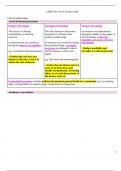
Primary Prevention Secondary Prevention Tertiary Prevention
The process of altering The early detection and prompt Its measures are implemented
susceptibility or reducing treatment of a disease at the during the middle or late stages of
exposure. earliest possible stage. clinical disease to alleviate
disability and restore effective
Its interventions are carried out Its measures are carried out during functioning.
during the stage of susceptibility. the preclinical stage. Screening
programs are designed to detect > Reduce morbidity and
e.g. vaccination and immunization specific diseases in their early mortality in a diseased person.
stages
> Patient does not have any
disease at this time. Goal is to e.g. Pap smear and mammography
reduce the risk of disease.
> Patient has the disease, but it is
early on in the process and
usually asymptomatic. Screening
allows us to catch the presence of
the disease early on.
Primordial Prevention: Includes policies that promote general health in a community (e.g. no smoking
signs, warning labels on cigarette packs, taking lead out of gasoline)
- Incidence vs prevalence
1
, - Prevalence = Incidence rate x Average duration of
https://www.omnicalculator.com/health/ disease
incidence-rate *Only applicable when prevalence is LOW (< 10%)
Short duration diseases (e.g., common cold):
Prevalence = Incidence
Chronic diseases due to large number of existing cases
(e.g., diabetes): Prevalence > Incidence
https://www.mdapp.co/prevalence-rate-formula-
calculator-586/
https://www.mdapp.co/incidence-rate-calculator-579/
- Calculating the number needed to treat (NNT)
Number needed to treat (NNT): # patients needed to be treated to achieve one favorable outcome
#1. Calculate ARR
Absolute risk reduction (ARR) = Experimental event rate (EER) – Control event rate (CER)
#2. Use ARR to calculate NNT
Number needed to treat (NNT) = 1/𝐴𝑅𝑅
https://www.omnicalculator.com/health/nnt
- The 2x2 table; definitions of, and calculating sensitivity, specificity, PPV, and NPV
TP: True positive (Test is positive and disease is present).
FP: False positive (Test is positive but disease is not present).
FN: False negative (Test is negative but disease is present).
TN: True negative (Test is negative and disease is not present).
1. How to calculate sensitivity?
a. Start w/ TP and go down to FN
b. True positive / True positive + False negative
2. How to calculate specificity?
2
, a. Start with TN and go up to FP
b. True negative / True negative + False positive
3. How to calculate PPV (Positive predictive value)?
a. Start with TP and go right to FP
b. True positive / True positive + False positive
4. How to calculate NPV (Negative predictive value?
a. Start with TN and go left to FN
b. True negative / True negative + False negative
https://www.omnicalculator.com/statistics/sensitivity-and-specificity
https://www.medcalc.org/calc/diagnostic_test.php
- The cutoff point: effects of increasing vs decreasing the cutoff point of a test
Decreasing the cutoff point will increase sensitivity (minimize FN) >> If you want to screen!
- leading to fewer false negatives but more false positives
Increasing the cutoff point will increase specificity (minimize FP) >> If you want to confirm a diagnosis!
- will reduce sensitivity, meaning there will be fewer false positives but more false negatives
- Screening tests: effect of sensitivity & specificity on the utility of a test for screening.
1. Sensitivity
a. A highly sensitive test is good for RULING out the disease when it is negative (SnOUT)
b. A sensitive test is primarily used as a screening tool
c. We usually start by doing a sensitive test, if it comes back “positive, we will do a more specific
test to confirm the diagnosis
d. Sensitivity is not related to the prevalence of the disease
e. If sensitivity increases, NPV increases
f. When sensitivity decreases, the test’s utility as a screening test is diminished because the
test fails to identify those having the disease (too many false negatives)
2. Specificity
3
Unit-6 Epidemiology
- Levels of disease prevention
Primary Prevention Secondary Prevention Tertiary Prevention
The process of altering The early detection and prompt Its measures are implemented
susceptibility or reducing treatment of a disease at the during the middle or late stages of
exposure. earliest possible stage. clinical disease to alleviate
disability and restore effective
Its interventions are carried out Its measures are carried out during functioning.
during the stage of susceptibility. the preclinical stage. Screening
programs are designed to detect > Reduce morbidity and
e.g. vaccination and immunization specific diseases in their early mortality in a diseased person.
stages
> Patient does not have any
disease at this time. Goal is to e.g. Pap smear and mammography
reduce the risk of disease.
> Patient has the disease, but it is
early on in the process and
usually asymptomatic. Screening
allows us to catch the presence of
the disease early on.
Primordial Prevention: Includes policies that promote general health in a community (e.g. no smoking
signs, warning labels on cigarette packs, taking lead out of gasoline)
- Incidence vs prevalence
1
, - Prevalence = Incidence rate x Average duration of
https://www.omnicalculator.com/health/ disease
incidence-rate *Only applicable when prevalence is LOW (< 10%)
Short duration diseases (e.g., common cold):
Prevalence = Incidence
Chronic diseases due to large number of existing cases
(e.g., diabetes): Prevalence > Incidence
https://www.mdapp.co/prevalence-rate-formula-
calculator-586/
https://www.mdapp.co/incidence-rate-calculator-579/
- Calculating the number needed to treat (NNT)
Number needed to treat (NNT): # patients needed to be treated to achieve one favorable outcome
#1. Calculate ARR
Absolute risk reduction (ARR) = Experimental event rate (EER) – Control event rate (CER)
#2. Use ARR to calculate NNT
Number needed to treat (NNT) = 1/𝐴𝑅𝑅
https://www.omnicalculator.com/health/nnt
- The 2x2 table; definitions of, and calculating sensitivity, specificity, PPV, and NPV
TP: True positive (Test is positive and disease is present).
FP: False positive (Test is positive but disease is not present).
FN: False negative (Test is negative but disease is present).
TN: True negative (Test is negative and disease is not present).
1. How to calculate sensitivity?
a. Start w/ TP and go down to FN
b. True positive / True positive + False negative
2. How to calculate specificity?
2
, a. Start with TN and go up to FP
b. True negative / True negative + False positive
3. How to calculate PPV (Positive predictive value)?
a. Start with TP and go right to FP
b. True positive / True positive + False positive
4. How to calculate NPV (Negative predictive value?
a. Start with TN and go left to FN
b. True negative / True negative + False negative
https://www.omnicalculator.com/statistics/sensitivity-and-specificity
https://www.medcalc.org/calc/diagnostic_test.php
- The cutoff point: effects of increasing vs decreasing the cutoff point of a test
Decreasing the cutoff point will increase sensitivity (minimize FN) >> If you want to screen!
- leading to fewer false negatives but more false positives
Increasing the cutoff point will increase specificity (minimize FP) >> If you want to confirm a diagnosis!
- will reduce sensitivity, meaning there will be fewer false positives but more false negatives
- Screening tests: effect of sensitivity & specificity on the utility of a test for screening.
1. Sensitivity
a. A highly sensitive test is good for RULING out the disease when it is negative (SnOUT)
b. A sensitive test is primarily used as a screening tool
c. We usually start by doing a sensitive test, if it comes back “positive, we will do a more specific
test to confirm the diagnosis
d. Sensitivity is not related to the prevalence of the disease
e. If sensitivity increases, NPV increases
f. When sensitivity decreases, the test’s utility as a screening test is diminished because the
test fails to identify those having the disease (too many false negatives)
2. Specificity
3


