

ATI Capstone Fundamentals Pre-Assessment Quiz Latest Update 2025
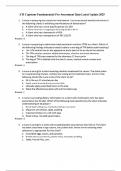
1. A nurse is assessing four clients for fluid balance. The nurse should identify that which of the following clients is exhibiting manifestations of dehydration? a. A client who has a urine specific gravity of 1.010 b. A client who has a weight gain of 2.2 kg (2 lb) in 24 hr c. A client who has a hematocrit of 45% d. A client who has a temperature of 39 C (102 F) Answer: d 2. A nurse is preparing to administer total parenteral nutrition (TPN) to a client. Which of the following findings indicates a need to obtain a new bag of TPN before administering? a. The TPN solution has an oily appearance and a layer of fat on top of the solution b. The TPN solution contains added electrolytes, vitamins and trace elements c. The bag of TPN was prepared by the pharmacy 12 hours prior d. The bag of TPN is labeled with the client’s name, medical record number and prescription Answer: a 3. A nurse is caring for a client receiving radiation treatments for cancer. The client states he is experiencing dryness, redness and scaling at the treatment area. Which of the following should the nurse instruct the client to do? a. Sit in the sun 15 minutes per day b. Apply moist heat to the area twice daily c. Liberally apply prescribed lotion to the area d. Wash the affected area daily with antimicrobial soap Answer: c 4. A nurse is providing dietary information to a client with cholecystitis who has been prescribed a low fat diet. Which of the following meal selections by the client indicates understanding of education? a. Roast beef with gravy, mashed potatoes, ice cream b. Macaroni and cheese, salad, pudding c. Creamed chicken on a roll with peas d. Roast turkey, rice pilaf, green beans Answer: d 5. A nurse is caring for a client with encephalopathy secondary to liver failure. The client has been prescribed a high calorie, low protein diet. Which of the following meal selections is appropriate for this client? a. Scrambled eggs, bacon, and pancakes b. Grilled cheese sandwich, potato chips, chocolate pudding c. Steak, French fries, corn d. Chicken breast, mashed potatoes, spinach Answer: d 6. A nurse is reviewing psychosocial stages of development for a school age child. What would be an expected behavioral finding for this child? a. Personalize values and beliefs and base reasoning on ethical fairness principles. Establish close relationships. Have influences that help with formation of healthy self-concept such as family and close friends. b. Develop sense of personal identity that family expectations influence. Peer relationships develop as support system. Concerned with body images that media portray. c. Develop sense of industry through advances in learning. Strive to develop healthy self-respect by finding out in what areas they excel. Peer groups play important role in social development. d. Take on new experiences and when unable to accomplish task may feel guilty or misbehave. Generally do not exhibit stranger anxiety. Understand behavior in terms of what is socially acceptable. Answer: c 7. A nurse is caring for an older adult with delirium. Which intervention will most effectively reduce the client’s risk for falls? a. Use of a night light b. Demonstrate how to use a call light c. Place bedside table in close proximity d. Hourly rounding by the nurse Answer: d 8. A client with a cystocele is encouraged to exercise to strengthen pelvic floor muscles and prevent organ prolapse. What exercise will the client need to perform? a. Kegel exercises b. Isometric exercises c. Circumduction exercises d. Uterine extension exercises Answer: a 9. Which of the following can cause a low pulse oximetry reading? a. Hyperthermia b. Increased hemoglobin level c. Inadequate peripheral circulation d.
Document information
- Uploaded on
- May 14, 2025
- Number of pages
- 4
- Written in
- 2024/2025
- Type
- Exam (elaborations)
- Contains
- Questions & answers


