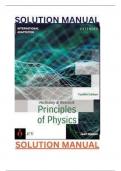
,Complete Solutions Manual
for Principles of Physics,
Extended, International
Adaptation, 12th Edition by
David Halliday, Robert
Resnick, Jearl Walker ;
ISBN13: 9781119820628. (Full
Chapters included Chapter 1
to 14) EXAM
1. Measurement. 2. Motion Along a Straight Line. 3. Vectors. 4. Motion in Two and Three
Dimensions. 5. Force and Motion--I. 6. Force and Motion--II. 7. Kinetic Energy and Work.
8. Potential Energy and Conservation of Energy. 9. Center of Mass and Linear Momentum.
10. Rotation. 11. Rolling, Torque, and Angular Momentum. 12. Equilibrium and Elasticity.
13. Gravitation. 14. Fluids. 15. Oscillations. 16. Waves--I. 17. Waves--II. 18. Temperature,
Heat, and the First Law of Thermodynamics. 19. The Kinetic Theory of Gases. 20. Entropy
and the Second Law of Thermodynamics. 21. Coulomb's Law. 22. Electric Fields. 23.
Gauss' Law. 24. Electric Potential. 25. Capacitance. 26. Current and Resistance. 27.
Circuits. 28. Magnetic Fields. 29. Magnetic Fields Due to Currents. 30. Induction and
Inductance. 31. Electromagnetic Oscillations and Alternating Current. 32. Maxwell's
Equations; Magnetism of Matter. 33. Electromagnetic Waves. 34. Images. 35. Interference.
36. Diffraction. 37. Relativity. 38. Photons and Matter Waves. 39. More About Matter
Waves. 40. All About Atoms. 41. Conduction of Electricity in Solids. 42. Nuclear Physics.
43. Energy from the Nucleus. 44. Quarks, Leptons, and the Big Bang
,Practice Test: Chapter 1 - Measurement - ANSWERS
Instructions: Choose the best answer for each question.
1. Physics is based on: (a) philosophical arguments. (b) experimental observations and
quantitative measurements. (c) personal opinions and beliefs. (d) mathematical proofs alone.
2. The SI unit of length is the: (a) centimeter. (b) kilometer. (c) meter. (d) foot.
3. The SI unit of time is the: (a) minute. (b) hour. (c) second. (d) day.
4. The SI unit of mass is the: (a) gram. (b) kilogram. (c) slug. (d) pound.
5. Which of the following is NOT a fundamental SI unit? (a) meter (b) second (c) Newton. (d)
kilogram
6. Which prefix in the metric system represents a factor of 103? (a) milli (b) micro (c) kilo. (d)
mega
7. Which prefix in the metric system represents a factor of 10−6? (a) milli (b) micro. (c) nano (d)
pico
8. How many centimeters are in 1 kilometer? (a) 100 (b) 1,000 (c) 10,000 (d) 100,000
9. How many nanoseconds are in 1 second? (a) 10−9 (b) 10−6 (c) 106 (d) 109
10. The result of a measurement should always be expressed with: (a) many decimal places. (b)
only one significant figure. (c) appropriate units. (d) very high precision.
11. Significant figures in a measurement indicate: (a) the number of digits known with
certainty plus one uncertain digit. (b) the total number of digits. (c) the number of decimal
places. (d) the precision of the measuring instrument.
12. How many significant figures are in the measurement 0.003050 m? (a) 3 (b) 4 (c) 6 (d) 7
13. How many significant figures are in the measurement 1.20 x 10⁵ kg? (a) 2 (b) 3 (c) 5 (d) 6
14. When multiplying or dividing measurements, the result should have the same number of
significant figures as: (a) the average number of significant figures in the original measurements.
(b) the measurement with the most significant figures. (c) the measurement with the fewest
significant figures. (d) the total number of significant figures in all measurements.
, 15. When adding or subtracting measurements, the result should have the same number of
decimal places as: (a) the average number of decimal places in the original measurements. (b) the
measurement with the most decimal places. (c) the measurement with the fewest decimal
places. (d) the total number of decimal places in all measurements.
16. The process of converting a measurement from one unit to another is called: (a) precision. (b)
accuracy. (c) unit conversion. (d) dimensional analysis.
17. Which of the following is a correct conversion factor? (a) 1 m = 10 cm (b) 1 kg = 1000 g (c)
1 s = 60 min (d) 1 km = 100 m
18. Estimate the order of magnitude of the number of seconds in a year. (a) 105 s (b) 107 s (c)
109 s (d) 1011 s
19. Dimensional analysis can be used to: (a) find the exact numerical value of a physical
quantity. (b) check the consistency of units in an equation. (c) determine the significant figures
in a calculation. (d) measure physical quantities with high precision.
20. Which of the following equations is dimensionally consistent if x is length and t is time? (a)
x=vt2 (where v is velocity) (b) x=at (where a is acceleration) (c) x=vt (d) v=xt
21. Accuracy refers to: (a) the closeness of a measurement to the true value. (b) the
reproducibility of a measurement. (c) the number of significant figures in a measurement. (d) the
smallest division on the measuring instrument.
22. Precision refers to: (a) the closeness of a measurement to the true value. (b) the
reproducibility of a measurement. (c) the number of significant figures in a measurement. (d)
the smallest division on the measuring instrument.
23. Random errors in measurement: (a) are constant and predictable. (b) have a definite cause
and affect all measurements in the same way. (c) fluctuate unpredictably and can be reduced
by taking multiple measurements. (d) are due to mistakes made by the person taking the
measurement.
24. Systematic errors in measurement: (a) fluctuate unpredictably. (b) have a definite cause and
affect all measurements in the same way. (c) can be reduced by taking multiple measurements.
(d) are due to limitations in the observer's skill.
25. A student measures the length of a table to be 1.50 m. The actual length is 1.52 m. The
percentage error in the measurement is: (a) 1.32% (b) 1.30% (c) 1.33% (d) 0.02% *(Calculation:
Percentage error = 1.52∣1.50−1.52∣×100%≈1.32%) *
26. Which of the following is the largest unit of length? (a) micrometer (b) millimeter (c)
kilometer (d) megameter
for Principles of Physics,
Extended, International
Adaptation, 12th Edition by
David Halliday, Robert
Resnick, Jearl Walker ;
ISBN13: 9781119820628. (Full
Chapters included Chapter 1
to 14) EXAM
1. Measurement. 2. Motion Along a Straight Line. 3. Vectors. 4. Motion in Two and Three
Dimensions. 5. Force and Motion--I. 6. Force and Motion--II. 7. Kinetic Energy and Work.
8. Potential Energy and Conservation of Energy. 9. Center of Mass and Linear Momentum.
10. Rotation. 11. Rolling, Torque, and Angular Momentum. 12. Equilibrium and Elasticity.
13. Gravitation. 14. Fluids. 15. Oscillations. 16. Waves--I. 17. Waves--II. 18. Temperature,
Heat, and the First Law of Thermodynamics. 19. The Kinetic Theory of Gases. 20. Entropy
and the Second Law of Thermodynamics. 21. Coulomb's Law. 22. Electric Fields. 23.
Gauss' Law. 24. Electric Potential. 25. Capacitance. 26. Current and Resistance. 27.
Circuits. 28. Magnetic Fields. 29. Magnetic Fields Due to Currents. 30. Induction and
Inductance. 31. Electromagnetic Oscillations and Alternating Current. 32. Maxwell's
Equations; Magnetism of Matter. 33. Electromagnetic Waves. 34. Images. 35. Interference.
36. Diffraction. 37. Relativity. 38. Photons and Matter Waves. 39. More About Matter
Waves. 40. All About Atoms. 41. Conduction of Electricity in Solids. 42. Nuclear Physics.
43. Energy from the Nucleus. 44. Quarks, Leptons, and the Big Bang
,Practice Test: Chapter 1 - Measurement - ANSWERS
Instructions: Choose the best answer for each question.
1. Physics is based on: (a) philosophical arguments. (b) experimental observations and
quantitative measurements. (c) personal opinions and beliefs. (d) mathematical proofs alone.
2. The SI unit of length is the: (a) centimeter. (b) kilometer. (c) meter. (d) foot.
3. The SI unit of time is the: (a) minute. (b) hour. (c) second. (d) day.
4. The SI unit of mass is the: (a) gram. (b) kilogram. (c) slug. (d) pound.
5. Which of the following is NOT a fundamental SI unit? (a) meter (b) second (c) Newton. (d)
kilogram
6. Which prefix in the metric system represents a factor of 103? (a) milli (b) micro (c) kilo. (d)
mega
7. Which prefix in the metric system represents a factor of 10−6? (a) milli (b) micro. (c) nano (d)
pico
8. How many centimeters are in 1 kilometer? (a) 100 (b) 1,000 (c) 10,000 (d) 100,000
9. How many nanoseconds are in 1 second? (a) 10−9 (b) 10−6 (c) 106 (d) 109
10. The result of a measurement should always be expressed with: (a) many decimal places. (b)
only one significant figure. (c) appropriate units. (d) very high precision.
11. Significant figures in a measurement indicate: (a) the number of digits known with
certainty plus one uncertain digit. (b) the total number of digits. (c) the number of decimal
places. (d) the precision of the measuring instrument.
12. How many significant figures are in the measurement 0.003050 m? (a) 3 (b) 4 (c) 6 (d) 7
13. How many significant figures are in the measurement 1.20 x 10⁵ kg? (a) 2 (b) 3 (c) 5 (d) 6
14. When multiplying or dividing measurements, the result should have the same number of
significant figures as: (a) the average number of significant figures in the original measurements.
(b) the measurement with the most significant figures. (c) the measurement with the fewest
significant figures. (d) the total number of significant figures in all measurements.
, 15. When adding or subtracting measurements, the result should have the same number of
decimal places as: (a) the average number of decimal places in the original measurements. (b) the
measurement with the most decimal places. (c) the measurement with the fewest decimal
places. (d) the total number of decimal places in all measurements.
16. The process of converting a measurement from one unit to another is called: (a) precision. (b)
accuracy. (c) unit conversion. (d) dimensional analysis.
17. Which of the following is a correct conversion factor? (a) 1 m = 10 cm (b) 1 kg = 1000 g (c)
1 s = 60 min (d) 1 km = 100 m
18. Estimate the order of magnitude of the number of seconds in a year. (a) 105 s (b) 107 s (c)
109 s (d) 1011 s
19. Dimensional analysis can be used to: (a) find the exact numerical value of a physical
quantity. (b) check the consistency of units in an equation. (c) determine the significant figures
in a calculation. (d) measure physical quantities with high precision.
20. Which of the following equations is dimensionally consistent if x is length and t is time? (a)
x=vt2 (where v is velocity) (b) x=at (where a is acceleration) (c) x=vt (d) v=xt
21. Accuracy refers to: (a) the closeness of a measurement to the true value. (b) the
reproducibility of a measurement. (c) the number of significant figures in a measurement. (d) the
smallest division on the measuring instrument.
22. Precision refers to: (a) the closeness of a measurement to the true value. (b) the
reproducibility of a measurement. (c) the number of significant figures in a measurement. (d)
the smallest division on the measuring instrument.
23. Random errors in measurement: (a) are constant and predictable. (b) have a definite cause
and affect all measurements in the same way. (c) fluctuate unpredictably and can be reduced
by taking multiple measurements. (d) are due to mistakes made by the person taking the
measurement.
24. Systematic errors in measurement: (a) fluctuate unpredictably. (b) have a definite cause and
affect all measurements in the same way. (c) can be reduced by taking multiple measurements.
(d) are due to limitations in the observer's skill.
25. A student measures the length of a table to be 1.50 m. The actual length is 1.52 m. The
percentage error in the measurement is: (a) 1.32% (b) 1.30% (c) 1.33% (d) 0.02% *(Calculation:
Percentage error = 1.52∣1.50−1.52∣×100%≈1.32%) *
26. Which of the following is the largest unit of length? (a) micrometer (b) millimeter (c)
kilometer (d) megameter