MGRADES
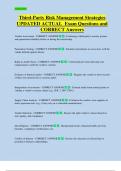
Third-Party Risk Management Strategies
UPDATED ACTUAL Exam Questions and
CORRECT Answers
Vendor Assessment - CORRECT ANSWER - Evaluating a third-party's security posture
and operational reliability before or during the relationship.
Penetration Testing - CORRECT ANSWER - Simulate cyberattacks to assess how well the
vendor defends against threats.
Right-to-Audit Clause - CORRECT ANSWER - Contractual provision allowing your
organization to audit the vendor's controls.
Evidence of Internal Audits - CORRECT ANSWER - Requires the vendor to show records
of their own internal risk or security audits.
Independent Assessments - CORRECT ANSWER - External audits from neutral parties to
validate a vendor's security claims (e.g., SOC 2, ISO 27001).
Supply Chain Analysis - CORRECT ANSWER - Evaluates the vendor's own suppliers to
detect upstream risks (e.g., if they rely on a vulnerable manufacturer).
Vendor Selection - CORRECT ANSWER - Ensures the right vendor is chosen based on
risk, quality, and compliance.
Due Diligence - CORRECT ANSWER - Background checks, financial health, previous
breaches, compliance certifications, etc.
Conflict of Interest - CORRECT ANSWER - Ensures the selection isn't biased due to
personal or business relationships.
Third-Party Risk Management Strategies
UPDATED ACTUAL Exam Questions and
CORRECT Answers
Vendor Assessment - CORRECT ANSWER - Evaluating a third-party's security posture
and operational reliability before or during the relationship.
Penetration Testing - CORRECT ANSWER - Simulate cyberattacks to assess how well the
vendor defends against threats.
Right-to-Audit Clause - CORRECT ANSWER - Contractual provision allowing your
organization to audit the vendor's controls.
Evidence of Internal Audits - CORRECT ANSWER - Requires the vendor to show records
of their own internal risk or security audits.
Independent Assessments - CORRECT ANSWER - External audits from neutral parties to
validate a vendor's security claims (e.g., SOC 2, ISO 27001).
Supply Chain Analysis - CORRECT ANSWER - Evaluates the vendor's own suppliers to
detect upstream risks (e.g., if they rely on a vulnerable manufacturer).
Vendor Selection - CORRECT ANSWER - Ensures the right vendor is chosen based on
risk, quality, and compliance.
Due Diligence - CORRECT ANSWER - Background checks, financial health, previous
breaches, compliance certifications, etc.
Conflict of Interest - CORRECT ANSWER - Ensures the selection isn't biased due to
personal or business relationships.