

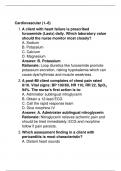
Cardiovascular (1–8)
1. A client with heart failure is prescribed
furosemide (Lasix) daily. Which laboratory value
should the nurse monitor most closely?
A. Sodium
B. Potassium
C. Calcium
D. Magnesium
Answer: B. Potassium
Rationale: Loop diuretics like furosemide promote
potassium excretion, risking hypokalemia which can
cause dysrhythmias and muscle weakness.
2. A post-MI client complains of chest pain rated
8/10. Vital signs: BP 100/60, HR 110, RR 22, SpO₂
94%. The nurse’s first action is to:
A. Administer sublingual nitroglycerin
B. Obtain a 12-lead ECG
C. Call the rapid response team
D. Give morphine IV
Answer: A. Administer sublingual nitroglycerin
Rationale: Nitroglycerin relieves ischemic pain and
should be tried immediately; ECG and morphine
follow if pain persists.
3. Which assessment finding in a client with
pericarditis is most characteristic?
A. Distant heart sounds
, B. Friction rub heard best at left lower sternal border
C. Jugular vein distention
D. Loud S₃ gallop
Answer: B. Friction rub heard best at left lower
sternal border
Rationale: Pericardial friction rub is pathognomonic
for pericarditis due to inflamed pericardial layers
rubbing.
4. A client with deep vein thrombosis is started on
heparin. Which lab is critical to monitor?
A. INR
B. aPTT
C. PT
D. Platelet count
Answer: B. aPTT
Rationale: Heparin’s effectiveness and safety are
gauged by activated partial thromboplastin time.
5. Which sign indicates left-sided heart failure?
A. Peripheral edema
B. Crackles in lung bases
C. JVD
D. Hepatomegaly
Answer: B. Crackles in lung bases
Rationale: Left-sided failure leads to pulmonary
congestion, manifesting as crackles.
6. A client on digoxin presents with nausea, visual
disturbances, and dysrhythmias. The nurse
, suspects:
A. Hypokalemia
B. Digoxin toxicity
C. Myocardial reinfarction
D. Anxiety reaction
Answer: B. Digoxin toxicity
Rationale: GI upset, visual changes (yellow halo),
and heart block are classic digoxin toxicity signs.
7. Which teaching point is most important for a
client receiving warfarin (Coumadin)?
A. Increase intake of green leafy vegetables
B. Monitor INR regularly
C. Take vitamin K supplements
D. Avoid aspirin
Answer: B. Monitor INR regularly
Rationale: Warfarin requires frequent INR checks to
maintain therapeutic anticoagulation and avoid
bleeding.
8. A client with a new mechanical aortic valve is on
warfarin. Target INR is:
A. 1.0–1.5
B. 2.0–3.0
C. 2.5–3.5
D. 3.5–4.5
Answer: C. 2.5–3.5
Rationale: Mechanical aortic valves require a slightly
higher INR for thrombosis prevention.
1. A client with heart failure is prescribed
furosemide (Lasix) daily. Which laboratory value
should the nurse monitor most closely?
A. Sodium
B. Potassium
C. Calcium
D. Magnesium
Answer: B. Potassium
Rationale: Loop diuretics like furosemide promote
potassium excretion, risking hypokalemia which can
cause dysrhythmias and muscle weakness.
2. A post-MI client complains of chest pain rated
8/10. Vital signs: BP 100/60, HR 110, RR 22, SpO₂
94%. The nurse’s first action is to:
A. Administer sublingual nitroglycerin
B. Obtain a 12-lead ECG
C. Call the rapid response team
D. Give morphine IV
Answer: A. Administer sublingual nitroglycerin
Rationale: Nitroglycerin relieves ischemic pain and
should be tried immediately; ECG and morphine
follow if pain persists.
3. Which assessment finding in a client with
pericarditis is most characteristic?
A. Distant heart sounds
, B. Friction rub heard best at left lower sternal border
C. Jugular vein distention
D. Loud S₃ gallop
Answer: B. Friction rub heard best at left lower
sternal border
Rationale: Pericardial friction rub is pathognomonic
for pericarditis due to inflamed pericardial layers
rubbing.
4. A client with deep vein thrombosis is started on
heparin. Which lab is critical to monitor?
A. INR
B. aPTT
C. PT
D. Platelet count
Answer: B. aPTT
Rationale: Heparin’s effectiveness and safety are
gauged by activated partial thromboplastin time.
5. Which sign indicates left-sided heart failure?
A. Peripheral edema
B. Crackles in lung bases
C. JVD
D. Hepatomegaly
Answer: B. Crackles in lung bases
Rationale: Left-sided failure leads to pulmonary
congestion, manifesting as crackles.
6. A client on digoxin presents with nausea, visual
disturbances, and dysrhythmias. The nurse
, suspects:
A. Hypokalemia
B. Digoxin toxicity
C. Myocardial reinfarction
D. Anxiety reaction
Answer: B. Digoxin toxicity
Rationale: GI upset, visual changes (yellow halo),
and heart block are classic digoxin toxicity signs.
7. Which teaching point is most important for a
client receiving warfarin (Coumadin)?
A. Increase intake of green leafy vegetables
B. Monitor INR regularly
C. Take vitamin K supplements
D. Avoid aspirin
Answer: B. Monitor INR regularly
Rationale: Warfarin requires frequent INR checks to
maintain therapeutic anticoagulation and avoid
bleeding.
8. A client with a new mechanical aortic valve is on
warfarin. Target INR is:
A. 1.0–1.5
B. 2.0–3.0
C. 2.5–3.5
D. 3.5–4.5
Answer: C. 2.5–3.5
Rationale: Mechanical aortic valves require a slightly
higher INR for thrombosis prevention.


