Nervous system development 31-10-2019
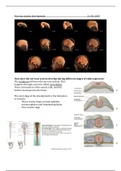
How does the nervous system develop during different stages of embryogenesis?
The ectoderm will form the nervous system. This
happens through a process called neurulation.
There is formation of the neural tube, and this
further develops into the brain.
The next stage of the development is the formation
of vesicles.
- Three vesicle stage: prosencephalon,
mesencephalon and rhombencephalon.
- Five-vesicle stage
,How can different brain cells be formed?
There are 3 important stages in neuronal development:
1. Cell proliferation
2. Cell migration
3. Cell differentiation
First, they proliferate, then they go to the place where they play a role, and in these
places they differentiate further into the function required for the specific region.
The brain develops from the walls of
the 5 fluid-filled vesicles, in the early
stages consisting of two layers: the
ventricular zone and the marginal
zone.
Cell proliferation
If you make a section of the brain, you
see that the vesicles have two layers. In
these layers, the cell proliferation
happens. There are 5 positions:
1. The neuronal cell is in the
ventricular zone. Then, the
neuronal cell moves to the
marginal zone.
2. Now, the DNA is copied and the
cell moves further into the pial
surface.
3. When the DNA is completely copied, the cell migrates back into the ventricular
zone.
4. Cell retracts arm from pia surface.
5. The cell divides into two:
o Symmetrical: two identical cells = radial glial cells
o Asymmetrical: one of the cells becomes a radial glial cell (precursor cells),
and one becomes a neuron.
The precursor cells are important at the beginning of the brain formation. At a certain
moment, you want to start forming neurons, so that is why there are two mechanisms of
dividing.
Cell migration
Once you have generated some cells, the
cells need to migrate to the right places
where they will function. The radial glial
cells are long, and because of this
structures, the neuron can migrate (via the
radial glial cells) to reach other layers,
deeper into the brain, where they will
function.
,Radial glial cells are in fact progenitor cells that generate both neurons and astrocytes.
They are the precursors of the neurons, but also of the post-mitotic neurons as well
(neurons in the mature brain).
The neurons will migrate from the
ventricular zone to the marginal zone.
The first cells t migrate to the cortical
plate are those that form the
subplate. As these differentiate into
neurons, the neural precursor cells
destined to become layer VI cells
migrate past and collect in the
cortical plate. This process repeats
again and again until all layers of the
cortex have differentiated. The
subplate neurons then disappear.
Cell differentiation
The growing cone is the tip of the neurite (gives rise to an
axon/dendrite). It is specialized to identify an appropriate path
for neurite elongation. The growing cone contains the
lamellipodia and the filopodia. The lamellipodia are the
structures that define the tentacles, and the filopodia are inside
those tentacles and go out, like filaments.
The differentiation of axons and dendrites marks the emergence
of neuronal polarity. Lamellipodia and filopodia undulate in
rhythmic waves and probe the environment.
, From a precursor cell, you can
get other precursor cells →
symmetric division.
If you have asymmetric
division, you can get a
precursor cell and a neuron,
but also a precursor cells and
an astroglia cell for example.
Usually, in the first asymmetric division, you get fast neuronal formation, and when the
neurons are ready, you will start forming astroglia. The order of forming cells = neurons
→ glial cells → oligodendrocytes.
Neural stem cells
Neuroblasts (same as progenitor cells, but then specific for neurons) are formed by the
asymmetric division of radial glial cells. Neurogenesis can only take place when neural
stem cells have transitioned into radial glial cells.
The proliferating progenitor cells or neuroblasts that give rise to more differentiated
progeny but themselves remain in the cell cycle are called neural stem cells.
In most animals, most proliferating neural cells use themselves up during development
so the sources of new neurons in an adult are extremely limited. In adult mammals,
neural stem cells persist in the hippocampus.
If you have a stem cell, which becomes a glial
progenitor, and it has an inhibition of Notch
signalling, it becomes an oligodendrocyte. But,
if notch signalling is activated, it will become
an astrocyte.
If the notch signalling is inhibited for the
neuronal progenitor cell, the cell becomes a
neuron.
How does the nervous system develop during different stages of embryogenesis?
The ectoderm will form the nervous system. This
happens through a process called neurulation.
There is formation of the neural tube, and this
further develops into the brain.
The next stage of the development is the formation
of vesicles.
- Three vesicle stage: prosencephalon,
mesencephalon and rhombencephalon.
- Five-vesicle stage
,How can different brain cells be formed?
There are 3 important stages in neuronal development:
1. Cell proliferation
2. Cell migration
3. Cell differentiation
First, they proliferate, then they go to the place where they play a role, and in these
places they differentiate further into the function required for the specific region.
The brain develops from the walls of
the 5 fluid-filled vesicles, in the early
stages consisting of two layers: the
ventricular zone and the marginal
zone.
Cell proliferation
If you make a section of the brain, you
see that the vesicles have two layers. In
these layers, the cell proliferation
happens. There are 5 positions:
1. The neuronal cell is in the
ventricular zone. Then, the
neuronal cell moves to the
marginal zone.
2. Now, the DNA is copied and the
cell moves further into the pial
surface.
3. When the DNA is completely copied, the cell migrates back into the ventricular
zone.
4. Cell retracts arm from pia surface.
5. The cell divides into two:
o Symmetrical: two identical cells = radial glial cells
o Asymmetrical: one of the cells becomes a radial glial cell (precursor cells),
and one becomes a neuron.
The precursor cells are important at the beginning of the brain formation. At a certain
moment, you want to start forming neurons, so that is why there are two mechanisms of
dividing.
Cell migration
Once you have generated some cells, the
cells need to migrate to the right places
where they will function. The radial glial
cells are long, and because of this
structures, the neuron can migrate (via the
radial glial cells) to reach other layers,
deeper into the brain, where they will
function.
,Radial glial cells are in fact progenitor cells that generate both neurons and astrocytes.
They are the precursors of the neurons, but also of the post-mitotic neurons as well
(neurons in the mature brain).
The neurons will migrate from the
ventricular zone to the marginal zone.
The first cells t migrate to the cortical
plate are those that form the
subplate. As these differentiate into
neurons, the neural precursor cells
destined to become layer VI cells
migrate past and collect in the
cortical plate. This process repeats
again and again until all layers of the
cortex have differentiated. The
subplate neurons then disappear.
Cell differentiation
The growing cone is the tip of the neurite (gives rise to an
axon/dendrite). It is specialized to identify an appropriate path
for neurite elongation. The growing cone contains the
lamellipodia and the filopodia. The lamellipodia are the
structures that define the tentacles, and the filopodia are inside
those tentacles and go out, like filaments.
The differentiation of axons and dendrites marks the emergence
of neuronal polarity. Lamellipodia and filopodia undulate in
rhythmic waves and probe the environment.
, From a precursor cell, you can
get other precursor cells →
symmetric division.
If you have asymmetric
division, you can get a
precursor cell and a neuron,
but also a precursor cells and
an astroglia cell for example.
Usually, in the first asymmetric division, you get fast neuronal formation, and when the
neurons are ready, you will start forming astroglia. The order of forming cells = neurons
→ glial cells → oligodendrocytes.
Neural stem cells
Neuroblasts (same as progenitor cells, but then specific for neurons) are formed by the
asymmetric division of radial glial cells. Neurogenesis can only take place when neural
stem cells have transitioned into radial glial cells.
The proliferating progenitor cells or neuroblasts that give rise to more differentiated
progeny but themselves remain in the cell cycle are called neural stem cells.
In most animals, most proliferating neural cells use themselves up during development
so the sources of new neurons in an adult are extremely limited. In adult mammals,
neural stem cells persist in the hippocampus.
If you have a stem cell, which becomes a glial
progenitor, and it has an inhibition of Notch
signalling, it becomes an oligodendrocyte. But,
if notch signalling is activated, it will become
an astrocyte.
If the notch signalling is inhibited for the
neuronal progenitor cell, the cell becomes a
neuron.