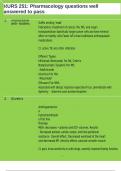
NURS 251: Pharmacology questions well
answered to pass
1. monoclonal
anti- bodies Suffix ending 'mab'
Indications: treatment of cancer, RA, MS, and organ
transplantation Specifically target cancer cells and have minimal
effect on healthy cells Fewer AE's than traditional antineoplastic
medications
CI: active TB and other infections
Different Types
Infliximab (Remicade) For RA, Crohn's
Natalizumab (Tysabri) For MS
·Adalimumab
(Humira) For RA
·Rituximab*
(Rituxan) For NHL
Associated with allergic response especially RI tux; premedicate with
diphenhy- dramine and acetaminophen
2. Diuretics
Antihypertensiv
e
hydrochlorothiazid
e first line
therapy
MOA: decreases • plasma and ECF volumes. Results
- Decreased preload, cardiac output, and total peripheral
resistance Overall effect: Decreased workload of the heart
and decreased BP. directly affects vascular smooth muscle
CI: gout, know sensitivity to sulfa drugs, severely impaired kidney function,
,NURS 251: Pharmacology questions well
answered to pass
hx of hyponatremia
AE: dry mouth, thirst, weakness, drowsiness, lethargy, muscle aches,
muscular fatigue, tachycardia, GI disturbances
NI: monitor for signs of electrolyte imbalance, encourage intake of
potassium-rich
,NURS 251: Pharmacology questions well
answered to pass
foods (i.e. fruits), gerontologic: risk of postural hypotension significant
due to volume depletion; measure BP in three positions; caution patient
to rise slowly
3. Adrenergic Antihypertensive
Issues with orthostatic hypotension & first dose syncope (especially α
blockers) Asthma and glucose metabolism issues (hypoglycemia by
preventing glycogenol- ysis) with β blocker combo's (i.e. carvedilol)
Interact with CNS depressants (alcohol, benzodiazepines, and opioids)
Nonselective β blockers will have both heart β1 and respiratory β2 effects;
β1 recommended for history of restrictive airway conditions
4. a1 blockers adrenergic
Doxazosin
mesylate
MOA: peripheral vasodilator acting directly on the blood vessel
CO: angina pectoris and coronary artery disease; induces tachycardia if
not pre- ceded by admin of propranolol and a diuretic
AE: vomiting and diarrhea, urinary frequency, cardiovascular collapse
(especially if given with hydralazine without lowering the dose of the
latter); drowsiness, lack of energy, and weakness
5. a2 agonist
adrenergi
c
Clonidin
e
centrally acting; norepinephrine and blood pressure
MOA: acts through CNS through centrally mediated alpha-adrenergic
stimulation in the brain, producing blood pressure reduction
CO: severe coronary artery disease, pregnancy
AE dry mouth, drowsiness, headaches, fatigue, anorexia, malaise, vomiting,
, NURS 251: Pharmacology questions well
answered to pass
mild liver function disturbance, sleepiness, constipation, impotence
NI: rebound or withdrawal hypertension common; monitor BP when
discontinu- ing medication
6. adrenergic
nebivolol promoted as causing less sexual dysfunction than Clonidine
answered to pass
1. monoclonal
anti- bodies Suffix ending 'mab'
Indications: treatment of cancer, RA, MS, and organ
transplantation Specifically target cancer cells and have minimal
effect on healthy cells Fewer AE's than traditional antineoplastic
medications
CI: active TB and other infections
Different Types
Infliximab (Remicade) For RA, Crohn's
Natalizumab (Tysabri) For MS
·Adalimumab
(Humira) For RA
·Rituximab*
(Rituxan) For NHL
Associated with allergic response especially RI tux; premedicate with
diphenhy- dramine and acetaminophen
2. Diuretics
Antihypertensiv
e
hydrochlorothiazid
e first line
therapy
MOA: decreases • plasma and ECF volumes. Results
- Decreased preload, cardiac output, and total peripheral
resistance Overall effect: Decreased workload of the heart
and decreased BP. directly affects vascular smooth muscle
CI: gout, know sensitivity to sulfa drugs, severely impaired kidney function,
,NURS 251: Pharmacology questions well
answered to pass
hx of hyponatremia
AE: dry mouth, thirst, weakness, drowsiness, lethargy, muscle aches,
muscular fatigue, tachycardia, GI disturbances
NI: monitor for signs of electrolyte imbalance, encourage intake of
potassium-rich
,NURS 251: Pharmacology questions well
answered to pass
foods (i.e. fruits), gerontologic: risk of postural hypotension significant
due to volume depletion; measure BP in three positions; caution patient
to rise slowly
3. Adrenergic Antihypertensive
Issues with orthostatic hypotension & first dose syncope (especially α
blockers) Asthma and glucose metabolism issues (hypoglycemia by
preventing glycogenol- ysis) with β blocker combo's (i.e. carvedilol)
Interact with CNS depressants (alcohol, benzodiazepines, and opioids)
Nonselective β blockers will have both heart β1 and respiratory β2 effects;
β1 recommended for history of restrictive airway conditions
4. a1 blockers adrenergic
Doxazosin
mesylate
MOA: peripheral vasodilator acting directly on the blood vessel
CO: angina pectoris and coronary artery disease; induces tachycardia if
not pre- ceded by admin of propranolol and a diuretic
AE: vomiting and diarrhea, urinary frequency, cardiovascular collapse
(especially if given with hydralazine without lowering the dose of the
latter); drowsiness, lack of energy, and weakness
5. a2 agonist
adrenergi
c
Clonidin
e
centrally acting; norepinephrine and blood pressure
MOA: acts through CNS through centrally mediated alpha-adrenergic
stimulation in the brain, producing blood pressure reduction
CO: severe coronary artery disease, pregnancy
AE dry mouth, drowsiness, headaches, fatigue, anorexia, malaise, vomiting,
, NURS 251: Pharmacology questions well
answered to pass
mild liver function disturbance, sleepiness, constipation, impotence
NI: rebound or withdrawal hypertension common; monitor BP when
discontinu- ing medication
6. adrenergic
nebivolol promoted as causing less sexual dysfunction than Clonidine