

Homeostasis
Feedback Mechanism
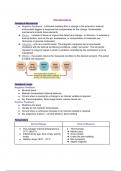
● Negative Feedback - a stimulus resulting from a change in the external or internal
environment triggers a response that compensates for the change. Homeostasis
mechanisms include three elements:
➔ Sensor - consists of tissue or organs that detect any change - or stimulus - in external or
internal factors, such as the pH, temperature, or concentration of molecules (ex.
Hormones or glucose molecules)
➔ Integrator - acts as a control center. The integrator compares the environmental
conditions with the optimal functioning conditions, called “set points”. The set points
represent a range of values in which a condition controlled by the mechanism is to be
maintained
➔ Effector - the system returns the measured condition to the desired set point. This action
is called “the response”
Feedback Loops
Negative Feedback
● Reverse trend
● Maintain homeostasis (internal balance)
● Occurs when a reversal to a change in an internal variable is required
● Eg. thermoregulation, blood sugar levels, calcium levels, etc
Positive Feedback
● Reinforce the trend
● Usually do not maintain homeostasis
● Occurs when a continuous increase in an internal variable is required
● Eg. pregnancy (Labour - cervical dilation), blood clotting
Temperature
Normal Range How to Measure
● The average* internal temperature is ● Thermometer
37°C (98.6°F) ➔ Mouth (oral)
● Influenced by age, time of day, activity ➔ Anus (rectal)
levels ➔ Under the arm (axillary)
● Healthy range: 36.5° - 37.3° ➔ Ear (tympanic)
➔ Vagina (vaginal)
, ➔ Bladder
➔ Skin of forehead over temporal artery
Thermoregulation *
● Proccess that is based on negative feedback mechanisms
Recalling Osmosis
● Osmosis: diffusion of H2O across a selectively permeable
membrane
● Hyperosmotic: solution with a higher concentration of
solute molecules on one side of a selectively permeable
membrane
● Hyposmotic: lower solute concentration. Water tends to
move to the hypoosmotic side
● Isosmotic: same solute and water concentration
Osmoregulation
● Osmotic Pressure: pressure that results from a difference in water concentration of
solutes across a membrane
● Osmoregulation: The process of actively regulating the osmotic pressure of bodily
fluids and cells
● The goal for organisms to keep intracellular fluid & extracellular fluid isosmotic (same
pressure)
● Some compounds must be eliminated
Nitrogenous Wastes
● Nitrogen is produced in different groups of animals
Feedback Mechanism
● Negative Feedback - a stimulus resulting from a change in the external or internal
environment triggers a response that compensates for the change. Homeostasis
mechanisms include three elements:
➔ Sensor - consists of tissue or organs that detect any change - or stimulus - in external or
internal factors, such as the pH, temperature, or concentration of molecules (ex.
Hormones or glucose molecules)
➔ Integrator - acts as a control center. The integrator compares the environmental
conditions with the optimal functioning conditions, called “set points”. The set points
represent a range of values in which a condition controlled by the mechanism is to be
maintained
➔ Effector - the system returns the measured condition to the desired set point. This action
is called “the response”
Feedback Loops
Negative Feedback
● Reverse trend
● Maintain homeostasis (internal balance)
● Occurs when a reversal to a change in an internal variable is required
● Eg. thermoregulation, blood sugar levels, calcium levels, etc
Positive Feedback
● Reinforce the trend
● Usually do not maintain homeostasis
● Occurs when a continuous increase in an internal variable is required
● Eg. pregnancy (Labour - cervical dilation), blood clotting
Temperature
Normal Range How to Measure
● The average* internal temperature is ● Thermometer
37°C (98.6°F) ➔ Mouth (oral)
● Influenced by age, time of day, activity ➔ Anus (rectal)
levels ➔ Under the arm (axillary)
● Healthy range: 36.5° - 37.3° ➔ Ear (tympanic)
➔ Vagina (vaginal)
, ➔ Bladder
➔ Skin of forehead over temporal artery
Thermoregulation *
● Proccess that is based on negative feedback mechanisms
Recalling Osmosis
● Osmosis: diffusion of H2O across a selectively permeable
membrane
● Hyperosmotic: solution with a higher concentration of
solute molecules on one side of a selectively permeable
membrane
● Hyposmotic: lower solute concentration. Water tends to
move to the hypoosmotic side
● Isosmotic: same solute and water concentration
Osmoregulation
● Osmotic Pressure: pressure that results from a difference in water concentration of
solutes across a membrane
● Osmoregulation: The process of actively regulating the osmotic pressure of bodily
fluids and cells
● The goal for organisms to keep intracellular fluid & extracellular fluid isosmotic (same
pressure)
● Some compounds must be eliminated
Nitrogenous Wastes
● Nitrogen is produced in different groups of animals


