Types of Matrices
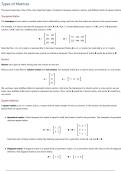
This lesson describes a few of the more important types of matrices: transpose matrices, vectors, and different kinds of square matrices
Transpose Matrix
The transpose of one matrix is another matrix that is obtained by using rows from the first matrix as columns in the second matrix.
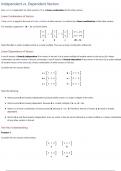
For example, it is easy to see that the transpose of matrix A is A'. Row 1 of matrix A becomes column 1 of A'; row 2 of A becomes
column 2 of A'; and row 3 of A becomes column 3 of A'.
111 222
111 333 555
A= 333 444 A' =
222 444 666
555 666
Note that the order of a matrix is reversed after it has been transposed. Matrix A is a 3 x 2 matrix, but matrix A' is a 2 x 3 matrix.
With respect to notation, this website uses a prime to indicate a transpose. Thus, the transpose of matrix B would be written as B'.
Vectors
Vectors are a type of matrix having only one column or one row.
Vectors come in two flavors: column vectors and row vectors. For example, matrix a is a column vector, and matrix a' is a row vector.
11
a= 12 a' = 11 12 33
33
We use lower-case, boldface letters to represent column vectors. And since the transpose of a column vector is a row vector, we use
lower-case, boldface letters plus a prime to represent row vectors. Thus, vector b would be a column vector, and vector b' would be a
row vector.
Square Matrices
A square matrix is an n x n matrix; that is, a matrix with the same number of rows as columns. In this section, we describe several
special kinds of square matrix.
Symmetric matrix. If the transpose of a matrix is equal to itself, that matrix is said to be symmetric. Two examples of symmetric
matrices appear below.
5 6 7
1 2
A = A' = B = B' = 6 3 2
2 3
7 2 1
Note that each of these matrices satisfy the defining requirement of a symmetric matrix: A = A' and B = B'.
Diagonal matrix. A diagonal matrix is a special kind of symmetric matrix. It is a symmetric matrix with zeros in the off-diagonal
elements. Two diagonal matrices are shown below.
A= 1 0 B= 5 0 0
This lesson describes a few of the more important types of matrices: transpose matrices, vectors, and different kinds of square matrices
Transpose Matrix
The transpose of one matrix is another matrix that is obtained by using rows from the first matrix as columns in the second matrix.
For example, it is easy to see that the transpose of matrix A is A'. Row 1 of matrix A becomes column 1 of A'; row 2 of A becomes
column 2 of A'; and row 3 of A becomes column 3 of A'.
111 222
111 333 555
A= 333 444 A' =
222 444 666
555 666
Note that the order of a matrix is reversed after it has been transposed. Matrix A is a 3 x 2 matrix, but matrix A' is a 2 x 3 matrix.
With respect to notation, this website uses a prime to indicate a transpose. Thus, the transpose of matrix B would be written as B'.
Vectors
Vectors are a type of matrix having only one column or one row.
Vectors come in two flavors: column vectors and row vectors. For example, matrix a is a column vector, and matrix a' is a row vector.
11
a= 12 a' = 11 12 33
33
We use lower-case, boldface letters to represent column vectors. And since the transpose of a column vector is a row vector, we use
lower-case, boldface letters plus a prime to represent row vectors. Thus, vector b would be a column vector, and vector b' would be a
row vector.
Square Matrices
A square matrix is an n x n matrix; that is, a matrix with the same number of rows as columns. In this section, we describe several
special kinds of square matrix.
Symmetric matrix. If the transpose of a matrix is equal to itself, that matrix is said to be symmetric. Two examples of symmetric
matrices appear below.
5 6 7
1 2
A = A' = B = B' = 6 3 2
2 3
7 2 1
Note that each of these matrices satisfy the defining requirement of a symmetric matrix: A = A' and B = B'.
Diagonal matrix. A diagonal matrix is a special kind of symmetric matrix. It is a symmetric matrix with zeros in the off-diagonal
elements. Two diagonal matrices are shown below.
A= 1 0 B= 5 0 0