Independent vs. Dependent Vectors
One vector is dependent on other vectors, if it is a linear combination of the other vectors.
Linear Combination of Vectors
If one vector is equal to the sum of scalar multiples of other vectors, it is said to be a linear combination of the other vectors.
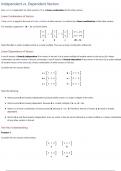
For example, suppose a = 2b + 3c, as shown below.
11 1 3 2*1 + 3*3
= 2 + 3 =
16 2 4 2*2 + 3*4
a b c 2b + 3c
Note that 2b is a scalar multiple and 3c is a scalar multiple. Thus, a is a linear combination of b and c.
Linear Dependence of Vectors
A set of vectors is linearly independent if no vector in the set is (a) a scalar multiple of another vector in the set or (b) a linear
combination of other vectors in the set; conversely, a set of vectors is linearly dependent if any vector in the set is (a) a scalar multiple
of another vector in the set or (b) a linear combination of other vectors in the set.
Consider the row vectors below.
a= 1 2 3 d= 2 4 6
b= 4 5 6 e= 0 1 0
c= 5 7 9 f= 0 0 1
Note the following:
Vectors a and b are linearly independent, because neither vector is a scalar multiple of the other.
Vectors a and d are linearly dependent, because d is a scalar multiple of a; i.e., d = 2a.
Vector c is a linear combination of vectors a and b, because c = a + b. Therefore, the set of vectors a, b, and c is linearly
dependent.
Vectors d, e, and f are linearly independent, since no vector in the set can be derived as a scalar multiple or a linear combination
of any other vectors in the set.
Test Your Understanding
Problem 1
Consider the row vectors shown below.
0 1 2 3 2 1
a b
3 3 3 3 4 5
c d
One vector is dependent on other vectors, if it is a linear combination of the other vectors.
Linear Combination of Vectors
If one vector is equal to the sum of scalar multiples of other vectors, it is said to be a linear combination of the other vectors.
For example, suppose a = 2b + 3c, as shown below.
11 1 3 2*1 + 3*3
= 2 + 3 =
16 2 4 2*2 + 3*4
a b c 2b + 3c
Note that 2b is a scalar multiple and 3c is a scalar multiple. Thus, a is a linear combination of b and c.
Linear Dependence of Vectors
A set of vectors is linearly independent if no vector in the set is (a) a scalar multiple of another vector in the set or (b) a linear
combination of other vectors in the set; conversely, a set of vectors is linearly dependent if any vector in the set is (a) a scalar multiple
of another vector in the set or (b) a linear combination of other vectors in the set.
Consider the row vectors below.
a= 1 2 3 d= 2 4 6
b= 4 5 6 e= 0 1 0
c= 5 7 9 f= 0 0 1
Note the following:
Vectors a and b are linearly independent, because neither vector is a scalar multiple of the other.
Vectors a and d are linearly dependent, because d is a scalar multiple of a; i.e., d = 2a.
Vector c is a linear combination of vectors a and b, because c = a + b. Therefore, the set of vectors a, b, and c is linearly
dependent.
Vectors d, e, and f are linearly independent, since no vector in the set can be derived as a scalar multiple or a linear combination
of any other vectors in the set.
Test Your Understanding
Problem 1
Consider the row vectors shown below.
0 1 2 3 2 1
a b
3 3 3 3 4 5
c d