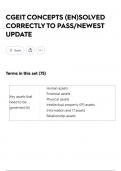
CGEIT CONCEPTS (EN)SOLVED
CORRECTLY TO PASS/NEWEST
UPDATE
Save
Terms in this set (75)
Human assets
Financial assets
Key assets that
Physical assets
need to be
Intellectual property (IP) assets
governed (6)
Information and IT assets
Relationship assets
, Principles, policies, and frameworks
Processes
Organizational structures
COBIT 5 Culture, ethics, and behavior
Enablers (7) Information
Services, infrastructure, and
applications
People, skills, and competencies
Business unit architecture
Information architecture
Layers of Information systems architecture
Enterprise (applications)
Architecture (5) Data architecture
Delivery system architecture
(technology architecture)
, Stakeholders - includes members of
the structure, other structures,
organizational entities, clients,
suppliers, and regulators
Goals - includes having a proper
mandate, well-defined operating
principles and application of other
good practices
Organizational Life cycle - includes inception (with
structure a defined mandate),
specifics (4) existence/adjustment, and
dissolution
Good practices - includes operating
principles (practical arrangements
of how the structure will operate),
composition, span of control, level
of authority / decision rights,
delegation of authority, and
escalation procedures
Payback period, ROI, IRR, NPV
IT performance
(tangible)
measurement
Cost/benefit analysis
approaches (4
Information economics
levels)
IT Balanced Scorecard (intangible)
, Firm wide IT infrastructure
(infrastructure availability, cost per
transaction, cost per workstation)
Business unit IT application (new
application implementation time and
Business value cost)
hierarchy (4 Business unit operational (time to
levels) bring a new product to market, sales
from new product, product or
service quality)
Business unit financial (revenue
growth, return on assets, revenue
per employee)
Business contribution - obtain a
reasonable business contribution
from IT investments
User orientation - be the preferred
Generic IT
supplier of information systems
Balanced
Operational excellence - deliver
Scorecard (4
effective and efficient IT
perspectives)
applications and services
Future orientation - develop
opportunities to address future
challenges
CORRECTLY TO PASS/NEWEST
UPDATE
Save
Terms in this set (75)
Human assets
Financial assets
Key assets that
Physical assets
need to be
Intellectual property (IP) assets
governed (6)
Information and IT assets
Relationship assets
, Principles, policies, and frameworks
Processes
Organizational structures
COBIT 5 Culture, ethics, and behavior
Enablers (7) Information
Services, infrastructure, and
applications
People, skills, and competencies
Business unit architecture
Information architecture
Layers of Information systems architecture
Enterprise (applications)
Architecture (5) Data architecture
Delivery system architecture
(technology architecture)
, Stakeholders - includes members of
the structure, other structures,
organizational entities, clients,
suppliers, and regulators
Goals - includes having a proper
mandate, well-defined operating
principles and application of other
good practices
Organizational Life cycle - includes inception (with
structure a defined mandate),
specifics (4) existence/adjustment, and
dissolution
Good practices - includes operating
principles (practical arrangements
of how the structure will operate),
composition, span of control, level
of authority / decision rights,
delegation of authority, and
escalation procedures
Payback period, ROI, IRR, NPV
IT performance
(tangible)
measurement
Cost/benefit analysis
approaches (4
Information economics
levels)
IT Balanced Scorecard (intangible)
, Firm wide IT infrastructure
(infrastructure availability, cost per
transaction, cost per workstation)
Business unit IT application (new
application implementation time and
Business value cost)
hierarchy (4 Business unit operational (time to
levels) bring a new product to market, sales
from new product, product or
service quality)
Business unit financial (revenue
growth, return on assets, revenue
per employee)
Business contribution - obtain a
reasonable business contribution
from IT investments
User orientation - be the preferred
Generic IT
supplier of information systems
Balanced
Operational excellence - deliver
Scorecard (4
effective and efficient IT
perspectives)
applications and services
Future orientation - develop
opportunities to address future
challenges