RES 204 FINAL EXAM STUDY GUIDE 103 QUESTIONS WITH COMPLETE SO
TIONS/NEWEST UPDATE
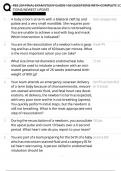
1. A baby is born at term with a bilateral cleft lip and Insert a laryngeal mask
palate and a very small mandible. She requires posi-
tive-pressure ventilation because she is not breathing.
You are unable to achieve a seal with bag and mask.
Which intervention is indicated?
2. You are at the resuscitation of a newborn who is gasp- Provide PPV
ing and has a heart rate of 60 beats per minute. What
is the most important action you can take?
3. What size (internal diameter) endotracheal tube 2.5 mm
should be used to intubate a newborn with an esti-
mated gestational age of 26 weeks (estimated birth
weight of 800 g)?
4. Your team attends an emergency cesarean delivery Start PPV and check HR af-
of a term baby because of chorioamnionitis, meconi- ter 15 seconds
um-stained amniotic fluid, and fetal heart rate decel-
erations. At delivery, the newborn is term as expected,
with very poor tone and he is not breathing (apneic).
You quickly perform initial steps, but the newborn is
still not breathing. What is the most appropriate next
step of resuscitation?
5. During the resuscitation of a newborn, you auscultate 100 bpm
the apical pulse and count 10 beats over a 6 second
period. What heart rate do you report to your team?
6. You are part of a team preparing for the birth of a baby present at birth
who has meconium-stained fluid and a category III fe-
tal heart rate tracing. A person skilled in endotracheal
intubation should be
, RES 204 FINAL EXAM STUDY GUIDE 103 QUESTIONS WITH COMPLETE SO
TIONS/NEWEST UPDATE
7. You are at a delivery of a baby born through meco- bring baby to radiant
nium-stained amniotic fluid, and the baby is not vig- warmer for initial steps of
orous. What steps should be taken immediately after newborn care.
birth?
8. What is the most effective maneuver to establish PPV that inflates the lungs
spontaneous breathing in a baby that is apneic after
initial steps?
9. A newborn of 34 weeks' gestation is not breathing 21-30%
(apneic) at birth, does not respond to initial steps and
requires positive-pressure ventilation. What concen-
tration of oxygen should be used as you begin posi-
tive-pressure ventilation?
10. You have started positive-pressure ventilation for a a rising heart rate
newborn because her heart rate is low (bradycardia).
What is the most important indicator of successful
positive-pressure ventilation?
11. A baby requires positive-pressure ventilation because Mask of self-inflating bag
she is not breathing (apneic), but she soon establish-
es spontaneous respirations and a heart rate over
100 beats per minute. Her oxygen saturation is lower
than the target level when in room air, so you provide
free-flow oxygen. Which of the following devices can-
not reliably deliver free-flow oxygen?
12. Which statement best describes normal transitional Babies may take as long
physiology at the time of birth? as 10 minutes after birth
to increase their oxygen
TIONS/NEWEST UPDATE
1. A baby is born at term with a bilateral cleft lip and Insert a laryngeal mask
palate and a very small mandible. She requires posi-
tive-pressure ventilation because she is not breathing.
You are unable to achieve a seal with bag and mask.
Which intervention is indicated?
2. You are at the resuscitation of a newborn who is gasp- Provide PPV
ing and has a heart rate of 60 beats per minute. What
is the most important action you can take?
3. What size (internal diameter) endotracheal tube 2.5 mm
should be used to intubate a newborn with an esti-
mated gestational age of 26 weeks (estimated birth
weight of 800 g)?
4. Your team attends an emergency cesarean delivery Start PPV and check HR af-
of a term baby because of chorioamnionitis, meconi- ter 15 seconds
um-stained amniotic fluid, and fetal heart rate decel-
erations. At delivery, the newborn is term as expected,
with very poor tone and he is not breathing (apneic).
You quickly perform initial steps, but the newborn is
still not breathing. What is the most appropriate next
step of resuscitation?
5. During the resuscitation of a newborn, you auscultate 100 bpm
the apical pulse and count 10 beats over a 6 second
period. What heart rate do you report to your team?
6. You are part of a team preparing for the birth of a baby present at birth
who has meconium-stained fluid and a category III fe-
tal heart rate tracing. A person skilled in endotracheal
intubation should be
, RES 204 FINAL EXAM STUDY GUIDE 103 QUESTIONS WITH COMPLETE SO
TIONS/NEWEST UPDATE
7. You are at a delivery of a baby born through meco- bring baby to radiant
nium-stained amniotic fluid, and the baby is not vig- warmer for initial steps of
orous. What steps should be taken immediately after newborn care.
birth?
8. What is the most effective maneuver to establish PPV that inflates the lungs
spontaneous breathing in a baby that is apneic after
initial steps?
9. A newborn of 34 weeks' gestation is not breathing 21-30%
(apneic) at birth, does not respond to initial steps and
requires positive-pressure ventilation. What concen-
tration of oxygen should be used as you begin posi-
tive-pressure ventilation?
10. You have started positive-pressure ventilation for a a rising heart rate
newborn because her heart rate is low (bradycardia).
What is the most important indicator of successful
positive-pressure ventilation?
11. A baby requires positive-pressure ventilation because Mask of self-inflating bag
she is not breathing (apneic), but she soon establish-
es spontaneous respirations and a heart rate over
100 beats per minute. Her oxygen saturation is lower
than the target level when in room air, so you provide
free-flow oxygen. Which of the following devices can-
not reliably deliver free-flow oxygen?
12. Which statement best describes normal transitional Babies may take as long
physiology at the time of birth? as 10 minutes after birth
to increase their oxygen