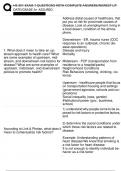
HS 301 EXAM 1 QUESTIONS WITH COMPLETE ANSWERS/NEWEST UP-
DATE/GRADE A+ ASSURED
Address distal causes of healthcare, that
put you at risk for proximate causes of
disease. Look at unemployment, living in
a food desert, condition of the atmos-
phere.
Downstream - ER, trauma nurse (CDC
response to an outbreak, chronic dis-
ease operations)
1. What does it mean to take an up- Disease and injury
stream approach to health care? What Mortality
are some examples of upstream, mid-
stream, and downstream risk factors for Midstream - PCP (transportation from
disease? What are some examples of residence to a hospital/parks)
upstream, midstream, and downstream Neighnorhood Conditions
policies to promote health? Risk Behaviors (smoking, drinking, vio-
lence)
Upstream - healthcare people that focus
on transportation/housing and settings
(government agencies, schools and cor-
porations)
Social inequality (race, gender)
INstitutional power (gov., busiiness,
school)
1) understand why people come to be ex-
posed to risk factors or protective factors,
and
2) determine the social conditions under
which those risk factors are related to
According to Link & Phelan, what does it
disease
mean to contextualize risk factors?
Example: Understanding patterns of
heart disease•We know that smoking is
a risk factor for heart disease:
It is not enough to identify individual be-
havior as a risk factor
, HS 301 EXAM 1 QUESTIONS WITH COMPLETE ANSWERS/NEWEST UP-
DATE/GRADE A+ ASSURED
We need to know WHY people are en-
gaging in the behavior
How are social conditions causing/con-
tributing to the behavior?
We cannot change individual behavior
without understanding how exposure to
risk occurs
Pockets where people live longer than
anywhere else in the world. The world's
highest percentages of centenarians.
Habits Shared:
What is a Blue Zone? What habits do
Blue Zone inhabitants tend to share? -Cherish Family
-Social Engagement
-Less Smoking
-Semi-vegetarianism (plant based diet)
-Legumes
-Constant Moderate Physical Activity
Focuses on the "root cause," rather
than intervening mechanisms. Includes
an emphasis on access to resources that
help individuals avoid disease.
Explain what is meant by a fundamen-
tal causes approach to understanding
"The essential feature of fundamental so-
health and illness?
cial causes is that they involve access
to resources that can be used to avoid
risks or to minimize the consequences of
disease once it occurs."
Proximate - Downstream behavioral or
biological risk factors
E.g., high blood pressure, poor diet,
Explain the difference between proxi-
smoking, UV rays
mate and distal causes of disease.
Distal - Upstream factors that put you at
risk for the proximate causes
DATE/GRADE A+ ASSURED
Address distal causes of healthcare, that
put you at risk for proximate causes of
disease. Look at unemployment, living in
a food desert, condition of the atmos-
phere.
Downstream - ER, trauma nurse (CDC
response to an outbreak, chronic dis-
ease operations)
1. What does it mean to take an up- Disease and injury
stream approach to health care? What Mortality
are some examples of upstream, mid-
stream, and downstream risk factors for Midstream - PCP (transportation from
disease? What are some examples of residence to a hospital/parks)
upstream, midstream, and downstream Neighnorhood Conditions
policies to promote health? Risk Behaviors (smoking, drinking, vio-
lence)
Upstream - healthcare people that focus
on transportation/housing and settings
(government agencies, schools and cor-
porations)
Social inequality (race, gender)
INstitutional power (gov., busiiness,
school)
1) understand why people come to be ex-
posed to risk factors or protective factors,
and
2) determine the social conditions under
which those risk factors are related to
According to Link & Phelan, what does it
disease
mean to contextualize risk factors?
Example: Understanding patterns of
heart disease•We know that smoking is
a risk factor for heart disease:
It is not enough to identify individual be-
havior as a risk factor
, HS 301 EXAM 1 QUESTIONS WITH COMPLETE ANSWERS/NEWEST UP-
DATE/GRADE A+ ASSURED
We need to know WHY people are en-
gaging in the behavior
How are social conditions causing/con-
tributing to the behavior?
We cannot change individual behavior
without understanding how exposure to
risk occurs
Pockets where people live longer than
anywhere else in the world. The world's
highest percentages of centenarians.
Habits Shared:
What is a Blue Zone? What habits do
Blue Zone inhabitants tend to share? -Cherish Family
-Social Engagement
-Less Smoking
-Semi-vegetarianism (plant based diet)
-Legumes
-Constant Moderate Physical Activity
Focuses on the "root cause," rather
than intervening mechanisms. Includes
an emphasis on access to resources that
help individuals avoid disease.
Explain what is meant by a fundamen-
tal causes approach to understanding
"The essential feature of fundamental so-
health and illness?
cial causes is that they involve access
to resources that can be used to avoid
risks or to minimize the consequences of
disease once it occurs."
Proximate - Downstream behavioral or
biological risk factors
E.g., high blood pressure, poor diet,
Explain the difference between proxi-
smoking, UV rays
mate and distal causes of disease.
Distal - Upstream factors that put you at
risk for the proximate causes