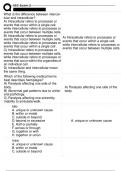
EEC Exam 2
What is the difference between intercel-
lular and intracellular?
A) Intracellular refers to processes or
events that occur within a single cell,
while intercellular refers to processes or
events that occur between multiple cells.
B) Intracellular refers to processes or
A) Intracellular refers to processes or
events that occur between multiple cells,
events that occur within a single cell,
while intercellular refers to processes or
while intercellular refers to processes or
events that occur within a single cell .
events that occur between multiple cells.
C) Intracellular refers to processes or
events that occur between multiple cells,
while intercellular refers to processes or
events that occur within the organelles of
an individual cell .
D) Intracellular and intercellular mean
the same thing.
Which of the following medical terms
best describes hemiplegia?
A) Paralysis affecting one side of the
body. A) Paralysis affecting one side of the
B) Abnormal gait patterns due to unilat- body.
eral pathology.
C) Paralysis affecting one extremity.
Inability to ambulate/walk.
Idio-
A. unique or unknown cause
B. within or inside
C. outside or beyond
D. beyond or excessive A. unique or unknown cause
E. Half or partially
F. across or through
G. together or with
H. together or union
Intra-
A. unique or unknown cause
B. within or inside
C. outside or beyond
,EEC Exam 2
D. beyond or excessive
E. Half or partially
F. across or through B. within or inside
G. together or with
H. together or union
Semi-
A. unique or unknown cause
B. within or inside
C. outside or beyond
D. beyond or excessive E. Half or partially
E. Half or partially
F. across or through
G. together or with
H. together or union
Syn-
A. unique or unknown cause
B. within or inside
C. outside or beyond
D. beyond or excessive H. together or union
E. Half or partially
F. across or through
G. together or with
H. together or union
Trans-
A. unique or unknown cause
B. within or inside
C. outside or beyond
D. beyond or excessive F. across or through
E. Half or partially
F. across or through
G. together or with
H. together or union
Ultra-
A. unique or unknown cause
B. within or inside
D. beyond or excessive
C. outside or beyond
D. beyond or excessive
E. Half or partially
, EEC Exam 2
F. across or through
G. together or with
H. together or union
Extra/Extro-
A. unique or unknown cause
B. within or inside
C. outside or beyond
D. beyond or excessive C. outside or beyond
E. Half or partially
F. across or through
G. together or with
H. together or union
Co/Con/Com-
A. unique or unknown cause
B. within or inside
C. outside or beyond
D. beyond or excessive G. together or with
E. Half or partially
F. across or through
G. together or with
H. together or union
leukocytosis
A. abnormal increase in the number of
red blood cells
B. abnormal increase in the number of
white blood cells B. abnormal increase in the number of
C. blood in the urine white blood cells
D. inability to urinate
E. abnormal increase in the total number
of blood cells
F. bedwetting
erythrocytosis
A. abnormal increase in the number of
red blood cells
A. abnormal increase in the number of
B. abnormal increase in the number of
red blood cells
white blood cells
C. blood in the urine
D. inability to urinate
What is the difference between intercel-
lular and intracellular?
A) Intracellular refers to processes or
events that occur within a single cell,
while intercellular refers to processes or
events that occur between multiple cells.
B) Intracellular refers to processes or
A) Intracellular refers to processes or
events that occur between multiple cells,
events that occur within a single cell,
while intercellular refers to processes or
while intercellular refers to processes or
events that occur within a single cell .
events that occur between multiple cells.
C) Intracellular refers to processes or
events that occur between multiple cells,
while intercellular refers to processes or
events that occur within the organelles of
an individual cell .
D) Intracellular and intercellular mean
the same thing.
Which of the following medical terms
best describes hemiplegia?
A) Paralysis affecting one side of the
body. A) Paralysis affecting one side of the
B) Abnormal gait patterns due to unilat- body.
eral pathology.
C) Paralysis affecting one extremity.
Inability to ambulate/walk.
Idio-
A. unique or unknown cause
B. within or inside
C. outside or beyond
D. beyond or excessive A. unique or unknown cause
E. Half or partially
F. across or through
G. together or with
H. together or union
Intra-
A. unique or unknown cause
B. within or inside
C. outside or beyond
,EEC Exam 2
D. beyond or excessive
E. Half or partially
F. across or through B. within or inside
G. together or with
H. together or union
Semi-
A. unique or unknown cause
B. within or inside
C. outside or beyond
D. beyond or excessive E. Half or partially
E. Half or partially
F. across or through
G. together or with
H. together or union
Syn-
A. unique or unknown cause
B. within or inside
C. outside or beyond
D. beyond or excessive H. together or union
E. Half or partially
F. across or through
G. together or with
H. together or union
Trans-
A. unique or unknown cause
B. within or inside
C. outside or beyond
D. beyond or excessive F. across or through
E. Half or partially
F. across or through
G. together or with
H. together or union
Ultra-
A. unique or unknown cause
B. within or inside
D. beyond or excessive
C. outside or beyond
D. beyond or excessive
E. Half or partially
, EEC Exam 2
F. across or through
G. together or with
H. together or union
Extra/Extro-
A. unique or unknown cause
B. within or inside
C. outside or beyond
D. beyond or excessive C. outside or beyond
E. Half or partially
F. across or through
G. together or with
H. together or union
Co/Con/Com-
A. unique or unknown cause
B. within or inside
C. outside or beyond
D. beyond or excessive G. together or with
E. Half or partially
F. across or through
G. together or with
H. together or union
leukocytosis
A. abnormal increase in the number of
red blood cells
B. abnormal increase in the number of
white blood cells B. abnormal increase in the number of
C. blood in the urine white blood cells
D. inability to urinate
E. abnormal increase in the total number
of blood cells
F. bedwetting
erythrocytosis
A. abnormal increase in the number of
red blood cells
A. abnormal increase in the number of
B. abnormal increase in the number of
red blood cells
white blood cells
C. blood in the urine
D. inability to urinate