

MDC1/NUR2356 Rasmussen
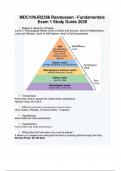
Maslow's Hierarchy of Needs (Level 1) Physiological Needs, (level 2) Safety and Security, (level 3) Relationships, Love and Affection, (level 4) Self Esteem, (level 5) Self Actualization Temperature Allows the nurse to assess the client's body temperature. Normal Temp: 96.4-99.5 Different methods a temperature can be taken Oral, Axillary, Rectally, Temporal Artery, Tympanic Hypothermia abnormally low body temperature Hyperthermia Abnormally high body temperature What does the Pulse allow the nurse to assess? It allows us to assess how adequate the heart is pumping blood through the body Normal Pulse: 60-100 bpm Where are the different Pulse points? Carotid, Radial, Femoral, Popliteal, Posterior Tibial, Dorsalis Pedis What does the Blood Pressure allow the nurse to assess? It allows the nurse to assess the force required to pump blood through the body Normal BP: 120/80 Hypotension lower than normal blood pressure Hypertension higher than normal blood pressure What do Respirations allow the nurse to assess? It allows the nurse to assess the effort of breathing Normal Respirations: 12-20 Pulse Oximetry (SpO2) Measures the oxygen level in the blood Hypoxia Low oxygen saturation of the body, not enough oxygen in the blood Pain Assessment Provocative or Palliative (what makes it worse/better) Quality or Quantity (For example, is the pain sharp or dull, throbbing?) Region or Radiation(Location) Severity Scale (Numeric pain intensity scale) Timing (Onset) Understand Patient's Perception (Activities of Daily Living assessment) What are the major energy sources of Nutrition for the body? Carbohydrates, Fats and Proteins What are the different forms of Nutrition? Oral: Intake by mouth Enteral: Intake through MG Tube, Peg Tube, Jejunostomy Tube, G-Tube Parenteral: Taking nutrition through a centrally inserted IV line such as a PICC or Central Venous Access Device Communication A process through which you send messages to and receive messages from others. Sharing of information between 2 individuals. Communication Strategies Empathy: A desire to understand and be sensitive to the feelings and situation of another person. Put yourself in the client's place mentally and emotionally. Respect: Allow the client to make choices. Be flexible when meeting the needs of each client. Genuineness: Respond honestly. Do not try to guess the answer. Let client know you will need assistance in answering a question you do not know the answer to. Concreteness: Provide your answers in specific and understandable terms. Confrontation: Request the client express his or her thoughts clearly so you can understand the meaning of the communication. Forms of Communication Verbal: Written or spoken word Non-Verbal: Body language that accompanied by the spoken word Intrapersonal: Self talk Interpersonal: Between 2 or more people with the goal of exchanging messages. Group: Organizational communication What should staff know about Fire Response Procedures? Location of Exits, Alarms, Fire Extinguishers, and Oxygen turn-off valves Do not block fire doors Know your evacuation plan! RACE acronym for fire R= Rescue A= Activate alarm C= Contain fire E= Extinguish PASS acronym Pull, Aim, Squeeze, Sweep What are the 3 Classes of Fire Extinguishers? Class A: paper, wood, upholstery, rags, other types of trash fires Class B: flammable liquids, and gas fires Class C: electrical fires Older Adult - Increased Risk for Falls CAUSES: Decrease in strength Impaired Mobility and Balance Endurance limitations combined w/decreased sensory perception Other clients with increased risk for falls 1) Those with decreased visual acuity 2) Generalized weakness 3) Gait and balance problems (CP, Injury, MS) and cognitive dysfunctions 4) Side effects of medication (orthostatic hypotension, drowsiness) GENERAL MEASURES to PREVENT FALLS -be sure the client knows how to use call light, it is within reach, and encourage its use -respond to call lights in a timely manner -orient client to setting and assistive devices -place clients at risk for falls near the nursing station -ensure bedside table and frequently used items are within the client's reach -maintain the bed in the low position -for clients who are sedated, unconscious, or otherwise compromised, bed rails are kept up and the bed kept in a low position -avoid the use of full side bed rails for clients who get out of bed or attempt to get out of bed without assistance -provide nonskid footwear -keep the floor free of clutter with a clear path to the bathroom -keep assistive devices nearby after validation of safe use by client and family -educate client and family/caregivers on identified risks and plan of care -lock wheels on beds, wheelchairs, and carts -use chair or bed sensors for clients at risk for getting up unattended Basic First Aid - Bleeding Apply direct pressure to wound, do NOT remove impaled objects Basic First Aid - Fractures and Splinting Assess the site for swelling, deformity, and skin integrity Assess temp, distal pulses, and mobility Apply a splint to immobilize the fx and cover open areas with a sterile cloth Reassess neurovascular status after splinting Basic First Aid - Sprains RICE Acronym: REFRAIN from weight bearing/REST, ICE applied to to decrease inflammation, COMPRESSION dressing to minimize swelling, ELEVATE the affected limb Basic First Aid - Heat Stroke Manifestations: Hot, dry skin, hypotension, tachypnea, tachycardia, anxiety, confusion, seizure, and coma Rapid Cooling must be achieved: Remove client clothes, ice packs placed on major arteries(armpit, chest, groin, neck), immerse in cold water bath, wet the client's body and fan with rapid air Basic First Aid - Frostnip and Frostbite Frostnip can be treated by warming Frostbite presents as white, waxy areas on exposed skin, and tissue injury occurs; May be FULL or PARTIAL thickness, warm area 100.4 - 105.8 degrees, give pain meds, administer tetanus vaccine Basic First Aid - Burns Causes: Electrical current, chemicals, radiation, and flames Remove the agent and smother flames Cover the client and maintain NPO Elevate the extremity if no fx present Estimate surface area of burn Administer fluids and tetanus toxoid
Document information
- Uploaded on
- May 5, 2025
- Number of pages
- 15
- Written in
- 2024/2025
- Type
- Exam (elaborations)
- Contains
- Questions & answers


