

NUR 2063 Essentials of Pathophysiology Test #1 2025
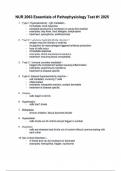
1. Type 1 Hypersensitivity - IgE mediated – - Immediate, local response - repeated exposures is necessary to cause this reaction - examples: hay fever, food allergies, anaphylaxis - treatment: epinephrine, antihistamines 2. Type 2 - cytotoxic hypersensitivity reaction – - antigen may be intrinsic or extrinsic - recognition by macrophages triggered antibody production - lysis of cells occur - immediate response - examples: blood transfusions reactions - treatment: ensuring blood compatibility 3. Type 3 - immune complex-mediated – - triggers the complement system causing inflammation - examples: autoimmune conditions - treatment is disease specific 4. Type 4: delayed hypersensitivity reaction – - cell mediated, involving T cells - inflammation - examples: transplant reaction, contact dermatitis - treatment is disease specific 5. Atrophy - cells begin to shrink 6. Hypertrophy - cells don't divide 7. Metaplasia - chronic irritation, tissue becomes thicker 8. Hyperplasia - cells divide out of control and get bigger in number 9. Dysplasia - cells are stressed and divide out of control without communicating with each other 10. Sex-Linked Disorders – - X-linked and can be recessive or dominant - examples: hemophilia, fragile x syndrome 11. Chromosomal Disorders – - major category of genetic disorders - result from chromosomal duplication or number - examples: Down syndrome, turner's syndrome 12. Autosomal Dominant Disease – - single sex gene mutation that are passed from an affect parent to offspring regardless of sex - examples: Huntington's disease, Marfan's syndrome 13. Autosomal Recessive Disorders – - single gene mutations that are passed from affected parent to offspring regardless of sex - only occur in homozygous allele pairs - examples: albinism, colored blindness, sickle cell, tay-sachs 14. Multifactorial Disorders – - result of interaction between genes and environment - examples: anencephaly, cleft lip/palate, club foot, congenital heart disease 15. General Adaptation Syndrome – - Alarm - resistance - exhaustion 16. Sympathetic Stress Response – - fight or flight response - increased heart rate, respirations, blood flow, muscle strength, mental alertness, fat and protein mobilization, glucose availability - diaphoresis - decreased inflammation 17. Active Immunity - acquired by having a disease and vaccinations 18. Passive Immunity - receiving antibodies from an external source 19. Hemodynamics - the science of the blood flow through the circulation 20. Inflammatory Process - redness, swelling, heat, and pain 21. infectious mononucleosis - Physiology: - oral transmission - Self-limiting - Most prevalent in adolescents and young adults - Caused by Epstein-Barr virus in the herpes family 22. Manifestations: - Insidious onset - anorexia - malaise - chills - leukocytosis - fever - chills - sore throat - lymphopathy 23. Hodgkin's Lymphoma - Physiology: -Solid tumors with presence of Reed-Sternberg cells -Typically originate in the lymph nodes of the upper body 24. Manifestations: - Painless enlarged nodes - Weight loss - Fever - Night sweats - Pruritus - Coughing - Difficulty breathing - Chest pain - Recurrent infections - Splenomegaly 25. Leukemia – - Second most common blood cancer - Cancer of the leukocytes - Leukemia cells abnormally proliferate, crowding normal blood cells 26. Manifestations: - Leukopenia - Anemia - Thrombocytopenia - Lymphadenopathy - Joint swelling - Bone paint - Weight loss - Anorexia - Hepatomegaly - Splenomegaly - CNS dysfunction 27. Acute Lymphoblastic Leukemia – - Affects primarily children - Responds well to therapy - Good prognosis 28. Acute Myeloid Leukemia – - affects primarily adults - happens years after exposure to chemo/radiation - responds fairly well to treatment 29. Chronic Lymphoid Leukemia – - Affects primarily adults - Responds poorly to therapy, yet most patients live many years after diagnosis 30. Chronic Myeloid Leukemia – - Affects primarily adults - Responds poorly to chemo, but the prognosis is improved with allogeneic bone marrow transplant 31. Multiple Myeloma - Physiology: - Plasma cell cancer - Excessive numbers of abnormal plasma cells in the bone marrow - Often well advanced upon diagnosis 32. Manifestations: - Anemia - Thrombocytopenia - Leukopenia - Decreased bone density - Bone pain - Hypercalcemia - Renal impairment 33. Anemia – - Results from a decreased number of erythrocytes, reduction of hemoglobin, or presence of abnormal hemoglobin 34. Manifestations: - Weakness - Fatigue - Pallor - Syncope - Dyspnea - Tachycardia 35. Iron Deficiency Anemia - Physiology: - very common 36. Manifestations: - Cyanosis to sclera - Brittle nails - Decreased appetite - Headache - Irritability - Stomatitis - Pica - Delayed healing 37. Pernicious Anemia - Physiology: - Vitamin B12 deficiency usually caused by a lack of intrinsic factor 38. Manifestations: - Bleeding gums - Diarrhea - Impaired sense of smell - Loss of deep tendon reflexes - Anorexia - Personality or memory changes - Positive Babinski's sign - Stomatitis - Paresthesia 39. Aplastic Anemia - Physiology: - bone marrow depression of all blood cells - onset may be insidious 40. Manifestations: - Anemia - Weakness - Pallor - Dyspnea - Leukocytopenia
Document information
- Uploaded on
- May 5, 2025
- Number of pages
- 16
- Written in
- 2024/2025
- Type
- Exam (elaborations)
- Contains
- Questions & answers


