

NGR6733 Quiz 1
Study online at https://quizlet.com/_h2eh70
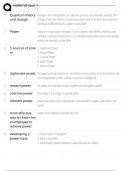
1. Quantum theory change is not a thing/event, its a dynamic process and cannot be avoided. With
and change change comes two realities: actual & potential. Leadership arises from potential.
All things INTERDEPENDENT, leaders must ADAPT
2. Power integral in organization behavior; it is the influence over beliefs, emotions and
behaviors. only exists when there is an unequal relationship between two people
where one depends on the other
3. 5 sources of pow- 1. Legitimate Power
er 2. Reward Power
3. Coercive Power
4. Expert Power
5. Referent Power
4. legitimate power the power a person receives as a result of his or her position in the formal hierarchy
of an organization (either cultural, structural or delegated)
5. reward power the ability of a manager to give tangible and intangible rewards
6. coercive power The ability of a manager to punish others
7. referent power power that comes from subordinates' and coworkers' respect, admiration, and
loyalty
8. most effective higher-level employee depends on them
way for lower-lev-
el employee to
acheive power
9. developing a 1. Create sense of obligation
power base 2. build a reputation
3. identification (leader behaves in way that leads to respect)
1/7
, NGR6733 Quiz 1
Study online at https://quizlet.com/_h2eh70
4. Perceived dependence (leaders allow others to believe that they are dependent
on them)
10. Leadership Trait Based on the assumption that leaders are born with certain traits and characteris-
Theory tics that make them ideal leaders.
11. University of 2 Leadership styles:
Michigan Leader- Job-centered & Employee-Centered
ship Model
12. Ohio State Lead- Found that consideration for people and initiating structure are two essential
ership Studies behaviors for leaders.
13. managerial grid Addresses the balance between the manager's concern for people and task.
(Blake and Mou- 1,9: Country Club management: high concern for people, low concern for task.
ton) 9,1: Authority-obedience: High concern for task, low concern for people (dictator)
9,9: Team management: High concern for people and task (ideal)
5,5: Organization man/middle of the road: Moderate/balanced concern for people
and task.
1,1: Impoverished Management: Low concern for both task and people. (laissez
faire)
14. Fiedler's Contin- based on the premise that a leader's effectiveness is contingent on the extent to
gency Theory which a leader's style fits or matches characteristics of the situation at hand (1.
leader-member relations, 2. task, 3. leader position power)
15. House's leader behaviors are effective when employees view them as a source of satis-
Path-Goal Theory faction or as paving the way to future satisfaction (these leaders are DIRECTIVE,
SUPPORTIVE, PARTICIPATORY, ACHIEVEMENT-ORIENTED)
16. Tannenbaum A model that highlights the range of different management styles that may be
Schmidt adopted ranging from a 'tell' approach to one that involves delegation; boss-cen-
Continuum tered to subordinate-centered.
2/7
Study online at https://quizlet.com/_h2eh70
1. Quantum theory change is not a thing/event, its a dynamic process and cannot be avoided. With
and change change comes two realities: actual & potential. Leadership arises from potential.
All things INTERDEPENDENT, leaders must ADAPT
2. Power integral in organization behavior; it is the influence over beliefs, emotions and
behaviors. only exists when there is an unequal relationship between two people
where one depends on the other
3. 5 sources of pow- 1. Legitimate Power
er 2. Reward Power
3. Coercive Power
4. Expert Power
5. Referent Power
4. legitimate power the power a person receives as a result of his or her position in the formal hierarchy
of an organization (either cultural, structural or delegated)
5. reward power the ability of a manager to give tangible and intangible rewards
6. coercive power The ability of a manager to punish others
7. referent power power that comes from subordinates' and coworkers' respect, admiration, and
loyalty
8. most effective higher-level employee depends on them
way for lower-lev-
el employee to
acheive power
9. developing a 1. Create sense of obligation
power base 2. build a reputation
3. identification (leader behaves in way that leads to respect)
1/7
, NGR6733 Quiz 1
Study online at https://quizlet.com/_h2eh70
4. Perceived dependence (leaders allow others to believe that they are dependent
on them)
10. Leadership Trait Based on the assumption that leaders are born with certain traits and characteris-
Theory tics that make them ideal leaders.
11. University of 2 Leadership styles:
Michigan Leader- Job-centered & Employee-Centered
ship Model
12. Ohio State Lead- Found that consideration for people and initiating structure are two essential
ership Studies behaviors for leaders.
13. managerial grid Addresses the balance between the manager's concern for people and task.
(Blake and Mou- 1,9: Country Club management: high concern for people, low concern for task.
ton) 9,1: Authority-obedience: High concern for task, low concern for people (dictator)
9,9: Team management: High concern for people and task (ideal)
5,5: Organization man/middle of the road: Moderate/balanced concern for people
and task.
1,1: Impoverished Management: Low concern for both task and people. (laissez
faire)
14. Fiedler's Contin- based on the premise that a leader's effectiveness is contingent on the extent to
gency Theory which a leader's style fits or matches characteristics of the situation at hand (1.
leader-member relations, 2. task, 3. leader position power)
15. House's leader behaviors are effective when employees view them as a source of satis-
Path-Goal Theory faction or as paving the way to future satisfaction (these leaders are DIRECTIVE,
SUPPORTIVE, PARTICIPATORY, ACHIEVEMENT-ORIENTED)
16. Tannenbaum A model that highlights the range of different management styles that may be
Schmidt adopted ranging from a 'tell' approach to one that involves delegation; boss-cen-
Continuum tered to subordinate-centered.
2/7


