

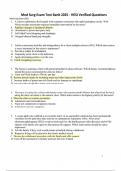
Med Surg Exam Test Bank 2025 - HESI Verified Questions
Med Surg Exam 2025 1. A client is admitted to the hospital with symptoms consistent with right hemisphere stroke. With Neurovascular assessment requires immediate intervention by the nurse? A. Pupillary changes to ipsilateral dilation B. Orientation to person and place only. C. Left Sided Facial dropping and dysphagia D. Unequal bilateral hand grip strengths 2. Achieve maximum mobility and independence for a client multiple sclerosis (MS). Which intervention is most important for the nurse to implement? A. Provide a walker for ambulation B. Frequently assist client to the bathroom C. Apply alternating patches over the eyes D. Teach strengthing exercises 3. The Nurse is teaching a client with glomerulonephritis about self-care. Which dietary recommendations should the nurse recommend the client to follow? A. Limit oral Fluid intake to 500 mL per day B. Restrict protein intake by including meats and other high protein foods C. Increase intake of potassium-rich foods such as bananas or cantaloupe D. Increase intake of high fiber foods, such as bran cereal. 4. The nurse Is caring for a client with herpes zoster who reports painful blisters that align from the back along the chest curvature to the anterior chest. Which intervention is the highest priority for the nurse? A. Place the client on contact precaution B. Administer antiviral medication C. Place wet compresses to ruptured vesicles D. Administer narcotic analgesics 5. A young adult who suffered a severe brain injury in an automobile collision has been mechanically ventilated for the past three days and has no spontaneous respiratory effort. After serial electroencephalograms (EEG) reveal no brain activity, the healthcare provider discusses end-of-life options with family who agree to discontinue life support. Which intervention should the nurse implement? A. Ask the family if they wish would remain at bedside during withdrawal B. Request a living will be placed in the client's medical record C. Discuss the withdrawal procedure with the family and offer support D. Turn off the mechanical ventilator and note the time of death lOMoAR cPSD| 2 6. Following a transurethral resection of the prostate (TURP), a client is discharged from the hospital with an indwelling urinary catheter. Which instruction is most important for the nurse to include in the discharge teaching plan? A. Eliminate all the spicy food from your diet B. Drinl 3 liters of water each day C. Clamp the catheter when taking a shower D. Avoid driving a car for 2 weeks 7. On the first postoperative day, the nurse finds an older male client disoriented and trying to climb over the bed railing. Previously he was oriented to person, place, and time on admission. Which intervention should the nurse implement first? A. Apply wrist restraints B. Determine the clients blood pressure C. Administer a mild sedative D. Asses the client for pain 8. Acute soft-tissue injuries (I.e. sprains, strains) provide the nurse with a variety of teaching opportunities. Which instruction should the nurse provide to a client with a soft-tissue injury? A. Watch for shortness of breath which may indicate a fat embolus B. Begin range of motion exercises within the first 24 hours C. Apply Ice intermittently for the first 24 hours D. After edema subsides, apply heat continuously 9. A male client is admitted to the rehabilitation unit following a cerebrovascular (CVA), which resulted in paralysis of his right arm. When the nurse enters the room, he is struggling to put on a shirt, and he curses at the nurse. What is the best response from the nurse? A. “We will give you a class on dressing tomorrow” B. This unit has a policy against staff harassment C. Dressing must be a frustrating experience for you” D. “It is important to dress the right arm first” 10. A client returns to unit following a craniotomy for removal of brain tumor and is obtunded but arouses to painful stimuli. Which assessment is most important for the nurse to obtain? A. Drainage on dressing B. Last administration of analgesia C. Body temperature D. Serial blood pressure and pulse 11. An older client who is agitated, dyspneic, orthopneic, and using accessory muscle to breathe is admitted for further treatment. Initial assessment indicates beats/minute and irregular, respirations 36 lOMoAR cPSD| 3 breaths/minute, blood pressure 168/100 mmHg. Wheezes and crackles in all lung fields. An hour after the administered mg IV, which assessment should the nurse obtain to determine the client's response to treatment? (Select all that apply) A. Skin B. Pain scale C. Lung Sounds D. Urinary output E. Oxygen saturation 12. The nurse is caring for an older male client with impaired skin integrity to sheering forces and pressure that is manifested as a draining stage 3 sacral ulcer. Which intervention is most important for the nurse to implement? A. Teach the family how to perform wound care B. Encourage a diet high in protein C. Ensure that IV fluids are administered as prescribed D. Daily Range of motion exercise 13. While planning care for a client with carpal tunnel syndrome. The nurse identifies a collaborative problem of pain. What is the etiology of this problem? A. Compression of a nerve B. Diminished blood flow C. Ischemic tissue changes D. Irritation of nerve endings 14. A young adult female visits the clinic for primary dysmenorrhea and tells the nurse that she started taking a calcium supplement to reduce her menstrual cramps. But I quit taking calcium because it caused constipation. The client to know what she does to relive her menstrual cramps. Which action should the nurse implement first to address the client's concern? A. Encourage client to increase her dietary intake fiber B. Question the client about her use of birth control pills C. Ask her how much calcium she had been taking daily D. Determine if she takes any over-the-counter analgesics 15. A client with a medical diagnosis of a ruptured cerebral aneurysm exhibits these symptoms no eye opening, no sound vocalized, and flexion to pain (decorticate posturing). When calculating the Glasgow Coma Scale score, Which value should the nurse document for this client? A. 13 B. 9
Document information
- Uploaded on
- May 1, 2025
- Number of pages
- 11
- Written in
- 2024/2025
- Type
- Exam (elaborations)
- Contains
- Questions & answers


